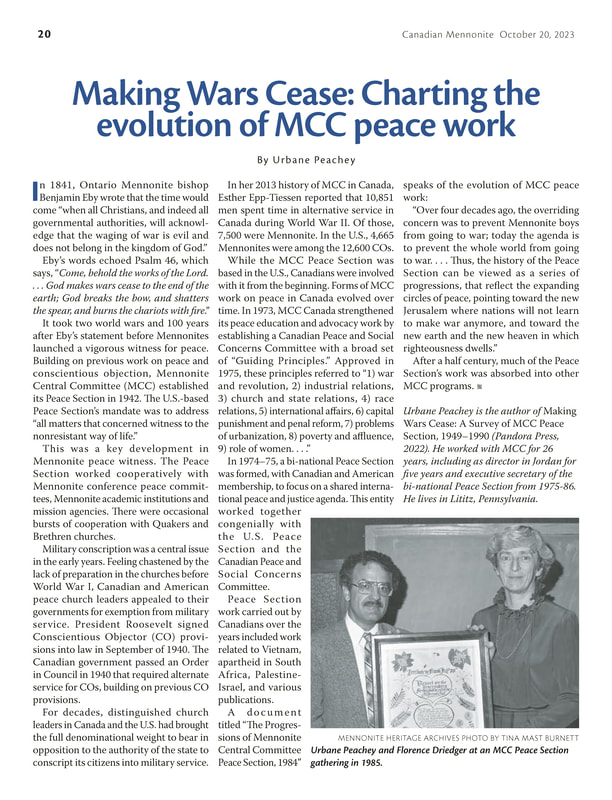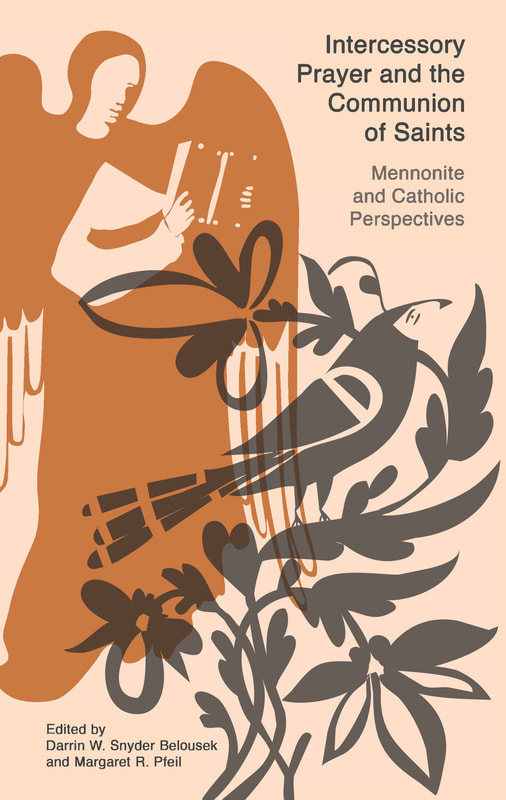
Summer 2026 Featured Titles
Meaning
|
Alone! Really?
|
|
Order here!
Is it something handed down to us, a universal truth to be discovered? Or does it lie in the moments we ourselves live through – encounters, struggles, reflections – in which significance unfolds? This book argues that meaning is not primarily found in doctrines, abstract philosophies, or religious structures, but in lived experiences. Drawing from poetry, philosophy, theology, and interviews with diverse individuals, Meaning develops a framework of sixteen experience categories, arranged in eight pairs of polarity and connection. Each category is illustrated with examples, reflections, and references to major thinkers. Meaning has already found a great reception in the Netherlands, with the first Dutch edition selling out quickly, alongside many presentations by the author. Both scholarly and lay readers have described its contents as relevant, sharp, and deeply engaging – a sign that its themes will speak well to an international English readership. Kees Blokland (Schiedam 1947) is a poet, retired human resources director, and governance administrator. He is currently active in organizing lectures at the intersection of meaning and society and in the administration of a Chair in Liberal Theology. He lives alternately in Amsterdam and Giethoorn and has been involved with the Mennorode Estate in Elspeet for many years. In this essay, his work experience in personnel matters, his poetry, his involvement with liberal theology, and his life experience come together. The gouaches are by Famke Hajonides (Jakarta, 1952). She attended the Royal Academy of Visual Arts in Amsterdam. She lives and works in Amsterdam and Gaasterland. |
Order here!
This book is a collection of drawings accompanied by short texts which allow the reader to question their own existence through a poetic-philosophical dialogue, tinged with surrealism. The passage of time, the construction of the future, the unfathomable mystery of the universe, the meaning of life, the beauty of nature, the secrets of intimacy, and the coincidences of everyday life are subjects which elicit reflection, hope, and self-reconstruction. While the sketches, enhanced with Chinese ink and sometimes watercolour, are meant to be suggestive, the text is just a draft of an interpretation. The reader is invited to freely imagine any other scenario than the one proposed by the author’s design and words. Likewise, the significance of each title, reduced to a single word, and of each section of text, reduced to several lines, permits the reader to stroll according to their desire through the kaleidoscope of images. Alone! Really? explores the sentiment that although everyone can feel alone in making decisions, whether they be of metaphysical nature or stemming from their personal life, throughout their life, events, people, cultures, and landscapes will accompany and influence them. We live in constant interaction, occasionally tormented, between the One and the Whole. Translated into English by Sarah Reid, Alone! Really? is the fifth volume in the ‘pandora poetica’ series, edited by Maxwell Kennel, which focuses on reflective, reflexive, and existential themes at the base of the human experience. Born in Belgium and living in France, Charles Boelen considers himself a citizen of the world. As a Medical Doctor specializing in public health, he had a long career in the World Health Organization, where he promoted strategies in Social Accountability designed to train healthcare professionals to better respond to health priorities of given populations. He is currently an international consultant and president of the Réseau International Francophone pour la Responsabilité Sociale en Santé (RIFRESS). |
July 2026 Director's Letter
Introduction
Dear Pandora Press Readers,
These are exciting times for those who are reading or writing books on themes related to Anabaptist and Mennonite culture and thought. In that spirit, the letter below will detail where Pandora Press has been in the past five years, and it will also give you a sense of the exciting things that are in store for us in the years ahead. Please take a look through the titles below, recommend them to your friends, and consider reviewing them for a publication or posting about them on social media. Even though Pandora Press is now on Instagram, our books are still largely sold through word of mouth by our dedicated readers.
As our readers will know, Pandora Press titles are often published in one series or another, so allow me to clarify the purpose and purview of each of them so you can find the kind of book you’re looking for!
These are exciting times for those who are reading or writing books on themes related to Anabaptist and Mennonite culture and thought. In that spirit, the letter below will detail where Pandora Press has been in the past five years, and it will also give you a sense of the exciting things that are in store for us in the years ahead. Please take a look through the titles below, recommend them to your friends, and consider reviewing them for a publication or posting about them on social media. Even though Pandora Press is now on Instagram, our books are still largely sold through word of mouth by our dedicated readers.
As our readers will know, Pandora Press titles are often published in one series or another, so allow me to clarify the purpose and purview of each of them so you can find the kind of book you’re looking for!
Anabaptist and Mennonite Studies
The flagship scholarly series from Pandora Press, Anabaptist and Mennonite Studies is the new iteration of a classic series by the same name, published by the press between 2000 and 2010. The previous series included important monographs and collections by A. James Reimer, Karl Koop, Werner Packull, Neal Blough, and an important book on Anabaptist Münster by Michael Driedger, James Stayer, and Willem de Bakker called Bernhard Rothmann and the Reformation in Münster, 1530-35.
The relaunched series will reach 15 volumes next month, with a half-dozen more books under contract for publication in the coming year. The series includes a mix of monographs (vols 1, 2, with several forthcoming), essay collections (vols 6, 7), new editions of older texts (vols 3, 4, 5, 8, 13, 14), and new translations of essential texts in the field by historians Astrid von Schlachta, Hans-Jürgen Goertz, Thomas Kaufmann, and Friedrich Dürrenmatt (vols 9, 10, 11, 12). Single-authored monographs in the series are double-blind peer reviewed and held to the highest standards in the field, while translations are done by subject-matter experts and edited with a preference for technical accuracy above all else.
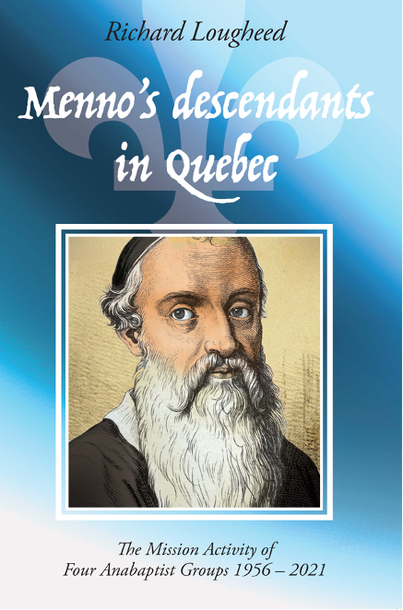
Published in 2021, before the series was relaunched, Richard Lougheed’s essential study of Mennonites in Quebec deserves to be included alongside the numbered titles in this series. See below for full details on the series!
Volume 0. Richard Lougheed, Menno’s Descendants in Quebec: The Mission Activity of Four Anabaptist Groups 1956-2021 (Hamilton, Ontario: Pandora Press, 2021): https://a.co/d/0bL6LuiX
See here for an interview on the book: https://anabaptisthistorians.org/2022/04/06/mennos-descendants-in-quebec-the-mission-activity-of-four-anabaptist-groups-1956-2021-a-conversation-with-author-richard-lougheed/
“Richard Lougheed delivers the first historical review of the Anabaptist movement in Québec since 1950. This volume, which provides a quite complete picture accompanied by many pertinent observations and questions, also reads well. It will certainly remain an important reference for some time both for Anabaptist history and for the evangelical movement in Quebec.” –Jean Raymond Théorêt, former Director of the Institut Biblique Laval and chairman of the Board of ÉTEQ.
Grandson and son of United Church pastors, Richard Lougheed also served as pastor of a joint Anglican-United congregation before PhD studies in French Protestantism. He has taught church history in French in Montreal since 1993 at the Faculté de Théologie Évangélique and since 2011 at the École de Théologie Évangélique du Québec. He serves on the Quebec and Canadian Boards of the Mennonite Brethren denomination. His research concentrates on French Protestant history and he is past chair of the Société d'histoire du protestantisme franco-québécois.
Volume 1. Gary Waite, Anti-Anabaptist Polemics: Dutch Anabaptism and the Devil in England, 1531-1660 (Hamilton, Ontario: Pandora Press, 2023): https://a.co/d/0iveQDSS
Reviewed in the 100th issue of the Mennonite Quarterly Review, and the Journal of Ecclesiastical History.
“Gary K. Waite’s original contribution in Anti-Anabaptist Polemics lies in his painstaking analysis of just one strand in the villain’s gallery of the heresiographers: the Dutch Anabaptists and Spiritualists. The study began as the 2021 Zeman Lecture delivered at the Acadia Centre for Baptist and Anabaptist Studies. Waite shows that a distinct pattern of a strongly disapproved set of beliefs settled in English polemic very quickly and consistently, even before 1550, when the Anabaptists were usually condemned. These reviled beliefs and behaviors boiled down to adult instead of infant baptism and the unfortunate reputation for violent intransigence, millenarian iconoclasm, and the complete community of property, both goods and women, associated with the Münster uprising of 1534–1535.” —Nigel Smith, Princeton University, in the Mennonite Quarterly Review
Anti-Anabaptist Polemics examines polemical works printed between 1531 (when the first known treatise on Anabaptism was printed in England) and 1660 (when the Restoration brought back royal control over religion after the Interregnum) to gauge how continental Anabaptism was understood, polemically distorted, and utilized as a weapon in the debates over religious diversity in England. In the process, Gary Waite argues that some of the weaponized elements of Dutch and German Anabaptism that were hurled about in thousands of hate-filled pamphlets and treatises over the century not only fed into fears of the devil and witchcraft, but inadvertently offered the discontented a number of innovative ideas to draw from, helping in fact to inspire the surge in new religious movements of the 1640s, even though the intention of the authors was to suppress, not encourage, dissent. Anti-Anabaptist Polemics fills significant gaps in our understanding of the development and impact of polemical publications against Anabaptism in England leading up to the Restoration.
Gary K. Waite (PhD, Waterloo, 1987) is Professor Emeritus at the University of New Brunswick and a Fellow of the Royal Society of Canada. His research has focused on the religion and culture of the early-modern Netherlands, beginning with the Dutch Anabaptist and Spiritualist David Joris (c.1501-1556). Waite has also published extensively in the fields of demonology and the witch-hunts (see his Eradicating the Devil’s Minions: Anabaptists and Witches in Reformation Europe, 1535-1600 of 2007) and the religious “other” (Jews and Muslims in Seventeenth-Century Discourse: From Religious Enemies to Allies and Friends of 2019). His most recent publications arise from the Amsterdamnified! research programme on the radical religious roots of the early Enlightenment: Anti-Anabaptist Polemics: Dutch Anabaptism and the Devil in England, 1531-1660 (2023), and the co-edited Spiritualism in Early Modern Europe, in Church History and Religious Culture (101, 2021). With Lisa M. Todd, he is also co-editor of European Racism: A History in Documents (2024).
Volume 2. Cornelius J. Dyck, Hans de Ries: A Study in Second Generation Dutch Anabaptism. Introduction by Mary S. Sprunger (Hamilton, Ontario: Pandora Press, 2023): https://a.co/d/0hwyuL33
Reviewed in the Journal of Ecclesiastical History.
In 1962, Cornelius J. Dyck (1921-2014) defended and submitted his dissertation, “Hans de Ries: Theologian and Churchman. A Study in Second Generation Dutch Anabaptism” with the Divinity School of the University of Chicago. While C. J. Dyck is a well-known name in certain North American Mennonite circles, Hans de Ries is not. De Ries helped to shape Mennonite doctrine, practice, polity and memory in northern Europe in the late sixteenth and early seventeenth centuries, thereby influencing second-generation Anabaptism. As it was meant to do, the dissertation earned Dyck a PhD and secured his professorship with the Associated Mennonite Biblical Seminaries (now Anabaptist Mennonite Biblical Seminary, or AMBS). Dyck, already an emerging “churchman” himself, went on to have a long and impressive career as, among other things, teacher, author, editor and director of the AMBS Institute for Mennonite Studies. Despite spawning several articles and chapters on De Ries and early Dutch Mennonite history, this book-length dissertation remained unpublished—until now.
—Dr. Mary S. Sprunger, Eastern Mennonite University (from the Introduction)
“In an age when Anabaptist scholarship was focused on rehabilitating early Anabaptism from mischaracterizations, Cornelius J. Dyck was ahead of his time in defending a dissertation on a leading second generation Anabaptist, Hans de Ries. Dyck’s work will be especially significant for those students and scholars interested in the mystical and spiritual impulses in Anabaptism, and for those interested in understanding possible linkages between Anabaptism and the early Dutch enlightenment.” —Dr. Karl Koop, Professor of History and Theology, Canadian Mennonite University
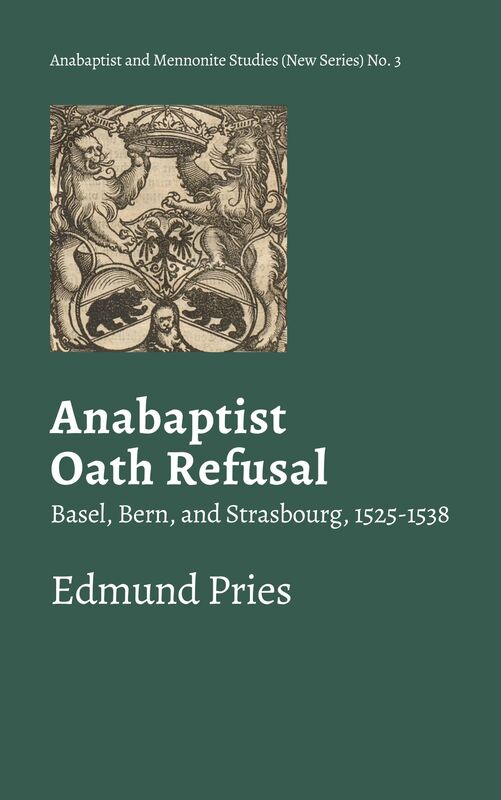
Volume 3. Edmund Pries, Anabaptist Oath Refusal: Basel, Bern, and Strasbourg, 1525-1538 (Hamilton, Ontario: Pandora Press, 2023): https://a.co/d/01EPCqrG
Reviewed in the Journal of Ecclesiastical History.
“Edmund Pries’s work remains the definitive and authoritative study of oath refusal in early Anabaptism.” —C. Arnold Snyder, Professor of History, emeritus. Conrad Grebel University College, University of Waterloo.
“Edmund Pries's Anabaptist Oath Refusal provides a focused treatment of this disruptive practice, which was distinctive of an emerging tradition of dissent. Offering a thorough survey of early modern printed materials and edited compilations of legal records, the book evaluates both commonalities and contrasts in urban authorities’ approaches to nonconformity, while tracing developments in Anabaptist behaviour and argumentation. Its detailed work places Anabaptist action alongside a kaleidoscopic overview of the oath’s history in European political and social life and its place in early Reformation debates about hermeneutics and the proper relationship of the church to the magistracy.” —David Y. Neufeld, Assistant Professor in History. Director, Institute for Anabaptist and Mennonite Studies. Conrad Grebel University College, University of Waterloo.
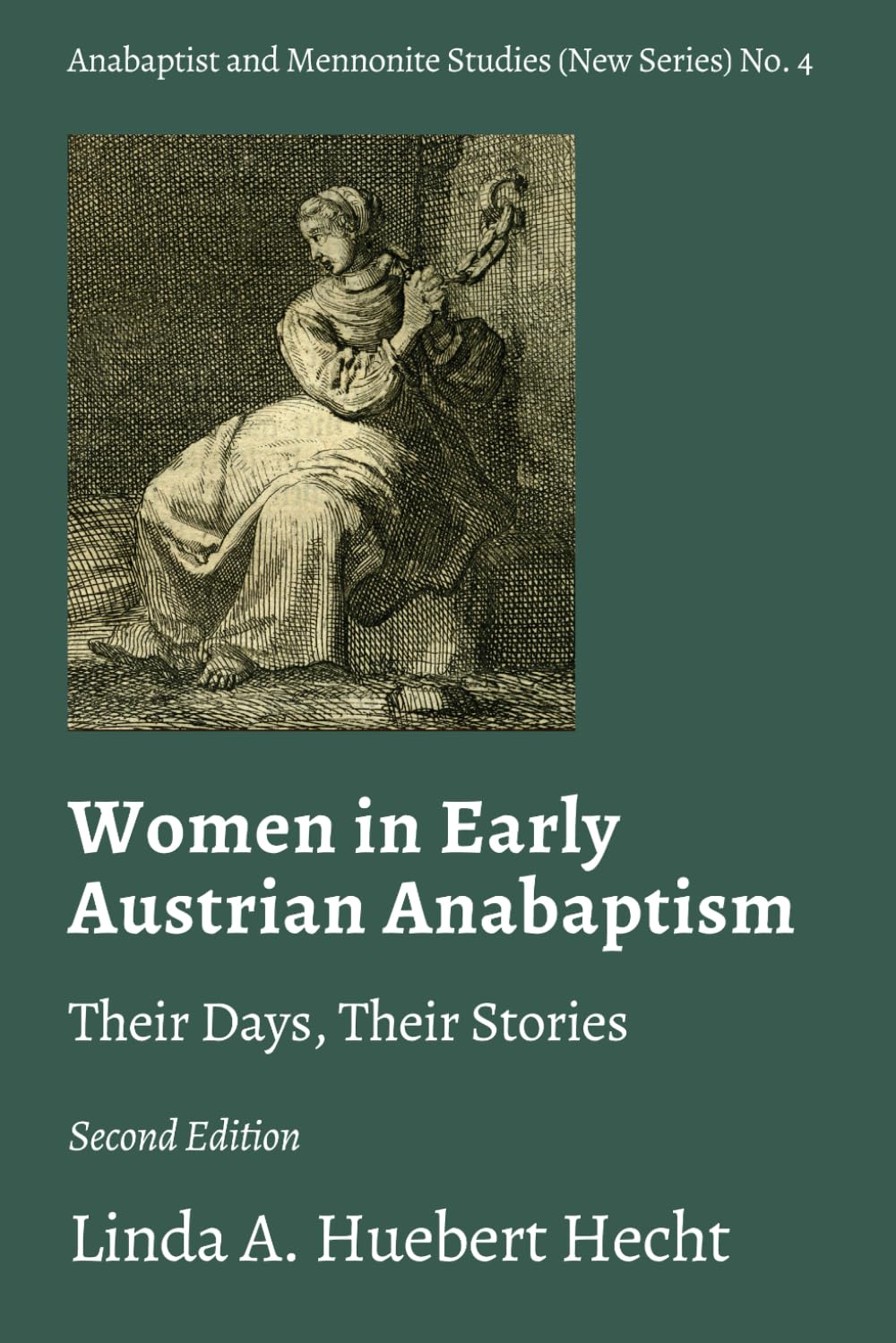
Volume 4. Linda A. Huebert Hecht, Women in Early Austrian Anabaptism: Their Days, Their Stories. 2nd Edition (Hamilton, Ontario: Pandora Press, 2023): https://a.co/d/04HIzcVz
Previously untold stories of women persecuted for their faith during the early years of the Reformation are revealed in the Austrian Anabaptist court records. In the turbulent years of the early 1500s, women chose to express their personal faith publicly through adult baptism, which was outlawed by the state. They took the initiative to proselytize among family members and neighbours. Their commitment to the Anabaptist movement in the Austrian territory of Tirol demonstrates profound faith and courage which still speak to us today. These stories, translated from the court records, add considerably to our knowledge of early Anabaptist history and of religious women in general.
“Anabaptist women were the mainstay of the early baptizing movement – a fact generally obscured by most historical narratives describing the movement. In this book, Linda H. Hecht opens a unique window through which we can glimpse the life, faith and practice of people to whom history has generally denied a voice. She does this by gathering and translating the records of judicial proceedings against Anabaptist women in Austria from 1527 to 1531. The translated records published here are contextualized with helpful historical introductions and commentary throughout. Contemporary illustrations and woodcuts enrich the historical texture of the collection. This book shines much needed light on the variety and extent of women’s participation in the baptizing movement.” —C. Arnold Snyder
“This book represents the culmination of a long-term project by one of the very few scholars to focus sustained attention on the subject of Anabaptist women. The result is as detailed a picture as the sources allow of Anabaptist women in the Austrian Tirol from 1527 to 1531, the period when Anabaptism was established there and persecution was the heaviest.” —Mary S. Sprunger in the Mennonite Quarterly Review
Volume 5. J. Lawrence Burkholder, Mennonite Ethics: From Isolation to Engagement. 2nd Edition. Edited by Lauren Friesen (Hamilton, Ontario: Pandora Press, 2023): https://a.co/d/06bY2BqF
“Mennonite Ethics is an important and long overdue contribution to the field of Anabaptist-Mennonite theological ethics. Burkholder’s work will resonate with theologians aware of the church’s responsibility to address its complicity in social inequalities. The ethics he proposes will invite more voices into the conversation about Anabaptist-Mennonite identity and discipleship.” —Kimberly L. Penner. Pastor, Stirling Avenue Mennonite Church, in the Conrad Grebel Review.
J. Lawrence Burkholder’s Mennonite Ethics traces the transition from a personal ethic of discipleship toward an ethic of social responsibility within the Mennonite tradition. This second edition collects his masters thesis, revised doctoral dissertation, and his late work on the “third way” – each of which reflect upon the relationship between religious communities and social-political life, rooted in nonviolent action. Presciently, he writes that “It is not enough for churches to be committed to love and justice while ignoring power.”
J. Lawrence Burkholder (1917-2010) was educated at Goshen College (B.A.), Gettysburg Seminary (B.D.), and Princeton University (M.A. and Th.D., summa cum laude.). He was a pastor of a Mennonite Church in Lowville, NY, a relief worker in post war China, professor at Goshen College and Harvard Divinity School and concluded his career as president of Goshen College. He was a frequent speaker at church conferences and professional conventions. Among his numerous publications is the recent volume Recollections of a Sectarian Realist (Elkhart, IN: Institute for Mennonite Studies, 2016).
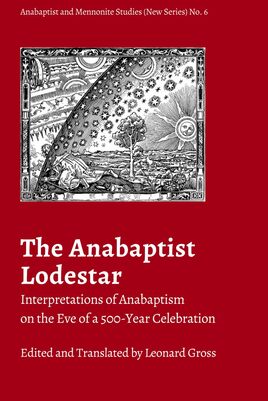
Volume 6. The Anabaptist Lodestar: Interpretations of Anabaptism on the Eve of a 500-Year Celebration. Edited and translated by Leonard Gross (Hamilton, Ontario: Pandora Press, 2024): https://a.co/d/0eTPVh1R
Originally titled Daring! and first appearing as a series of German pamphlets, this collection of essays calls its readers to consider following the Anabaptist lodestar by asking again what it means to be a Christian in the 21st century. As Paul Schrag, editor of Anabaptist World, notes in his January 2024 editorial: “It is the relevance of Anabaptist principles that energizes our [500-year anniversary] celebration. The European organizers of ‘Daring!’ refer to Anabaptism as a ‘lodestar’ – a celestial guide for a mariner charting a course – that directs us to follow Jesus and to raise a prophetic voice as the first Anabaptists did when they insisted baptism must be an adult decision.”
The diverse texts that make up this English-language selection provide a window into current interpretations of historical Anabaptism by contemporary Mennonites and their interlocutors in Germany. The brief chapters that make up this accessible yet scholarly volume will show North American Mennonites (and those who study them) how their European counterparts are interpreting and reinterpreting the tradition on the eve of its 500-year anniversary, and will provide readers with a glimpse into the ongoing reckoning of a radical tradition with both its past and its present.
“I hope that this message will be heard by as many people as possible in a time when cohesion is challenged internally, and peace is threatened in many parts of the world.” –Frank-Walter Steinmeier, President of Germany
“I hope that this special issue [on nonviolence] will find its way into our global fellowship, the Mennonite World Conference, and that it will help us reflect on Anabaptist identity 500 years after the first rebaptism.” –Henk Stenvers, President of Mennonite World Conference
Volume 7. James M. Stayer, Anabaptism, Radicalism, and the Reformation: Collected Essays. Edited by Geoffrey Dipple, Sharon Judd, and Michael Driedger (Hamilton, Ontario: Pandora Press, 2024): https://a.co/d/05v744on
James Stayer is widely recognized as an important contributor to the revision in the study of Anabaptism and the Radical Reformation which began in the 1970s and to which scholars continue to respond half a century later. On the surface, this revision looks like a straightforward secular challenge – tinged with a strong element of social history – to the primarily historical-theological approach of the confessionally oriented scholars who had dominated the field in decades past. However, as the essays collected in Anabaptism, Radicalism, and the Reformation reveal, the original revision was much more nuanced than that and it remained open to correction on the basis of new evidence. Included here are republications of some of Stayer’s seminal articles and book chapters, some important elements of his scholarship that were originally published in less accessible places, and previously unpublished essays, presentations, and reflections. Their subject matter ranges from Anabaptism and the Radical Reformation to the popular and magisterial Reformations and from methodology to historiography.
James M. Stayer (1935-2025) was an historian of the German Reformation and the Anabaptist movements, and Professor Emeritus in the History Department at Queen's University in Kingston, Ontario, Canada. He is the author of Anabaptists and the Sword (Coronado Press 1972, 1976), The German Peasants' War and Anabaptist Community of Goods (McGill-Queens UP, 1991), Martin Luther, German Saviour: German Evangelical Theological Factions and the Interpretation of Luther, 1917-1933 (McGill-Queens UP, 2000), and co-editor of The Anabaptists and Thomas Müntzer (Kendall/Hunt, 1980, with Werner O. Packull), Radikalität und Dissent im 16. Jahrhundert / Radicalism and Dissent in the Sixteenth Century (Duncker & Humblot, 2002, with Hans-Jürgen Goertz), and the field-defining collection, A Companion to Anabaptism and Spiritualism, 1521-1700 (Brill, 2007, with John D. Roth).
Volume 8. “Elisabeth’s Manly Courage”: Testimonials and Songs of Martyred Anabaptist Women in the Low Countries. Edited and translated by Hermina Joldersma and Louis Grijp. Reprint of the 2001 original with a new preface by Christina Moss (Hamilton, Ontario: Pandora Press, 2024): https://a.co/d/0gy13lqQ
“Since Anabaptists judged the preservation of martyrs' examples of particular importance and since a relatively high proportion of women appear in the martyrological collections, documents from the Anabaptist tradition are a rich source for understanding gender norms in the past.” —Marybeth Carlson in the Sixteenth Century Journal
Among the most moving writings of the Reformation in the sixteenth-century Low Countries are the final words of Anabaptists condemned to death for their faith. Through a series of circumstances, we have a significant body of such writings by women: Anabaptists were the most severely persecuted among Protestant groups, Anabaptist women made up a comparatively high proportion of those martyred, and Anabaptists attached great importance to preserving the memory of the martyred, regardless of gender, through the written word.
As these women recount the details of arguments with their inquisitors, their feelings during turbulent months in prison, their love for their children, husbands, parents, and friends, their ecstasy at having been found worthy to die for their faith, one cannot help but be moved, and impressed, by their voices and their experiences. Their writings reveal them to be articulate and courageous individuals who show not only a form of “manly courage” but the kind of personal courage which is rooted in a self-assurance uncommon for women of the time, one based on taking personal responsibility for the most important matter in their lives, their own salvation.
Archival documents are included in the Dutch original with an English translation on the facing page. There are also texts and music for martyr songs, highlighting the well-known and central role of song in preserving memory of martyrs in the sixteenth and seventeenth centuries. This edition is a reprint of the original 2001 text published with Marquette University Press. The present Pandora Press edition of 2024 includes a new preface by historian Christina Moss.
Volume 9. Thomas Kaufmann, The Anabaptists: From the Radical Reformers to the Baptists. Translated by Christina Moss. Edited by Maxwell Kennel (Hamilton, Ontario: Pandora Press, 2024): https://a.co/d/0azTaivg
“Not a word too much, not a word too little. Thomas Kaufmann presents a terse but rich introduction to the history of Anabaptism, along with all of its ramifications in religion and society. This book is a gift to all of us who are looking for solid information about the Anabaptists and want to get it quickly.” –Volker Leppin, Horace Tracy Pitkin Professor, Yale Divinity School
“Thomas Kaufmann has been remarkably successful in summarizing a wealth of sound scholarship and new perspectives in this little book.” –Peter Matheson, University of Otago, writing in the Mennonite Quarterly Review and the Theologische Literaturzeitung
Christians have baptized children since antiquity in order to preserve them from eternal damnation. In the course of the Reformation, however, some radical theologians broke with this tradition in order to restrict baptism to mature Christians who chose it for themselves. In his book The Anabaptists: From the Radical Reformers to the Baptists, Thomas Kaufmann concisely describes the history of the Anabaptists from their beginnings, to the Anabaptist Kingdom of Münster and pacifist groups such as the Hutterites and the Mennonites, and finally to the Baptists, who soon spread quickly – particularly in North America – and are one of the largest Christian denominations today. His evocative overview makes it clear that their radical protest against ecclesiastical traditions remains relevant to this day.
Thomas Kaufmann is Professor of Church History at the University of Göttingen, Chair of the Verein für Reformationsgeschichte (Society for Reformation History), Director of the State and University Library in Göttingen, and a fellow of Göttingen’s Academy of Sciences. He is the author of more than twenty books including The Saved and the Damned: A History of the Reformation (Oxford University Press, 2023) and Das Bauernkrieg: Ein Medienereignis (Herder, 2024, published in English translation in 2026).
Volume 10. Astrid von Schlachta, Anabaptists: From the Reformation to the 21st Century. Translated by Victor Thiessen. Edited by Maxwell Kennel (Hamilton, Ontario: Pandora Press, 2024): https://a.co/d/0d7ycSwp
Recent interviews in Anabaptist World, Canadian Mennonite, and the New Books Network
The Anabaptists, alongside the Lutheran and Reformed churches, were the third major current in the sixteenth century Reformation movements. From their beginnings, the Anabaptists were highly diverse and yet they shared some central beliefs and practices for which they were quickly persecuted – for example, defenselessness and nonresistance, the refusal to swear oaths, and the separation of church and state. Ideal for both teachers and students, this book provides a comprehensive and scholarly account of the history and development of the Anabaptists, alongside the Mennonite, Hutterite, and Amish traditions that emerged from their movement.
Anabaptists: From the Reformation to the 21st Century shows the cultural diversity of the Anabaptists over five centuries as they moved between persecution and toleration, isolation and social integration, and traditionalization and renewal. Amidst these tensions, the Anabaptist story is told here anew based on the current state of the field on the eve of its 500-year anniversary. Written by an established scholar of Anabaptist history, and expertly translated into English by Victor Thiessen, this comprehensive study appears in the Anabaptist and Mennonite Studies series, edited by Maxwell Kennel, and published by Pandora Press.
PD Dr. Astrid von Schlachta is a Lecturer at the Universities of Regensburg and Hamburg, and head of the Mennonite Research Center in Weierhof, Germany.
Volume 11. Hans-Jürgen Goertz, Conrad Grebel (1498-1526), Critic of Pious Facades: A Biographical Sketch. Translated by Christina Moss. Edited by Maxwell Kennel (Hamilton, Ontario: Pandora Press, 2025): https://a.co/d/0g3nUd7O
“The temptation towards hagiography is especially problematic in the case of a compelling, but complicated, figure like Grebel. Hans-Jürgen Goertz’s biography resists that temptation, offering an accessible introduction to the life and thought of a man who has been claimed as a founder of ‘Anabaptism’—a designation he himself would have rejected—that recovers the man from the mythos.” —Jennifer Otto, Associate Professor of Religious Studies, University of Lethbridge. Author of Willing to Die: Martyrdom in the Mennonite Imagination.
“Goertz’s portrait of the complicated, human Conrad is much more interesting than the man we placed on the pedestal, and his description of the fragmented society Grebel inhabited throws an unexpected light on our own fraught and polarized times.”—Marcus Shantz, President of Conrad Grebel University College
In this brief study, Conrad Grebel (1498-1526), Critic of Pious Facades, historian Hans-Jürgen Goertz fascinatingly portrays the short life of a nonconformist, idiosyncratic, and radical figure who was first a comrade in the Zurich Reformation and later became one of its fiercest critics. “Inclined toward evil signs by nature, he had always sought some tragedy,” Ulrich Zwingli wrote to Joachim Vadian, Grebel’s brother-in-law, adding, “Now he has found it.” Goertz’s biographical sketch shows how Conrad Grebel – born in Zurich as the son of a politically influential patrician – ended up persecuted and socially marginalized, despite having “caused one of the greatest scandals of the Christian West: the first adult baptism.” Long before Mennonites would look to him as one of the founders of Anabaptism, Grebel lived and died as a critic of pious facades. This biography – translated by Christina Moss and edited by Maxwell Kennel for the Anabaptist and Mennonite Studies published by Pandora Press – provides the most reliable, scholarly report on his life currently available. It is published in the year 2025, following the 500-year anniversary of the first Anabaptist baptisms in 1525.
Hans-Jürgen Goertz was Professor of History at the Institüt für Sozial- und Wirtschaftsgeschichte, University of Hamburg, until his retirement in 2003. He is the author of many significant works on the Anabaptists and the Reformation, focusing on themes such as anticlericalism, radicality and dissent, and theories of history. His major works include studies of Thomas Müntzer – from his dissertation on inner and outer “order” (Ordnung) to his 1989 book Thomas Müntzer: Apocalyptic Mystic and Revolutionary (translated into English in 1993; revised German edition in 2025) – as well as a key study called The Anabaptists, translated into English by Trevor Johnson in 1996. Recent works include a series of theological essays, an autobiography, and a supplemental volume to the Mennonitisches Lexikon.
Volume 12. Friedrich Dürrenmatt, The Anabaptists: A Comedy in Two Acts. Translated by Lauren Friesen. Edited by Berit Jany and Maxwell Kennel (Hamilton, Ontario: Pandora Press, 2025): https://a.co/d/05BP4WLr
“The Anabaptists was Dürrenmatt’s first staged play, in 1947, although under a different title. It caused a scandal and never caught on, but Dürrenmatt liked to joke that it was the play that made him famous... Set amid the denominational wars of 16th-century Europe, it draws on the brief reign of the Anabaptist movement, a radical eschatological splinter group, in the town of Münster. A siege occurs, the city walls are breached, crowds mill about; the incidents are crass, the language coarse and blasphemous, and the key protagonist, Johann Bockelsohn, is an impostor and hypocrite. Dürrenmatt whoops it all up into the burlesque, grotesque, tragicomic — the first example of his theatrum mundi.
The play turns on a contrast between the mayhem within the city walls and the bishop’s actions outside them. Inside, the contrast is mainly between the demagogue Anabaptist leader Bockelsohn, a former stage actor, and the simpleminded religious zealot Mayor Knipperdollinck, whom Bockelsohn exploits. Foregrounding the political-religious mass hysteria and the uncontrolled power of a despotic leader, the 1947 version directly reflects its historical context of World War II; both Knipperdollinck and Bockelsohn end up broken on the wheel...
In this second version, Bockelsohn, the rebel leader, remains unpunished. Instead, after his defeat, he is hired into the ‘media team,’ as we might say now — the bishop’s court theater troupe — for his stage skills of lying and rabble-rousing. The victors, appreciating the fundamental homology between acting and politics, recognize themselves in the play-actor, for their own ‘real’ power is no less reliant on illusion. ‘Bockelson,’ Dürrenmatt writes, ‘is the topic of all power, namely its foundation in theatricality.’ We’ll take this as proof of Dürrenmatt’s continued relevance.”
— Hans J. Rindisbacher in the Los Angeles Review of Books (2021)
The Anabaptists is a rewritten version of Friedrich Dürrenmatt’s early drama, Es steht geschrieben (It is Written). In contrast to the original version from 1947, The Anabaptists is sharper and more concise, but no less powerful. By drawing on the historical events of the Anabaptist takeover of the city of Münster in 1533-1534, Dürrenmatt produced a cautionary parable about human deceivability.
In 1533, Anabaptists led by Jan Matthison reached the city of Münster. Intending to establish a “New Jerusalem” within the city walls, they encountered Johann Bockelson, who claimed to have been an actor until a voice – in the middle of the dress rehearsal for Sophocles’ Oedipus Rex – commanded him to become an Anabaptist. With eloquence and persuasive sloganeering, the Anabaptists gained numerous followers within the city, including the Mayor Knipperdollinck, which gave them political power. Many were executed or expelled from the city, including Bishop Franz von Waldeck, who fled to the city gates and raised an army there, intent on liberating Münster from the Anabaptists. When Matthison was killed in an attack, Bockelson assumed the role of leader and brutally continued on his chosen path.
At the request of Bishop von Waldeck, Emperor Charles V, the Cardinal, the Landgrave of Hesse, and an Elector finally sent troops to Münster for support. The Anabaptists, now weakened by the siege, were defeated in an attack. Only Bockelson escaped execution by using his acting and oratory skills to convince the Cardinal to give him a place in his court theater troupe. However, to keep up appearances, someone else was executed in his place, visible to all, leaving the reader and viewer with “an ironic play about power, religious madness, and self-interest.”
The author of almost thirty plays, who was nominated many times for the Nobel Prize in Literature, Swiss dramatist Friedrich Dürrenmatt is one of the most important European playwrights of the 20th century. He became known in the 1950s and 1960s for plays like The Visit and The Physicists, while producing numerous works of theater theory and a large body of narrative work, especially detective fiction. Dürrenmatt was born in 1921 in Konolfingen (near Bern), the son of a Protestant pastor. He initially studied German, philosophy, and the natural sciences, while planning to become a painter, before turning to writing in 1945. Following his most important dramatic works, which were authored between 1952 and 1962, Dürrenmatt worked as a theatre director and member of the management team at the Basel Theater (1967-1969) and as a consultant to the Zurich Schauspielhaus (1970-1972), adapting plays by Shakespeare, Lessing, Büchner, and Strindberg. At the end of the 1980s, Dürrenmatt retired from the theater following a fierce cultural and political controversy. He died in Neuchâtel on December 14, 1990. Many of his works are collected in English translation in a three-volume set, published by the University of Chicago Press, translated by Joel Agee, under the title Selected Writings: Essays (Vol. 1), Fictions (Vol. 2), and Plays (Vol. 3). His play, The Anabaptists, appears here, for the first time.
Volume 13.1/13.2 Jeremy Dupertuis Bangs (Ed. & Trans.). Letters on Toleration: Dutch Aid to Persecuted Swiss and Palatine Mennonites 1615-1699. 2 Volumes. Reprint of the 2004 original. Preface by Piet Visser (Hamilton, Ontario: Pandora Press 2026). Volume 1 (Introduction and English Translations): https://a.co/d/02XhCx4u / Volume 2 (Transcribed source texts in Dutch, French, German, and Latin): https://a.co/d/07vkvaJp
“With this collection of primary sources, Jeremy Bangs recounts the little-known story of how seventeenth- and eighteenth-century Dutch Mennonites assisted their Swiss and German coreligionists to escape the governmental oppression that ‘the Mennonite democratic impulse’ continued to provoke. But he does far more than that. Bangs also reveals the important yet neglected role played by Dutch Mennonites and other nonconformists in the development of a philosophy of religious toleration and diversity formulated by, for example, the English refugee to Amsterdam, John Locke. For such thinkers, the plight of the persecuted Anabaptists was a testcase for the application of the new principles of toleration and proto-democratic governance. A treasure trove of primary sources and a ground-breaking work of scholarship, Bangs’ labour of love deserves a wide audience.” —Gary K. Waite
“The 17th century was a difficult time for the Anabaptists of Europe. Hounded out of Switzerland and driven hither and yon through other parts of Europe, it was not until arrival in America that many Mennonites found their paradise. Jeremy Bangs has transcribed and translated over 250 original letters, accounts, and other documents found in Dutch, Swiss, and German archives. Among the host of letters showing officials arguing, ministers remonstrating, and Dutch fellow-Mennonites and ordinary Dutch citizens raising relief funds, are golden nuggets of genealogical data. Hundreds of Mennonite refugee families are detailed, most often with ages, occupations, origins, spouse's and children's names given.” (Original 2004 Publisher’s Description)
Jeremy Dupertuis Bangs (1946–2023) was an American historian, scholar, and the former director of the Leiden American Pilgrim Museum. He was known for his research on the pilgrims and authored eleven books covering early modern Dutch, English, and American history.
Volume 14. Gary Waite, David Joris and Dutch Anabaptism, 1524-1543. 2nd Expanded Edition, with a new 100-page introduction and supplementary essay (Hamilton, Ontario: Pandora Press, 2026): https://a.co/d/03d1Fh5f
“With this re-release of his pioneering study of David Joris and Dutch Anabaptism, Gary Waite shows that the Devil is quite literally in the details – and much more besides. Waite appends a sweeping and authoritative survey to the original text in order to demonstrate how the field has grown radically since the book’s appearance in 1990. He shows how works on demonology, on the history of emotions and of the senses, on the Jews and mysticism, on language, humanists, rhetoricians, and witches have all shifted the historiographical landscape. Joris’s own radicalism gains even greater fluidity, with Waite following the currents – perhaps waves — that move it towards anabaptism, spiritualism, and libertinism. By pairing the original text with an extended review of the research which he and others have carried out over the past forty years, Waite paints a far richer portrait of this complex character who was much loved and greatly reviled, and whose visionary view of a religion free of compulsion is more compelling now than ever.” —Nicholas Terpstra, University of Toronto
“This new edition of Gary Waite’s important 1990 study on David Joris enriches what was already a ground-breaking publication with the latest research updates on Joris, many of which are from Waite’s own impressive body of publications over the last 35 years. This edition also provides a historiographical update to findings within the broader field of early modern Anabaptist studies and related early modern European religious history in the past several decades. Waite uses the new 100+ page preface to emphasize some concepts that were already present in the original version but that he has come to see as even more significant than he had initially indicated back in 1990; he also adds in new insights on Joris and his context, and takes the opportunity to make some corrections and adjustments to past assessments. The preface alone serves as an excellent introduction not only to the book, and to Joris, but it also provides an accessible start into the conversation for a new generation of readers, and offers the latest academic perspectives (including both methodological and factual updates) on Joris, his networks, and their early modern religious contexts.
Joris was deemed a heretic by the orthodox establishment and even pejoratively called the Devil of Delft by some - which is ironic, since Joris’s spiritualist beliefs led him to dismiss the concept of a physical devil and instead understand evil as something internalized within the individual. In this volume’s new chapter on Joris’s distinct demonology, Waite explores all of this in detail.
Though it was controversial, Joris’s theological work had an extremely long reach, influencing writers and thinkers among some circles of Mennonites and also many free thinkers of other creeds for centuries after his lifetime. His spiritualist approach to Christianity, which places minimal emphasis on the material trappings of religious practice, is a significant lasting legacy of his reforming work, and one well worth understanding for both historians and theologians today.” —Nina Schroeder van 't Schip, author of Mennonites and Art in the Dutch Republic: Church Home and Art Marketplace (Pandora Press, forthcoming)
Originally published in 1990 by Wilfrid Laurier University Press, and reprinted in 2025 by Pandora Press with a new preface and supplementary chapter by the author, Gary Waite’s biography of David Joris is still the most comprehensive scholarly treatment of Joris’ life and thought.
The flagship scholarly series from Pandora Press, Anabaptist and Mennonite Studies is the new iteration of a classic series by the same name, published by the press between 2000 and 2010. The previous series included important monographs and collections by A. James Reimer, Karl Koop, Werner Packull, Neal Blough, and an important book on Anabaptist Münster by Michael Driedger, James Stayer, and Willem de Bakker called Bernhard Rothmann and the Reformation in Münster, 1530-35.
The relaunched series will reach 15 volumes next month, with a half-dozen more books under contract for publication in the coming year. The series includes a mix of monographs (vols 1, 2, with several forthcoming), essay collections (vols 6, 7), new editions of older texts (vols 3, 4, 5, 8, 13, 14), and new translations of essential texts in the field by historians Astrid von Schlachta, Hans-Jürgen Goertz, Thomas Kaufmann, and Friedrich Dürrenmatt (vols 9, 10, 11, 12). Single-authored monographs in the series are double-blind peer reviewed and held to the highest standards in the field, while translations are done by subject-matter experts and edited with a preference for technical accuracy above all else.
Published in 2021, before the series was relaunched, Richard Lougheed’s essential study of Mennonites in Quebec deserves to be included alongside the numbered titles in this series. See below for full details on the series!
Volume 0. Richard Lougheed, Menno’s Descendants in Quebec: The Mission Activity of Four Anabaptist Groups 1956-2021 (Hamilton, Ontario: Pandora Press, 2021): https://a.co/d/0bL6LuiX
See here for an interview on the book: https://anabaptisthistorians.org/2022/04/06/mennos-descendants-in-quebec-the-mission-activity-of-four-anabaptist-groups-1956-2021-a-conversation-with-author-richard-lougheed/
“Richard Lougheed delivers the first historical review of the Anabaptist movement in Québec since 1950. This volume, which provides a quite complete picture accompanied by many pertinent observations and questions, also reads well. It will certainly remain an important reference for some time both for Anabaptist history and for the evangelical movement in Quebec.” –Jean Raymond Théorêt, former Director of the Institut Biblique Laval and chairman of the Board of ÉTEQ.
Grandson and son of United Church pastors, Richard Lougheed also served as pastor of a joint Anglican-United congregation before PhD studies in French Protestantism. He has taught church history in French in Montreal since 1993 at the Faculté de Théologie Évangélique and since 2011 at the École de Théologie Évangélique du Québec. He serves on the Quebec and Canadian Boards of the Mennonite Brethren denomination. His research concentrates on French Protestant history and he is past chair of the Société d'histoire du protestantisme franco-québécois.
Volume 1. Gary Waite, Anti-Anabaptist Polemics: Dutch Anabaptism and the Devil in England, 1531-1660 (Hamilton, Ontario: Pandora Press, 2023): https://a.co/d/0iveQDSS
Reviewed in the 100th issue of the Mennonite Quarterly Review, and the Journal of Ecclesiastical History.
“Gary K. Waite’s original contribution in Anti-Anabaptist Polemics lies in his painstaking analysis of just one strand in the villain’s gallery of the heresiographers: the Dutch Anabaptists and Spiritualists. The study began as the 2021 Zeman Lecture delivered at the Acadia Centre for Baptist and Anabaptist Studies. Waite shows that a distinct pattern of a strongly disapproved set of beliefs settled in English polemic very quickly and consistently, even before 1550, when the Anabaptists were usually condemned. These reviled beliefs and behaviors boiled down to adult instead of infant baptism and the unfortunate reputation for violent intransigence, millenarian iconoclasm, and the complete community of property, both goods and women, associated with the Münster uprising of 1534–1535.” —Nigel Smith, Princeton University, in the Mennonite Quarterly Review
Anti-Anabaptist Polemics examines polemical works printed between 1531 (when the first known treatise on Anabaptism was printed in England) and 1660 (when the Restoration brought back royal control over religion after the Interregnum) to gauge how continental Anabaptism was understood, polemically distorted, and utilized as a weapon in the debates over religious diversity in England. In the process, Gary Waite argues that some of the weaponized elements of Dutch and German Anabaptism that were hurled about in thousands of hate-filled pamphlets and treatises over the century not only fed into fears of the devil and witchcraft, but inadvertently offered the discontented a number of innovative ideas to draw from, helping in fact to inspire the surge in new religious movements of the 1640s, even though the intention of the authors was to suppress, not encourage, dissent. Anti-Anabaptist Polemics fills significant gaps in our understanding of the development and impact of polemical publications against Anabaptism in England leading up to the Restoration.
Gary K. Waite (PhD, Waterloo, 1987) is Professor Emeritus at the University of New Brunswick and a Fellow of the Royal Society of Canada. His research has focused on the religion and culture of the early-modern Netherlands, beginning with the Dutch Anabaptist and Spiritualist David Joris (c.1501-1556). Waite has also published extensively in the fields of demonology and the witch-hunts (see his Eradicating the Devil’s Minions: Anabaptists and Witches in Reformation Europe, 1535-1600 of 2007) and the religious “other” (Jews and Muslims in Seventeenth-Century Discourse: From Religious Enemies to Allies and Friends of 2019). His most recent publications arise from the Amsterdamnified! research programme on the radical religious roots of the early Enlightenment: Anti-Anabaptist Polemics: Dutch Anabaptism and the Devil in England, 1531-1660 (2023), and the co-edited Spiritualism in Early Modern Europe, in Church History and Religious Culture (101, 2021). With Lisa M. Todd, he is also co-editor of European Racism: A History in Documents (2024).
Volume 2. Cornelius J. Dyck, Hans de Ries: A Study in Second Generation Dutch Anabaptism. Introduction by Mary S. Sprunger (Hamilton, Ontario: Pandora Press, 2023): https://a.co/d/0hwyuL33
Reviewed in the Journal of Ecclesiastical History.
In 1962, Cornelius J. Dyck (1921-2014) defended and submitted his dissertation, “Hans de Ries: Theologian and Churchman. A Study in Second Generation Dutch Anabaptism” with the Divinity School of the University of Chicago. While C. J. Dyck is a well-known name in certain North American Mennonite circles, Hans de Ries is not. De Ries helped to shape Mennonite doctrine, practice, polity and memory in northern Europe in the late sixteenth and early seventeenth centuries, thereby influencing second-generation Anabaptism. As it was meant to do, the dissertation earned Dyck a PhD and secured his professorship with the Associated Mennonite Biblical Seminaries (now Anabaptist Mennonite Biblical Seminary, or AMBS). Dyck, already an emerging “churchman” himself, went on to have a long and impressive career as, among other things, teacher, author, editor and director of the AMBS Institute for Mennonite Studies. Despite spawning several articles and chapters on De Ries and early Dutch Mennonite history, this book-length dissertation remained unpublished—until now.
—Dr. Mary S. Sprunger, Eastern Mennonite University (from the Introduction)
“In an age when Anabaptist scholarship was focused on rehabilitating early Anabaptism from mischaracterizations, Cornelius J. Dyck was ahead of his time in defending a dissertation on a leading second generation Anabaptist, Hans de Ries. Dyck’s work will be especially significant for those students and scholars interested in the mystical and spiritual impulses in Anabaptism, and for those interested in understanding possible linkages between Anabaptism and the early Dutch enlightenment.” —Dr. Karl Koop, Professor of History and Theology, Canadian Mennonite University
Volume 3. Edmund Pries, Anabaptist Oath Refusal: Basel, Bern, and Strasbourg, 1525-1538 (Hamilton, Ontario: Pandora Press, 2023): https://a.co/d/01EPCqrG
Reviewed in the Journal of Ecclesiastical History.
“Edmund Pries’s work remains the definitive and authoritative study of oath refusal in early Anabaptism.” —C. Arnold Snyder, Professor of History, emeritus. Conrad Grebel University College, University of Waterloo.
“Edmund Pries's Anabaptist Oath Refusal provides a focused treatment of this disruptive practice, which was distinctive of an emerging tradition of dissent. Offering a thorough survey of early modern printed materials and edited compilations of legal records, the book evaluates both commonalities and contrasts in urban authorities’ approaches to nonconformity, while tracing developments in Anabaptist behaviour and argumentation. Its detailed work places Anabaptist action alongside a kaleidoscopic overview of the oath’s history in European political and social life and its place in early Reformation debates about hermeneutics and the proper relationship of the church to the magistracy.” —David Y. Neufeld, Assistant Professor in History. Director, Institute for Anabaptist and Mennonite Studies. Conrad Grebel University College, University of Waterloo.
Volume 4. Linda A. Huebert Hecht, Women in Early Austrian Anabaptism: Their Days, Their Stories. 2nd Edition (Hamilton, Ontario: Pandora Press, 2023): https://a.co/d/04HIzcVz
Previously untold stories of women persecuted for their faith during the early years of the Reformation are revealed in the Austrian Anabaptist court records. In the turbulent years of the early 1500s, women chose to express their personal faith publicly through adult baptism, which was outlawed by the state. They took the initiative to proselytize among family members and neighbours. Their commitment to the Anabaptist movement in the Austrian territory of Tirol demonstrates profound faith and courage which still speak to us today. These stories, translated from the court records, add considerably to our knowledge of early Anabaptist history and of religious women in general.
“Anabaptist women were the mainstay of the early baptizing movement – a fact generally obscured by most historical narratives describing the movement. In this book, Linda H. Hecht opens a unique window through which we can glimpse the life, faith and practice of people to whom history has generally denied a voice. She does this by gathering and translating the records of judicial proceedings against Anabaptist women in Austria from 1527 to 1531. The translated records published here are contextualized with helpful historical introductions and commentary throughout. Contemporary illustrations and woodcuts enrich the historical texture of the collection. This book shines much needed light on the variety and extent of women’s participation in the baptizing movement.” —C. Arnold Snyder
“This book represents the culmination of a long-term project by one of the very few scholars to focus sustained attention on the subject of Anabaptist women. The result is as detailed a picture as the sources allow of Anabaptist women in the Austrian Tirol from 1527 to 1531, the period when Anabaptism was established there and persecution was the heaviest.” —Mary S. Sprunger in the Mennonite Quarterly Review
Volume 5. J. Lawrence Burkholder, Mennonite Ethics: From Isolation to Engagement. 2nd Edition. Edited by Lauren Friesen (Hamilton, Ontario: Pandora Press, 2023): https://a.co/d/06bY2BqF
“Mennonite Ethics is an important and long overdue contribution to the field of Anabaptist-Mennonite theological ethics. Burkholder’s work will resonate with theologians aware of the church’s responsibility to address its complicity in social inequalities. The ethics he proposes will invite more voices into the conversation about Anabaptist-Mennonite identity and discipleship.” —Kimberly L. Penner. Pastor, Stirling Avenue Mennonite Church, in the Conrad Grebel Review.
J. Lawrence Burkholder’s Mennonite Ethics traces the transition from a personal ethic of discipleship toward an ethic of social responsibility within the Mennonite tradition. This second edition collects his masters thesis, revised doctoral dissertation, and his late work on the “third way” – each of which reflect upon the relationship between religious communities and social-political life, rooted in nonviolent action. Presciently, he writes that “It is not enough for churches to be committed to love and justice while ignoring power.”
J. Lawrence Burkholder (1917-2010) was educated at Goshen College (B.A.), Gettysburg Seminary (B.D.), and Princeton University (M.A. and Th.D., summa cum laude.). He was a pastor of a Mennonite Church in Lowville, NY, a relief worker in post war China, professor at Goshen College and Harvard Divinity School and concluded his career as president of Goshen College. He was a frequent speaker at church conferences and professional conventions. Among his numerous publications is the recent volume Recollections of a Sectarian Realist (Elkhart, IN: Institute for Mennonite Studies, 2016).
Volume 6. The Anabaptist Lodestar: Interpretations of Anabaptism on the Eve of a 500-Year Celebration. Edited and translated by Leonard Gross (Hamilton, Ontario: Pandora Press, 2024): https://a.co/d/0eTPVh1R
Originally titled Daring! and first appearing as a series of German pamphlets, this collection of essays calls its readers to consider following the Anabaptist lodestar by asking again what it means to be a Christian in the 21st century. As Paul Schrag, editor of Anabaptist World, notes in his January 2024 editorial: “It is the relevance of Anabaptist principles that energizes our [500-year anniversary] celebration. The European organizers of ‘Daring!’ refer to Anabaptism as a ‘lodestar’ – a celestial guide for a mariner charting a course – that directs us to follow Jesus and to raise a prophetic voice as the first Anabaptists did when they insisted baptism must be an adult decision.”
The diverse texts that make up this English-language selection provide a window into current interpretations of historical Anabaptism by contemporary Mennonites and their interlocutors in Germany. The brief chapters that make up this accessible yet scholarly volume will show North American Mennonites (and those who study them) how their European counterparts are interpreting and reinterpreting the tradition on the eve of its 500-year anniversary, and will provide readers with a glimpse into the ongoing reckoning of a radical tradition with both its past and its present.
“I hope that this message will be heard by as many people as possible in a time when cohesion is challenged internally, and peace is threatened in many parts of the world.” –Frank-Walter Steinmeier, President of Germany
“I hope that this special issue [on nonviolence] will find its way into our global fellowship, the Mennonite World Conference, and that it will help us reflect on Anabaptist identity 500 years after the first rebaptism.” –Henk Stenvers, President of Mennonite World Conference
Volume 7. James M. Stayer, Anabaptism, Radicalism, and the Reformation: Collected Essays. Edited by Geoffrey Dipple, Sharon Judd, and Michael Driedger (Hamilton, Ontario: Pandora Press, 2024): https://a.co/d/05v744on
James Stayer is widely recognized as an important contributor to the revision in the study of Anabaptism and the Radical Reformation which began in the 1970s and to which scholars continue to respond half a century later. On the surface, this revision looks like a straightforward secular challenge – tinged with a strong element of social history – to the primarily historical-theological approach of the confessionally oriented scholars who had dominated the field in decades past. However, as the essays collected in Anabaptism, Radicalism, and the Reformation reveal, the original revision was much more nuanced than that and it remained open to correction on the basis of new evidence. Included here are republications of some of Stayer’s seminal articles and book chapters, some important elements of his scholarship that were originally published in less accessible places, and previously unpublished essays, presentations, and reflections. Their subject matter ranges from Anabaptism and the Radical Reformation to the popular and magisterial Reformations and from methodology to historiography.
James M. Stayer (1935-2025) was an historian of the German Reformation and the Anabaptist movements, and Professor Emeritus in the History Department at Queen's University in Kingston, Ontario, Canada. He is the author of Anabaptists and the Sword (Coronado Press 1972, 1976), The German Peasants' War and Anabaptist Community of Goods (McGill-Queens UP, 1991), Martin Luther, German Saviour: German Evangelical Theological Factions and the Interpretation of Luther, 1917-1933 (McGill-Queens UP, 2000), and co-editor of The Anabaptists and Thomas Müntzer (Kendall/Hunt, 1980, with Werner O. Packull), Radikalität und Dissent im 16. Jahrhundert / Radicalism and Dissent in the Sixteenth Century (Duncker & Humblot, 2002, with Hans-Jürgen Goertz), and the field-defining collection, A Companion to Anabaptism and Spiritualism, 1521-1700 (Brill, 2007, with John D. Roth).
Volume 8. “Elisabeth’s Manly Courage”: Testimonials and Songs of Martyred Anabaptist Women in the Low Countries. Edited and translated by Hermina Joldersma and Louis Grijp. Reprint of the 2001 original with a new preface by Christina Moss (Hamilton, Ontario: Pandora Press, 2024): https://a.co/d/0gy13lqQ
“Since Anabaptists judged the preservation of martyrs' examples of particular importance and since a relatively high proportion of women appear in the martyrological collections, documents from the Anabaptist tradition are a rich source for understanding gender norms in the past.” —Marybeth Carlson in the Sixteenth Century Journal
Among the most moving writings of the Reformation in the sixteenth-century Low Countries are the final words of Anabaptists condemned to death for their faith. Through a series of circumstances, we have a significant body of such writings by women: Anabaptists were the most severely persecuted among Protestant groups, Anabaptist women made up a comparatively high proportion of those martyred, and Anabaptists attached great importance to preserving the memory of the martyred, regardless of gender, through the written word.
As these women recount the details of arguments with their inquisitors, their feelings during turbulent months in prison, their love for their children, husbands, parents, and friends, their ecstasy at having been found worthy to die for their faith, one cannot help but be moved, and impressed, by their voices and their experiences. Their writings reveal them to be articulate and courageous individuals who show not only a form of “manly courage” but the kind of personal courage which is rooted in a self-assurance uncommon for women of the time, one based on taking personal responsibility for the most important matter in their lives, their own salvation.
Archival documents are included in the Dutch original with an English translation on the facing page. There are also texts and music for martyr songs, highlighting the well-known and central role of song in preserving memory of martyrs in the sixteenth and seventeenth centuries. This edition is a reprint of the original 2001 text published with Marquette University Press. The present Pandora Press edition of 2024 includes a new preface by historian Christina Moss.
Volume 9. Thomas Kaufmann, The Anabaptists: From the Radical Reformers to the Baptists. Translated by Christina Moss. Edited by Maxwell Kennel (Hamilton, Ontario: Pandora Press, 2024): https://a.co/d/0azTaivg
“Not a word too much, not a word too little. Thomas Kaufmann presents a terse but rich introduction to the history of Anabaptism, along with all of its ramifications in religion and society. This book is a gift to all of us who are looking for solid information about the Anabaptists and want to get it quickly.” –Volker Leppin, Horace Tracy Pitkin Professor, Yale Divinity School
“Thomas Kaufmann has been remarkably successful in summarizing a wealth of sound scholarship and new perspectives in this little book.” –Peter Matheson, University of Otago, writing in the Mennonite Quarterly Review and the Theologische Literaturzeitung
Christians have baptized children since antiquity in order to preserve them from eternal damnation. In the course of the Reformation, however, some radical theologians broke with this tradition in order to restrict baptism to mature Christians who chose it for themselves. In his book The Anabaptists: From the Radical Reformers to the Baptists, Thomas Kaufmann concisely describes the history of the Anabaptists from their beginnings, to the Anabaptist Kingdom of Münster and pacifist groups such as the Hutterites and the Mennonites, and finally to the Baptists, who soon spread quickly – particularly in North America – and are one of the largest Christian denominations today. His evocative overview makes it clear that their radical protest against ecclesiastical traditions remains relevant to this day.
Thomas Kaufmann is Professor of Church History at the University of Göttingen, Chair of the Verein für Reformationsgeschichte (Society for Reformation History), Director of the State and University Library in Göttingen, and a fellow of Göttingen’s Academy of Sciences. He is the author of more than twenty books including The Saved and the Damned: A History of the Reformation (Oxford University Press, 2023) and Das Bauernkrieg: Ein Medienereignis (Herder, 2024, published in English translation in 2026).
Volume 10. Astrid von Schlachta, Anabaptists: From the Reformation to the 21st Century. Translated by Victor Thiessen. Edited by Maxwell Kennel (Hamilton, Ontario: Pandora Press, 2024): https://a.co/d/0d7ycSwp
Recent interviews in Anabaptist World, Canadian Mennonite, and the New Books Network
- “an essential overview” – Kat Hill, Institute for Advanced Study, Princeton University
- “ambitious” – PD Dr. Ingo Klitzsch, Eberhard Karls Universität Tübingen
- “saturated with sources” – Freikirchenforschung
- “excellent” – Dr. Thomas Klöckner, Habilitation candidate at JGU Mainz
- “comprehensive” – Moritz Vachek, in Ichthys
- “a great achievement.” – PD Dr. Andrea Strübind, Carl von Ossietzky Universität Oldenburg
- “a welcome and insightful work of commemoration.” – Douglas H. Shantz, University of Calgary
- “This work will be a significant point of reference for Anabaptist scholarship for decades to come.” – John D. Roth, Professor of History Emeritus, Goshen College.
- “A tour de force… I can see this becoming the standard text for courses on Anabaptism.” – Gary K. Waite, Professor Emeritus, University of New Brunswick.
The Anabaptists, alongside the Lutheran and Reformed churches, were the third major current in the sixteenth century Reformation movements. From their beginnings, the Anabaptists were highly diverse and yet they shared some central beliefs and practices for which they were quickly persecuted – for example, defenselessness and nonresistance, the refusal to swear oaths, and the separation of church and state. Ideal for both teachers and students, this book provides a comprehensive and scholarly account of the history and development of the Anabaptists, alongside the Mennonite, Hutterite, and Amish traditions that emerged from their movement.
Anabaptists: From the Reformation to the 21st Century shows the cultural diversity of the Anabaptists over five centuries as they moved between persecution and toleration, isolation and social integration, and traditionalization and renewal. Amidst these tensions, the Anabaptist story is told here anew based on the current state of the field on the eve of its 500-year anniversary. Written by an established scholar of Anabaptist history, and expertly translated into English by Victor Thiessen, this comprehensive study appears in the Anabaptist and Mennonite Studies series, edited by Maxwell Kennel, and published by Pandora Press.
PD Dr. Astrid von Schlachta is a Lecturer at the Universities of Regensburg and Hamburg, and head of the Mennonite Research Center in Weierhof, Germany.
Volume 11. Hans-Jürgen Goertz, Conrad Grebel (1498-1526), Critic of Pious Facades: A Biographical Sketch. Translated by Christina Moss. Edited by Maxwell Kennel (Hamilton, Ontario: Pandora Press, 2025): https://a.co/d/0g3nUd7O
“The temptation towards hagiography is especially problematic in the case of a compelling, but complicated, figure like Grebel. Hans-Jürgen Goertz’s biography resists that temptation, offering an accessible introduction to the life and thought of a man who has been claimed as a founder of ‘Anabaptism’—a designation he himself would have rejected—that recovers the man from the mythos.” —Jennifer Otto, Associate Professor of Religious Studies, University of Lethbridge. Author of Willing to Die: Martyrdom in the Mennonite Imagination.
“Goertz’s portrait of the complicated, human Conrad is much more interesting than the man we placed on the pedestal, and his description of the fragmented society Grebel inhabited throws an unexpected light on our own fraught and polarized times.”—Marcus Shantz, President of Conrad Grebel University College
In this brief study, Conrad Grebel (1498-1526), Critic of Pious Facades, historian Hans-Jürgen Goertz fascinatingly portrays the short life of a nonconformist, idiosyncratic, and radical figure who was first a comrade in the Zurich Reformation and later became one of its fiercest critics. “Inclined toward evil signs by nature, he had always sought some tragedy,” Ulrich Zwingli wrote to Joachim Vadian, Grebel’s brother-in-law, adding, “Now he has found it.” Goertz’s biographical sketch shows how Conrad Grebel – born in Zurich as the son of a politically influential patrician – ended up persecuted and socially marginalized, despite having “caused one of the greatest scandals of the Christian West: the first adult baptism.” Long before Mennonites would look to him as one of the founders of Anabaptism, Grebel lived and died as a critic of pious facades. This biography – translated by Christina Moss and edited by Maxwell Kennel for the Anabaptist and Mennonite Studies published by Pandora Press – provides the most reliable, scholarly report on his life currently available. It is published in the year 2025, following the 500-year anniversary of the first Anabaptist baptisms in 1525.
Hans-Jürgen Goertz was Professor of History at the Institüt für Sozial- und Wirtschaftsgeschichte, University of Hamburg, until his retirement in 2003. He is the author of many significant works on the Anabaptists and the Reformation, focusing on themes such as anticlericalism, radicality and dissent, and theories of history. His major works include studies of Thomas Müntzer – from his dissertation on inner and outer “order” (Ordnung) to his 1989 book Thomas Müntzer: Apocalyptic Mystic and Revolutionary (translated into English in 1993; revised German edition in 2025) – as well as a key study called The Anabaptists, translated into English by Trevor Johnson in 1996. Recent works include a series of theological essays, an autobiography, and a supplemental volume to the Mennonitisches Lexikon.
Volume 12. Friedrich Dürrenmatt, The Anabaptists: A Comedy in Two Acts. Translated by Lauren Friesen. Edited by Berit Jany and Maxwell Kennel (Hamilton, Ontario: Pandora Press, 2025): https://a.co/d/05BP4WLr
“The Anabaptists was Dürrenmatt’s first staged play, in 1947, although under a different title. It caused a scandal and never caught on, but Dürrenmatt liked to joke that it was the play that made him famous... Set amid the denominational wars of 16th-century Europe, it draws on the brief reign of the Anabaptist movement, a radical eschatological splinter group, in the town of Münster. A siege occurs, the city walls are breached, crowds mill about; the incidents are crass, the language coarse and blasphemous, and the key protagonist, Johann Bockelsohn, is an impostor and hypocrite. Dürrenmatt whoops it all up into the burlesque, grotesque, tragicomic — the first example of his theatrum mundi.
The play turns on a contrast between the mayhem within the city walls and the bishop’s actions outside them. Inside, the contrast is mainly between the demagogue Anabaptist leader Bockelsohn, a former stage actor, and the simpleminded religious zealot Mayor Knipperdollinck, whom Bockelsohn exploits. Foregrounding the political-religious mass hysteria and the uncontrolled power of a despotic leader, the 1947 version directly reflects its historical context of World War II; both Knipperdollinck and Bockelsohn end up broken on the wheel...
In this second version, Bockelsohn, the rebel leader, remains unpunished. Instead, after his defeat, he is hired into the ‘media team,’ as we might say now — the bishop’s court theater troupe — for his stage skills of lying and rabble-rousing. The victors, appreciating the fundamental homology between acting and politics, recognize themselves in the play-actor, for their own ‘real’ power is no less reliant on illusion. ‘Bockelson,’ Dürrenmatt writes, ‘is the topic of all power, namely its foundation in theatricality.’ We’ll take this as proof of Dürrenmatt’s continued relevance.”
— Hans J. Rindisbacher in the Los Angeles Review of Books (2021)
The Anabaptists is a rewritten version of Friedrich Dürrenmatt’s early drama, Es steht geschrieben (It is Written). In contrast to the original version from 1947, The Anabaptists is sharper and more concise, but no less powerful. By drawing on the historical events of the Anabaptist takeover of the city of Münster in 1533-1534, Dürrenmatt produced a cautionary parable about human deceivability.
In 1533, Anabaptists led by Jan Matthison reached the city of Münster. Intending to establish a “New Jerusalem” within the city walls, they encountered Johann Bockelson, who claimed to have been an actor until a voice – in the middle of the dress rehearsal for Sophocles’ Oedipus Rex – commanded him to become an Anabaptist. With eloquence and persuasive sloganeering, the Anabaptists gained numerous followers within the city, including the Mayor Knipperdollinck, which gave them political power. Many were executed or expelled from the city, including Bishop Franz von Waldeck, who fled to the city gates and raised an army there, intent on liberating Münster from the Anabaptists. When Matthison was killed in an attack, Bockelson assumed the role of leader and brutally continued on his chosen path.
At the request of Bishop von Waldeck, Emperor Charles V, the Cardinal, the Landgrave of Hesse, and an Elector finally sent troops to Münster for support. The Anabaptists, now weakened by the siege, were defeated in an attack. Only Bockelson escaped execution by using his acting and oratory skills to convince the Cardinal to give him a place in his court theater troupe. However, to keep up appearances, someone else was executed in his place, visible to all, leaving the reader and viewer with “an ironic play about power, religious madness, and self-interest.”
The author of almost thirty plays, who was nominated many times for the Nobel Prize in Literature, Swiss dramatist Friedrich Dürrenmatt is one of the most important European playwrights of the 20th century. He became known in the 1950s and 1960s for plays like The Visit and The Physicists, while producing numerous works of theater theory and a large body of narrative work, especially detective fiction. Dürrenmatt was born in 1921 in Konolfingen (near Bern), the son of a Protestant pastor. He initially studied German, philosophy, and the natural sciences, while planning to become a painter, before turning to writing in 1945. Following his most important dramatic works, which were authored between 1952 and 1962, Dürrenmatt worked as a theatre director and member of the management team at the Basel Theater (1967-1969) and as a consultant to the Zurich Schauspielhaus (1970-1972), adapting plays by Shakespeare, Lessing, Büchner, and Strindberg. At the end of the 1980s, Dürrenmatt retired from the theater following a fierce cultural and political controversy. He died in Neuchâtel on December 14, 1990. Many of his works are collected in English translation in a three-volume set, published by the University of Chicago Press, translated by Joel Agee, under the title Selected Writings: Essays (Vol. 1), Fictions (Vol. 2), and Plays (Vol. 3). His play, The Anabaptists, appears here, for the first time.
Volume 13.1/13.2 Jeremy Dupertuis Bangs (Ed. & Trans.). Letters on Toleration: Dutch Aid to Persecuted Swiss and Palatine Mennonites 1615-1699. 2 Volumes. Reprint of the 2004 original. Preface by Piet Visser (Hamilton, Ontario: Pandora Press 2026). Volume 1 (Introduction and English Translations): https://a.co/d/02XhCx4u / Volume 2 (Transcribed source texts in Dutch, French, German, and Latin): https://a.co/d/07vkvaJp
“With this collection of primary sources, Jeremy Bangs recounts the little-known story of how seventeenth- and eighteenth-century Dutch Mennonites assisted their Swiss and German coreligionists to escape the governmental oppression that ‘the Mennonite democratic impulse’ continued to provoke. But he does far more than that. Bangs also reveals the important yet neglected role played by Dutch Mennonites and other nonconformists in the development of a philosophy of religious toleration and diversity formulated by, for example, the English refugee to Amsterdam, John Locke. For such thinkers, the plight of the persecuted Anabaptists was a testcase for the application of the new principles of toleration and proto-democratic governance. A treasure trove of primary sources and a ground-breaking work of scholarship, Bangs’ labour of love deserves a wide audience.” —Gary K. Waite
“The 17th century was a difficult time for the Anabaptists of Europe. Hounded out of Switzerland and driven hither and yon through other parts of Europe, it was not until arrival in America that many Mennonites found their paradise. Jeremy Bangs has transcribed and translated over 250 original letters, accounts, and other documents found in Dutch, Swiss, and German archives. Among the host of letters showing officials arguing, ministers remonstrating, and Dutch fellow-Mennonites and ordinary Dutch citizens raising relief funds, are golden nuggets of genealogical data. Hundreds of Mennonite refugee families are detailed, most often with ages, occupations, origins, spouse's and children's names given.” (Original 2004 Publisher’s Description)
Jeremy Dupertuis Bangs (1946–2023) was an American historian, scholar, and the former director of the Leiden American Pilgrim Museum. He was known for his research on the pilgrims and authored eleven books covering early modern Dutch, English, and American history.
Volume 14. Gary Waite, David Joris and Dutch Anabaptism, 1524-1543. 2nd Expanded Edition, with a new 100-page introduction and supplementary essay (Hamilton, Ontario: Pandora Press, 2026): https://a.co/d/03d1Fh5f
“With this re-release of his pioneering study of David Joris and Dutch Anabaptism, Gary Waite shows that the Devil is quite literally in the details – and much more besides. Waite appends a sweeping and authoritative survey to the original text in order to demonstrate how the field has grown radically since the book’s appearance in 1990. He shows how works on demonology, on the history of emotions and of the senses, on the Jews and mysticism, on language, humanists, rhetoricians, and witches have all shifted the historiographical landscape. Joris’s own radicalism gains even greater fluidity, with Waite following the currents – perhaps waves — that move it towards anabaptism, spiritualism, and libertinism. By pairing the original text with an extended review of the research which he and others have carried out over the past forty years, Waite paints a far richer portrait of this complex character who was much loved and greatly reviled, and whose visionary view of a religion free of compulsion is more compelling now than ever.” —Nicholas Terpstra, University of Toronto
“This new edition of Gary Waite’s important 1990 study on David Joris enriches what was already a ground-breaking publication with the latest research updates on Joris, many of which are from Waite’s own impressive body of publications over the last 35 years. This edition also provides a historiographical update to findings within the broader field of early modern Anabaptist studies and related early modern European religious history in the past several decades. Waite uses the new 100+ page preface to emphasize some concepts that were already present in the original version but that he has come to see as even more significant than he had initially indicated back in 1990; he also adds in new insights on Joris and his context, and takes the opportunity to make some corrections and adjustments to past assessments. The preface alone serves as an excellent introduction not only to the book, and to Joris, but it also provides an accessible start into the conversation for a new generation of readers, and offers the latest academic perspectives (including both methodological and factual updates) on Joris, his networks, and their early modern religious contexts.
Joris was deemed a heretic by the orthodox establishment and even pejoratively called the Devil of Delft by some - which is ironic, since Joris’s spiritualist beliefs led him to dismiss the concept of a physical devil and instead understand evil as something internalized within the individual. In this volume’s new chapter on Joris’s distinct demonology, Waite explores all of this in detail.
Though it was controversial, Joris’s theological work had an extremely long reach, influencing writers and thinkers among some circles of Mennonites and also many free thinkers of other creeds for centuries after his lifetime. His spiritualist approach to Christianity, which places minimal emphasis on the material trappings of religious practice, is a significant lasting legacy of his reforming work, and one well worth understanding for both historians and theologians today.” —Nina Schroeder van 't Schip, author of Mennonites and Art in the Dutch Republic: Church Home and Art Marketplace (Pandora Press, forthcoming)
Originally published in 1990 by Wilfrid Laurier University Press, and reprinted in 2025 by Pandora Press with a new preface and supplementary chapter by the author, Gary Waite’s biography of David Joris is still the most comprehensive scholarly treatment of Joris’ life and thought.
Mennonite Reflections
The new iteration of the Mennonite Reflections series is a place to find novelistic, autobiographical, and memoir writing by and about Mennonites. This series will include accessible, interesting, and meaningful expressions of Mennonite life and Anabaptist thought and culture.
Volume 1. Dion Martens, Lineage: Five Centuries of Mennonites Wondering and Wandering (Hamilton, Ontario: Pandora Press, 2026): https://a.co/d/07ZdFhdq
For more, see www.lineagebook.ca
“Like the master Rudy Wiebe before him, Martens deftly weaves fiction and nonfiction, the past and present, to reveal five centuries of Mennonite history. Even those familiar with the story will be certain to find in these pages a wellspring of new insights, details, and ponderable moments from both Martens’s imagination as well as his careful archival research.” —Andrew Unger
“Lineage is the fruit of many years of careful research and thoughtful writing. I savoured every page. Dion Martens weaves together Mennonite history, family lore, and world events into a story that is both deeply moving and profoundly meaningful.” —Leonard Doell
Lineage traces the Mennonite story through the real lives of two families across 500 years—journeying from Amsterdam’s canals to the lowlands of Poland and Prussia, across the steppes of Imperial Russia, and at last to the wide-open prairie skies of Canada. Along the way, they risk their lives for faith, negotiate for freedom, carve homesteads from unforgiving ground, and wrest prosperity from the narrow spaces left to them. They carry grief and hope across borders and seas, and wrestle with what to preserve and what to change. This is a novel of persecution and belonging, resilience and renewal. It weaves history and story, fact and fiction, into the sweeping tapestry of the Mennonite people: wondering, wandering, enduring.
Dion Martens grew up in the former Hague-Osler Mennonite Reserve and now lives in Saskatoon. He holds a PhD in Public Policy, works as an agri-food business executive, and serves as an adjunct professor. Lineage is his first novel—a blend of archival research and imaginative storytelling that honours his ancestors while telling the broader Mennonite story.
Volume 2. Daniel Shenk with Joyce Maxwell, Search for a Blessing: A Gay Man’s Journey from a Mennonite Missionary Childhood to the Streets of AIDS Activism (Hamilton, Ontario: Pandora Press, 2026): https://a.co/d/0cf1Oijb
Search for a Blessing: A Gay Man’s Journey from a Mennonite Missionary Childhood to the Streets of AIDS Activism is an inspirational memoir by Daniel Shenk, who was on the forefront as an activist during the AIDS crisis in New York City in the 1980s and 1990s. Co-authored by Joyce Maxwell, the memoir is a narrative of a young man who is raised in an isolated region of East Africa with his Mennonite missionary parents and who eventually leaves that community for New York City. As gay men are growing sick and dying from an illness that no one yet understands, Shenk becomes a chaplain for the disenfranchised and a founding member of Bailey House, a residence for people with AIDS. This memoir is also a story of family, as Shenk grapples with a demanding father and struggles to relate to his conservative siblings.
In Search for a Blessing, Shenk’s missionary childhood doesn’t prepare him for what comes next. He wants to be ordained, but he has a secret, and nothing in his background gives him words to describe it: he is gay. Knowing the rules of the Mennonite church at the time, he knows what he must do to lead an authentic life.
Separated from his family, all in East Africa, Shenk is no stranger to mustering his courage: he survived sexual assault as a child and young man and lost his mother to a tragedy when he is only 20. Through the study of existentialist theology, he reinterprets his family’s culture of service and eventually becomes deeply involved in New York City’s AIDS crisis, finding resources for men who find themselves suddenly homeless. For a period, he works in corrections on Rikers Island, becoming a chaplain there and elsewhere, caring for those society pushed to the margins. He finds solace in the company of Edwin, the love of his life, even as Edwin suffers from AIDS. Embracing the radical Christian activism of Judson Memorial Church, some mending begins between him and his father.
Search for a Blessing speaks especially to readers who seek a spiritual map or framework following their own abuse or alienation. It also speaks to LGBTQ+ readers, their families and allies, and those interested in micro-histories: the early AIDS epidemic in New York City and early Mennonite missions in East Africa.
Daniel Shenk served as a chaplain and activist in New York City for most of his adult life and is now retired and living in Virginia. Joyce Maxwell, a writer and editor of biographies who also lives in Virginia, began recording her uncle Daniel Shenk’s stories during the COVID-19 lockdown. Her website is www.joycemaxwell.com
Volume 3. Nanette Norris, Christina’s Ghosts: A Mennonite Journey (Hamilton, Ontario: Pandora Press, forthcoming 2026).
Christina’s Ghosts is a multi-generational historical novel in which Christina Metzger - a young woman in early 20th century Woolwich County, Ontario - faces rumours of witchcraft in light of accusations that she is in a relationship with married man, Menno Brubacher. Christina, Menno, and all who are associated with them are eventually excommunicated from the newly-established Old Order church. Her story of exile is the sieve through which the reader will discover her family’s history: their journey from persecution in 18th century Switzerland to their settlement in Pennsylvania and eventually in Ontario, Canada. Her complicated road to freedom amidst death and tragedy will spur readers to look inward at their own hearts, and outward at all forms of social control. Persecution, an ocean voyage in a former slave ship, the colonial slaughter of the Conestoga, famine and loss, all lead to a reckoning with the truth, and a spiritual and sexual bond that breaks with accusations of madness and heresy.
The new iteration of the Mennonite Reflections series is a place to find novelistic, autobiographical, and memoir writing by and about Mennonites. This series will include accessible, interesting, and meaningful expressions of Mennonite life and Anabaptist thought and culture.
Volume 1. Dion Martens, Lineage: Five Centuries of Mennonites Wondering and Wandering (Hamilton, Ontario: Pandora Press, 2026): https://a.co/d/07ZdFhdq
For more, see www.lineagebook.ca
“Like the master Rudy Wiebe before him, Martens deftly weaves fiction and nonfiction, the past and present, to reveal five centuries of Mennonite history. Even those familiar with the story will be certain to find in these pages a wellspring of new insights, details, and ponderable moments from both Martens’s imagination as well as his careful archival research.” —Andrew Unger
“Lineage is the fruit of many years of careful research and thoughtful writing. I savoured every page. Dion Martens weaves together Mennonite history, family lore, and world events into a story that is both deeply moving and profoundly meaningful.” —Leonard Doell
Lineage traces the Mennonite story through the real lives of two families across 500 years—journeying from Amsterdam’s canals to the lowlands of Poland and Prussia, across the steppes of Imperial Russia, and at last to the wide-open prairie skies of Canada. Along the way, they risk their lives for faith, negotiate for freedom, carve homesteads from unforgiving ground, and wrest prosperity from the narrow spaces left to them. They carry grief and hope across borders and seas, and wrestle with what to preserve and what to change. This is a novel of persecution and belonging, resilience and renewal. It weaves history and story, fact and fiction, into the sweeping tapestry of the Mennonite people: wondering, wandering, enduring.
Dion Martens grew up in the former Hague-Osler Mennonite Reserve and now lives in Saskatoon. He holds a PhD in Public Policy, works as an agri-food business executive, and serves as an adjunct professor. Lineage is his first novel—a blend of archival research and imaginative storytelling that honours his ancestors while telling the broader Mennonite story.
Volume 2. Daniel Shenk with Joyce Maxwell, Search for a Blessing: A Gay Man’s Journey from a Mennonite Missionary Childhood to the Streets of AIDS Activism (Hamilton, Ontario: Pandora Press, 2026): https://a.co/d/0cf1Oijb
Search for a Blessing: A Gay Man’s Journey from a Mennonite Missionary Childhood to the Streets of AIDS Activism is an inspirational memoir by Daniel Shenk, who was on the forefront as an activist during the AIDS crisis in New York City in the 1980s and 1990s. Co-authored by Joyce Maxwell, the memoir is a narrative of a young man who is raised in an isolated region of East Africa with his Mennonite missionary parents and who eventually leaves that community for New York City. As gay men are growing sick and dying from an illness that no one yet understands, Shenk becomes a chaplain for the disenfranchised and a founding member of Bailey House, a residence for people with AIDS. This memoir is also a story of family, as Shenk grapples with a demanding father and struggles to relate to his conservative siblings.
In Search for a Blessing, Shenk’s missionary childhood doesn’t prepare him for what comes next. He wants to be ordained, but he has a secret, and nothing in his background gives him words to describe it: he is gay. Knowing the rules of the Mennonite church at the time, he knows what he must do to lead an authentic life.
Separated from his family, all in East Africa, Shenk is no stranger to mustering his courage: he survived sexual assault as a child and young man and lost his mother to a tragedy when he is only 20. Through the study of existentialist theology, he reinterprets his family’s culture of service and eventually becomes deeply involved in New York City’s AIDS crisis, finding resources for men who find themselves suddenly homeless. For a period, he works in corrections on Rikers Island, becoming a chaplain there and elsewhere, caring for those society pushed to the margins. He finds solace in the company of Edwin, the love of his life, even as Edwin suffers from AIDS. Embracing the radical Christian activism of Judson Memorial Church, some mending begins between him and his father.
Search for a Blessing speaks especially to readers who seek a spiritual map or framework following their own abuse or alienation. It also speaks to LGBTQ+ readers, their families and allies, and those interested in micro-histories: the early AIDS epidemic in New York City and early Mennonite missions in East Africa.
Daniel Shenk served as a chaplain and activist in New York City for most of his adult life and is now retired and living in Virginia. Joyce Maxwell, a writer and editor of biographies who also lives in Virginia, began recording her uncle Daniel Shenk’s stories during the COVID-19 lockdown. Her website is www.joycemaxwell.com
Volume 3. Nanette Norris, Christina’s Ghosts: A Mennonite Journey (Hamilton, Ontario: Pandora Press, forthcoming 2026).
Christina’s Ghosts is a multi-generational historical novel in which Christina Metzger - a young woman in early 20th century Woolwich County, Ontario - faces rumours of witchcraft in light of accusations that she is in a relationship with married man, Menno Brubacher. Christina, Menno, and all who are associated with them are eventually excommunicated from the newly-established Old Order church. Her story of exile is the sieve through which the reader will discover her family’s history: their journey from persecution in 18th century Switzerland to their settlement in Pennsylvania and eventually in Ontario, Canada. Her complicated road to freedom amidst death and tragedy will spur readers to look inward at their own hearts, and outward at all forms of social control. Persecution, an ocean voyage in a former slave ship, the colonial slaughter of the Conestoga, famine and loss, all lead to a reckoning with the truth, and a spiritual and sexual bond that breaks with accusations of madness and heresy.
Anabaptist and Mennonite Theologies
More scholarly than the Mennonite Reflections series, and more accessible than some titles in the Anabaptist and Mennonite Studies series, the new Anabaptist and Mennonite Theologies series aims to publish some of the most important new contributions to the field, in the form of monographs, essay collections, and translations.
Volume 1. David C. L. Driedger, Nothing Will Save Us: A Theology of Immeasurable Life (Hamilton, Ontario: Pandora Press, 2025): https://a.co/d/02gbIuxN
The Torah requires that nothing be placed at the centre of worship. The Gospel proclaims that God came into the world as nothing. So will nothing save us? This book is a pastoral and critical work of constructive Mennonite theology, inspired by the tradition of liberation theology which claims there is no salvation outside the poor. By attending to the people and places dismissed, despised, and discounted as nothing, we find eyes to see the idolatrous systems and the structural sin of the church and world. From beginning to end, Nothing Will Save Us is in search of what church and world should be made accountable to. There is a tendency for conservatives to abuse judgment and liberals to abdicate themselves from it, with both disavowing those who are daily crucified. Once we understand our common place among those considered nothing by the world, we may find ears to hear the good news of another, immeasurable, life.
David C. L. Driedger is Leading Minister at First Mennonite Church in Winnipeg, and a public theologian who speaks and writes at the intersection of faith and politics.
“Nothing Will Save Us is a hopeful book about hopelessness. Pastor, theologian, and activist David Driedger’s voice is both unique and much needed in these times where all hopes for a just and humane society and thriving planet appear to be lost causes. With an eye well trained to the contours and complexities of the biblical text, Driedger engages a range of social and political questions—from Basic Income to sex work to policing—with humility, depth, experience, and compassion. This book is a must read for clergy, theologians, and Christians who seek the immeasurable and abundant life to which Christ calls us in the midst of idolatry and violence.” —Jane Barter, University of Winnipeg
“David Driedger writes from a less than familiar perspective. This permits him to dispose quite readily of the various triumphalisms that seduce us. He makes room for hope and reflection on ‘what is not of this world.’ He puts our daily lives into quite a fresh perspective. He knows in compelling ways that our lives are beyond our own management, and are best lived in response to the Holy One who lives beyond us and outside of our control. This book is an invitation to reflect and trust beyond the ideologies that press upon us.” —Walter Brueggemann, Columbia Theological Seminary
“David Driedger’s Nothing Will Save Us shows us how the Gospel can be a challenging word, one that dismantles idols while recognizing its own temptation to set up new ones. Addressing topics as wide-ranging as universal basic income and sex work, Driedger gives us a theology that is both deeply biblical and urgently contemporary, both sharply critical and profoundly empathetic.” —Adam Kotsko, author of Neoliberalism’s Demons
“Nothing Will Save Us–beyond attentive thinking, refusing to place faith in easy answers. In this way, Driedger’s book is a testimony to an examined life, bringing the thoughtfulness of the Bible to bear on the many dimensions of structural sin. This is liberation theology for a Canadian context: engaged, sincere, and open-hearted. Above all, Driedger’s own character comes across, a character condensing and expressing a Christian life faithfully lived.” —Philip Goodchild, University of Nottingham
“It’s hard to find much ‘good’ in the Christian Good News these days, in a world shaped by structural injustices and systemic oppressions empowered and sustained by the assumption of Christian supremacy. If there is anything good to hear in this news, it will be, as David Driedger provocatively suggests, ‘nothing’ in terms of the logic of this world. Nothing Will Save Us is an impassioned call for Christians to resist violence in the name of a Gospel that the church historically has refused to hear and follow.” —David W. Congdon, University of Kansas, author of Who Is a True Christian?
Volume 2. Christian Scheidegger, Revolutionaries of Faith: The Untold Story of the Swiss Anabaptists. Edited by Maxwell Kennel. Translated by Ervie L. Glick (Hamilton, Ontario: Pandora Press, 2026): https://a.co/d/04nM3Xoo
“I thank Christian Scheidegger for his meticulously researched and years-long study of the history of Swiss Anabaptism; a story that could not be told more compellingly. The author’s engaging connection of historical events to contemporary issues opens up surprising perspectives on the past and present and encourages further reflection.” —Rev. Dr. Esther Straub, President of the Church Council, Reformed Church of the Canton of Zürich
“There are many reasons to appreciate Scheidegger’s contribution, especially the sixteenth century context that deepens our understanding of the Anabaptist movement and offers essential insights into Ulrich Zwingli, Zürich, and the Swiss Reformed Church. Notable also is his description of the gigantische Heilsvermittlungs-industrie, the ‘gigantic Salvation Industry,’ marketed by the Roman Church of the day. Scheidegger marks this as his contribution to Anabaptism at 500 years.” —John E. Sharp, author of My Calling to Fulfill: The Orie O. Miller Story
“Against the backdrop of Anabaptist history, Scheidegger advocates for a neutral religious policy that allows a pluralistic religious landscape to flourish.” —Felix Reich, in Reformiert
Condemned, expelled, forgotten? The Swiss Anabaptists may not be among the great victors of history, but they are certainly among its hidden triumphs. In the Early Modern period, their radical faith challenged society and the established Church, with repercussions that extend to the present day. 500 years ago, in 1525 the Swiss Anabaptists began advocating for religious tolerance and the separation of church and state. This was met with fierce resistance from ecclesiastical and political elites, forcing the Anabaptists to flee persecution in their homeland. Revolutionaries of Faith brings the story of the Swiss Anabaptists to life, and demonstrates their social and political relevance for religious and political discussions today.
Christian Scheidegger, lic. phil., grew up in Schleitheim and studied history at the University of Zürich. Since 2002, he has been Deputy Head of the Rare Books and Early Modern Literature Department at the Zürich Central Library. He regularly publishes on the history of books and churches in the Early Modern period and edits Anabaptist sources.
More scholarly than the Mennonite Reflections series, and more accessible than some titles in the Anabaptist and Mennonite Studies series, the new Anabaptist and Mennonite Theologies series aims to publish some of the most important new contributions to the field, in the form of monographs, essay collections, and translations.
Volume 1. David C. L. Driedger, Nothing Will Save Us: A Theology of Immeasurable Life (Hamilton, Ontario: Pandora Press, 2025): https://a.co/d/02gbIuxN
- Book launch for David Driedger's Nothing Will Save Us
- Recently featured in Anabaptist World!
- Recently excerpted in the Canadian Mennonite!
- Recently featured in Biidaajimowin: News from the Centre
The Torah requires that nothing be placed at the centre of worship. The Gospel proclaims that God came into the world as nothing. So will nothing save us? This book is a pastoral and critical work of constructive Mennonite theology, inspired by the tradition of liberation theology which claims there is no salvation outside the poor. By attending to the people and places dismissed, despised, and discounted as nothing, we find eyes to see the idolatrous systems and the structural sin of the church and world. From beginning to end, Nothing Will Save Us is in search of what church and world should be made accountable to. There is a tendency for conservatives to abuse judgment and liberals to abdicate themselves from it, with both disavowing those who are daily crucified. Once we understand our common place among those considered nothing by the world, we may find ears to hear the good news of another, immeasurable, life.
David C. L. Driedger is Leading Minister at First Mennonite Church in Winnipeg, and a public theologian who speaks and writes at the intersection of faith and politics.
“Nothing Will Save Us is a hopeful book about hopelessness. Pastor, theologian, and activist David Driedger’s voice is both unique and much needed in these times where all hopes for a just and humane society and thriving planet appear to be lost causes. With an eye well trained to the contours and complexities of the biblical text, Driedger engages a range of social and political questions—from Basic Income to sex work to policing—with humility, depth, experience, and compassion. This book is a must read for clergy, theologians, and Christians who seek the immeasurable and abundant life to which Christ calls us in the midst of idolatry and violence.” —Jane Barter, University of Winnipeg
“David Driedger writes from a less than familiar perspective. This permits him to dispose quite readily of the various triumphalisms that seduce us. He makes room for hope and reflection on ‘what is not of this world.’ He puts our daily lives into quite a fresh perspective. He knows in compelling ways that our lives are beyond our own management, and are best lived in response to the Holy One who lives beyond us and outside of our control. This book is an invitation to reflect and trust beyond the ideologies that press upon us.” —Walter Brueggemann, Columbia Theological Seminary
“David Driedger’s Nothing Will Save Us shows us how the Gospel can be a challenging word, one that dismantles idols while recognizing its own temptation to set up new ones. Addressing topics as wide-ranging as universal basic income and sex work, Driedger gives us a theology that is both deeply biblical and urgently contemporary, both sharply critical and profoundly empathetic.” —Adam Kotsko, author of Neoliberalism’s Demons
“Nothing Will Save Us–beyond attentive thinking, refusing to place faith in easy answers. In this way, Driedger’s book is a testimony to an examined life, bringing the thoughtfulness of the Bible to bear on the many dimensions of structural sin. This is liberation theology for a Canadian context: engaged, sincere, and open-hearted. Above all, Driedger’s own character comes across, a character condensing and expressing a Christian life faithfully lived.” —Philip Goodchild, University of Nottingham
“It’s hard to find much ‘good’ in the Christian Good News these days, in a world shaped by structural injustices and systemic oppressions empowered and sustained by the assumption of Christian supremacy. If there is anything good to hear in this news, it will be, as David Driedger provocatively suggests, ‘nothing’ in terms of the logic of this world. Nothing Will Save Us is an impassioned call for Christians to resist violence in the name of a Gospel that the church historically has refused to hear and follow.” —David W. Congdon, University of Kansas, author of Who Is a True Christian?
Volume 2. Christian Scheidegger, Revolutionaries of Faith: The Untold Story of the Swiss Anabaptists. Edited by Maxwell Kennel. Translated by Ervie L. Glick (Hamilton, Ontario: Pandora Press, 2026): https://a.co/d/04nM3Xoo
“I thank Christian Scheidegger for his meticulously researched and years-long study of the history of Swiss Anabaptism; a story that could not be told more compellingly. The author’s engaging connection of historical events to contemporary issues opens up surprising perspectives on the past and present and encourages further reflection.” —Rev. Dr. Esther Straub, President of the Church Council, Reformed Church of the Canton of Zürich
“There are many reasons to appreciate Scheidegger’s contribution, especially the sixteenth century context that deepens our understanding of the Anabaptist movement and offers essential insights into Ulrich Zwingli, Zürich, and the Swiss Reformed Church. Notable also is his description of the gigantische Heilsvermittlungs-industrie, the ‘gigantic Salvation Industry,’ marketed by the Roman Church of the day. Scheidegger marks this as his contribution to Anabaptism at 500 years.” —John E. Sharp, author of My Calling to Fulfill: The Orie O. Miller Story
“Against the backdrop of Anabaptist history, Scheidegger advocates for a neutral religious policy that allows a pluralistic religious landscape to flourish.” —Felix Reich, in Reformiert
Condemned, expelled, forgotten? The Swiss Anabaptists may not be among the great victors of history, but they are certainly among its hidden triumphs. In the Early Modern period, their radical faith challenged society and the established Church, with repercussions that extend to the present day. 500 years ago, in 1525 the Swiss Anabaptists began advocating for religious tolerance and the separation of church and state. This was met with fierce resistance from ecclesiastical and political elites, forcing the Anabaptists to flee persecution in their homeland. Revolutionaries of Faith brings the story of the Swiss Anabaptists to life, and demonstrates their social and political relevance for religious and political discussions today.
Christian Scheidegger, lic. phil., grew up in Schleitheim and studied history at the University of Zürich. Since 2002, he has been Deputy Head of the Rare Books and Early Modern Literature Department at the Zürich Central Library. He regularly publishes on the history of books and churches in the Early Modern period and edits Anabaptist sources.
Main imprint
Main Imprint
If a title is published with Pandora Press without indication that it is part of a specific series, then the book is published in our main imprint, which is a popular and accessible publication venue made for readers of any background. Unlike our academic series, the main imprint is not peer reviewed and may not always reflect the most recent scholarly treatment of their subject, but like our other books, these titles are exciting new contributions that will inspire your interest. They include:
Yves H. Schumacher, Following in the Footsteps of the Anabaptists in Switzerland: A Travel Guide (Hamilton, Ontario: Pandora Press, 2025): https://a.co/d/06XXiZQE
In Following in the Footsteps of the Anabaptists, Yves H. Schumacher takes the reader on a journey to the heart of Anabaptism in the Swiss cantons. Full of historical background and practical suggestions for tourism and delight, this book will be the essential travel guide for anyone searching for the paths the Anabaptists trod 500 years ago. Complete with many color images and up-to-date locations, addresses, and public contact information, this book will be an essential tool in the hands of the Anabaptist-curious traveller.
“Yves H. Schumacher, a Swiss cultural scholar, takes readers to the often remote places where the first Anabaptists sought refuge or lived. He invites them on a multi-sensory journey of discovery through Switzerland – complete with travel and culinary tips – while repeatedly returning to the dark origins of Anabaptism. Profound knowledge presented with a light touch.” –Dr. Jürg von Ins, scholar of Religion and Culture, Privatdozent Emeritus, University of Bern
Yves H. Schumacher (born 1946) grew up bilingually in Zurich. After studying ethnology and training in communications, he worked for various international companies and spent two years as a Regional Manager in Beijing, China. He returned to Switzerland where he founded his own PR agency in Zurich where he worked on behalf of the Canadian Tourism Commission (CTC) in cooperation with the Canadian Embassy in Bern to promote Canada as a travel destination. This mandate provided the opportunity to contact the North American Mennonite and Hutterite communities. He later served as the Managing Director of the Museum Association of Zurich. He has curated exhibitions and is the author of numerous published novels as well as many books and articles on cultural history. Further details on his work can be found at https://ysc.ch/en/
Jerrad A. Peters, The Way Back Home: Wandering the Renaissance and Reformation of the First Flemish Anabaptists (Hamilton, Ontario: Pandora Press, 2024): https://a.co/d/05STnQgc
See here for a recent interview in the Canadian Mennonite: https://canadianmennonite.org/revising-the-mennonite-origin-story/
Part travelogue, part historiography, part historical fiction, part art book; interesting to both scholars and descendants of the Dutch Mennonites; playful, archival, poetic, and profound, This novel wanders from the excesses of Jan van Leiden and Kanye West, between iconoclasm and iconophilia, from beginning to end, to find the way back home. In The Way Back Home, Jerrad A. Peters takes the reader on a spontaneous walking tour – a wandering – of late-medieval and early-modern Flanders. Along the way, he introduces the period’s major figures, key ideas, and iconic artworks into the oftentimes restrictive story of the region’s nascent Anabaptist movements, most significantly that of the Mennonites. At the heart of the book is the experience of an ordinary Flemish family, whose encounters with the volatile Reformation of the Low Countries reveal the tension, hope, grief, and beauty of a Europe undergoing formative Renaissance. Ultimately, it asks its reader to do something at once straightforward and novel: to start at the beginning.
“Jerrad Peters' The Way Back Home offers a bold re-examination of the Mennonite cultural tradition. Drawing upon painstaking archival research in Belgium and the Netherlands and inspired episodes of imaginative reconstruction, Peters illuminates a vibrant moment when monks vacillated between mass and Mennonite services and the acolytes of Old Masters shaped a culture that would later turn plain. Part historical investigation, part personal quest, this remarkable work lays bare the fascinating contradictions at the heart of Mennonite religious, cultural, and historical identity, inviting readers to reconsider reductionist readings of their own Mennonite inheritances.” –Andrew Harnish, Assistant Professor of Writing, University of Alaska Anchorage
Jerrad A. Peters is an independent writer and historian. His articles have been published by The New York Times, the Winnipeg Free Press, the Mirror, and the CBC. He lives in Canada.
Jakob Aron Rempel, Hope is our Deliverance: Aeltester Jakob Aron Rempel: The Tragic Experience of a Mennonite Leader and His Family in Stalin’s Russia, Edited and Translated by Amalie Enns. (Hamilton, Ontario: Pandora Press, 2024) [Original 2005. Reprinted 2024. Open access PDF available.]: https://a.co/d/02GabWQ9
“The story is simply a must-read. It is a story that a person cannot begin to retell properly in a brief review. Pandora Press has done a fine printing job, the writing and editing have been excellent, and the product stands as a beautiful and powerful tribute to a man whose family, above all a most supportive son, Alexander, had once pledged to have the story told to all, and now has done just that – and done it marvelously well.” –Mennonite Historian
“P.A. Rempel’s 1946 Ältesten J. A. Rempel’s Lebens- und Leidensgeschichte was a short biography of a Mennonite bishop, including his Siberian exile. Reissued in English in an expanded format Hope is Our Deliverance: The Tragic Experience of a Mennonite Leader and his family in Stalin’s Russia (2005), it traced the remarkable story of one educated in Switzerland, including at the University of Basel, who declined an appointment at Moscow State University as a Professor of German in favor of providing leadership for Mennonites resisting Sovietization. Championing their cause resulted in a Siberian exile from his arrest in 1929 to his death in 1941.” –Journal of Mennonite Studies
Alexander Rempel, oldest son of Jakob Aron Rempel (1883-1941), promised his father that his father's story would not be forgotten. The account is primarily the story of a beloved father, whose forcible removal from the family left an indelible mark on his wife and children. It is the story of a man who was passionately devoted to his Mennonite people. It is the story of a man who, given the choice between recanting his faith to regain his freedom or being subjected to repeated torture and eventually imprisonment in exile, did not bend in his resolve to faithfulness. Unfortunately, illness and death prevented Alexander Rempel from completing his research and writing the story. His niece Amalie Enns finished the project, and the book also includes translations of the letters written by Aeltester Jakob Rempel from exile.
Lauren Friesen, Theatre, Peace, Justice: Collected Essays Toward a Mennonite Dramaturgy (Hamilton, Ontario: Pandora Press, 2024): https://a.co/d/0jfK2LoV
See here for a review in Mennonite Life: https://ml.bethelks.edu/2024/07/10/review-of-theatre-peace-justice-collected-essays-toward-a-mennonite-dramaturgy-lauren-friesen-pandora-press-2024/
“In this thought-provoking volume, Lauren Friesen investigates compelling intersections between theatre-making and meaning-making. Using insights from aesthetics, dramatic theory, pivotal plays, and personal experience, Friesen’s essays seek the sources and implications of the immense power of theatre for social justice that have animated his life as a theatre practitioner and scholar. Whether addressing big-picture questions about theatre and transcendence or zooming in on the historical contexts of playwrights such as Hermann Sudermann, Friesen writes with clarity and curiosity about theatre as an act of restorative justice.” –Melissa Friesen, Bluffton University
Lauren Friesen is the David M. French Professor Emeritus at the University of Michigan. He received his Ph.D. (with honors) from Graduate Theological Union and the University of California-Berkeley. His publications include the memoir Prairie Lands, Private Landscapes (Archway Publications, 2023); a German to English translation of Hermann Sudermann’s comedy The Storm Komrade Sokrates (Rowman and Littlefield, 2003); an edition of J. Lawrence Burkholder’s writings called Mennonite Ethics: From Isolation to Engagement (Hamilton, Ontario: Pandora Press, 2023), and the present volume. Friesen was Professor of Drama at Goshen College and, early in his career, Pastor of the Seattle Mennonite Church.
Carla Klassen, Living Our Hymns: These Songs We Sing, Volume 2 (Hamilton, Ontario: Pandora Press, 2024): https://a.co/d/0bIwyh7Y
Living Our Hymns is a continuation of a project undertaken by author Carla Klassen a number of years ago. A second volume of reflections on favourite hymns, this follow-up to her first book, These Songs We Sing, continues to explore the world of hymnody – how these songs baffle and inspire us, warm our hearts and remind us of people and places long gone. This collection of thoughts seeks both obvious and hidden wisdom to guide and challenge; wisdom that finds ways to live within these hymns and ways for them to continue living. These are songs that can fill us with joy, purpose and hope. These are the songs we continue to sing.
“In this book, Klassen provides deep and poignant reflections on enduring hymn texts. She uses the lyrics to help the reader muse on faith and doubt, hope and despair, in the context of the stories of our everyday lives. Her words evoke a sense of the intense beauty and deep sadness that permeates life. She draws on the lives of the writers and composers to give insight into the text. Whether read as a daily devotional or all in one sitting, Klassen's musings invite us to offer these hymns up as prayer. Through her simple and clear writing, she explains how the hymns she's chosen help us to "think, struggle, learn, share, weep, and soar.” –Dr. Carol Penner, Conrad Grebel University College
M. Darrol Bryant, Crossing Borders: Stories from my Life and Encounters with the World’s Religions (Hamilton, Ontario: Pandora Press, 2024): https://a.co/d/07d1HBJj
“Why am I writing these stories? They are a scattered account, and I sometimes find myself smiling at what I have written. The stories occasionally seem more like fiction than memoir, more what I wanted things to be than what they actually were. In his Confessions, Augustine says wise things about memory. Wittgenstein called Augustine’s Confessions “the most serious book ever written.” He was mostly thinking of what Augustine had to say about language and memory. We know how curious, how faulty, how elusive, memory can be. At least I find it so, and I am aware of that in writing these memories. I do know that what I write is mine. And it is given as a testimony.” –M. Darrol Bryant in Crossing Borders.
M. Darrol Bryant was Distinguished Professor Emeritus in the Department of Religious Studies at the University of Waterloo. He is the author and editor of several scholarly monographs and collections on world religions, several of which are published by Pandora Press: https://www.pandorapress.com/m-darrol-bryant-series.html
Colin Godwin, Anabaptist Meditations: Thirty days of Biblical Reflection from the Founders of the Tradition (Hamilton, Ontario: Pandora Press, 2022): https://a.co/d/0eAZ635L
See here for a brief interview with the author: https://youtu.be/16WEGkspGtk?si=3Nnw7qxBOMQUwzXa
“Colin Godwin’s Anabaptist Meditations provides an accessible and attractive set of devotional readings that integrate biblical, historical, and contemporary reflections alongside discussion questions designed to provoke deeper engagement. The book is a very helpful introduction to Anabaptist spirituality.” -Stuart Murray, author of Biblical Interpretation in the Anabaptist Tradition (Hamilton, Ontario: Pandora Press, 2000) and The Naked Anabaptist (Herald Press, 2010).
Five hundred years ago, a movement emerged in Europe that took seriously the call to follow in the footsteps of Christ. The Anabaptists developed a new form of Christian spirituality and practice in response to the political changes, spiritual confusion, violence, and the economic disparities that they saw around them. Their new faith went beyond carefully crafted creedal statements and instead, they developed a new understanding of Christian discipleship based on their reading of the New Testament and centered on the life and teachings of Christ.
In Anabaptist Meditations, Colin Godwin offers thirty devotional readings carefully crafted to guide you to the heart of the Anabaptist tradition. Five themes will challenge you to a more engaged and Christ-centered spiritual life: choosing faith (voluntarism), following Christ (discipleship), Christian community (church), separation (nonresistance), and witness (mission). Each entry begins with a biblical passage, followed by a short meditation and quotation from an Anabaptist writer, and concludes with questions for reflection and a prayer. Anabaptist Meditations provides a devotional complement to the Anabaptist tradition that draws on its past to inform our present.
Carla Klassen, These Songs We Sing: Reflections on the Hymns We Have Loved (Hamilton, Ontario: Pandora Press, 2022): https://a.co/d/02X7Ph8f
This collection of reflections on favourite hymns emerged from a project undertaken by the author a number of years ago. At the time, the idea was to create a piano arrangement of one hymn, write a few thoughts on the music and text, and post it on a blog every week for one year. The passing of time has since opened up the space to develop these writings, to finish thoughts that needed to expand, and to revisit meaningful ideas that will speak to the hearts and minds of many. These reflections are about finding a place within these old songs that offer a glimpse into who we were, who we are, and who we can be. These hymns inspire us, baffle us, warm our hearts, remind us of people and places long gone, and ultimately provide guidance for those who sing them whether we adhere to the faith in which they are found or not. These are songs that can fill us with joy, purpose, and hope. They are the hymns we’ve loved. These are the songs we sing.
“As a church musician and pianist, the discovery of Carla Klassen's volume of inventive hymn arrangements several years ago was like meeting a new friend with whom one feels an instant connection. In These Songs We Sing, Carla's written voice is as satisfying as her musical voice, creating a devotional guide for Christian discipleship as she explores why these timeless hymns resonate so deeply in our individual and collective souls.” —Dr. Beverly Lapp, Vice President and Academic Dean, Anabaptist Mennonite Biblical Seminary
Ronald Tiessen, Menno in Athens: A Novel (Hamilton, Ontario: Pandora Press, 2022): https://a.co/d/064Qkm5v
See here for a review in The Conrad Grebel Review.
“Menno in Athens: A Novel. A quirky charmer & unusual travel book & exploration of Greek myths and Christian origins via a young Mennonite. Yikes, naked statues!” —Margaret E. Atwood, on Twitter. July 29, 2022: www.twitter.com/MargaretAtwood/status/1553121753093873664
An Anabaptist-Mennonite finding a home, not in Jerusalem, but in Athens? Cavorting with ancient pagans? Placing Greek poets and playwrights next to Hebrew prophets? Imagining peacemakers in the heroic age that celebrated prowess in war? And, finding inspiration in the writings of the French mystic, Simone Weil? Menno in Athens stages such encounters while blending memoir and meditative travelogue where the wisdom of ancient Greece and the tenets of Anabaptism meet. Menno, the narrator, undertakes a pilgrimage to Greece, where he visits sites once home to ancient poets, sages, playwrights, and philosophers. Along the way, an imposing coincidence with Menno’s Anabaptist heritage reveals itself in voices that draw attention to the true cost of violence and discord—voices reiterating an aspiration for peace, and even love.
Ronald Tiessen was raised in a Mennonite family and fellowship outside Leamington, Ontario. His studies brought him to Conrad Grebel College, the University of Waterloo, the University of Windsor, and thereafter to Greece. After studying Ancient Greek history in Athens, he made his home on Pelee Island, the setting of his 2016 novel The Pele’ Harbour for Odd Birds. Following his studies, he retained an unflagging curiosity about ancient Greece and has returned numerous times. Menno in Athens bridges two defining experiences in his life—his Anabaptist-Mennonite heritage and his love for Greece.
Lisa Rollo Kipp is a multimedia artist from Pelee Island, Ontario, whose love for art began at a very early age. The encouragement of her parents and a gifted high school teacher inspired her to continue her exploration of art. She currently enjoys oil painting, pen and ink drawing, and working with found items in nature.
Hadje Cresencio Sadje, Theology at the Border: Community Peacemaker Teams and the Refugee Crisis in Europe (Hamilton, Ontario: Pandora Press, 2022): https://a.co/d/0j9FDCcS
See the summary at Cambridge Centre for Christianity Worldwide: https://www.cccw.cam.ac.uk/new-book-on-refugee-crisis-in-europe/
Following its change in name from Christian Peacemaker Teams to Community Peacemaker Teams, CPT Europe places significant theologically-informed emphases on political, economic, and public policy advocacy. The identity of CPT Europe differs markedly from traditional theological and pastoral approaches, but does not preclude theological interpretations of its work. This booklet explores how CPT Europe’s work can inform a contextually sensitive, socially relevant, and liberating form of Christian faith that is immersed in the everyday lives of people, especially refugee lives. Although it is not solely a Christian organization, the work of CPT rests on a strong theological affirmation of immersion as a concrete approach to doing theology at the borders of this world. The work of CPT Europe shows how theological reflection at the borderland should not remain academic exercise, but instead it ought to emerge in the context of common people, especially the poor, the vulnerable, and the oppressed.
Hadje Cresencio Sadje is a theologian, activist, and decolonial scholar. He is currently completing his PhD at the University of Vienna (Austria), with an ongoing Erasmus+ PhD exchange at KU Leuven’s Faculty of Theology and Religious Studies (Belgium).
If a title is published with Pandora Press without indication that it is part of a specific series, then the book is published in our main imprint, which is a popular and accessible publication venue made for readers of any background. Unlike our academic series, the main imprint is not peer reviewed and may not always reflect the most recent scholarly treatment of their subject, but like our other books, these titles are exciting new contributions that will inspire your interest. They include:
Yves H. Schumacher, Following in the Footsteps of the Anabaptists in Switzerland: A Travel Guide (Hamilton, Ontario: Pandora Press, 2025): https://a.co/d/06XXiZQE
In Following in the Footsteps of the Anabaptists, Yves H. Schumacher takes the reader on a journey to the heart of Anabaptism in the Swiss cantons. Full of historical background and practical suggestions for tourism and delight, this book will be the essential travel guide for anyone searching for the paths the Anabaptists trod 500 years ago. Complete with many color images and up-to-date locations, addresses, and public contact information, this book will be an essential tool in the hands of the Anabaptist-curious traveller.
“Yves H. Schumacher, a Swiss cultural scholar, takes readers to the often remote places where the first Anabaptists sought refuge or lived. He invites them on a multi-sensory journey of discovery through Switzerland – complete with travel and culinary tips – while repeatedly returning to the dark origins of Anabaptism. Profound knowledge presented with a light touch.” –Dr. Jürg von Ins, scholar of Religion and Culture, Privatdozent Emeritus, University of Bern
Yves H. Schumacher (born 1946) grew up bilingually in Zurich. After studying ethnology and training in communications, he worked for various international companies and spent two years as a Regional Manager in Beijing, China. He returned to Switzerland where he founded his own PR agency in Zurich where he worked on behalf of the Canadian Tourism Commission (CTC) in cooperation with the Canadian Embassy in Bern to promote Canada as a travel destination. This mandate provided the opportunity to contact the North American Mennonite and Hutterite communities. He later served as the Managing Director of the Museum Association of Zurich. He has curated exhibitions and is the author of numerous published novels as well as many books and articles on cultural history. Further details on his work can be found at https://ysc.ch/en/
Jerrad A. Peters, The Way Back Home: Wandering the Renaissance and Reformation of the First Flemish Anabaptists (Hamilton, Ontario: Pandora Press, 2024): https://a.co/d/05STnQgc
See here for a recent interview in the Canadian Mennonite: https://canadianmennonite.org/revising-the-mennonite-origin-story/
Part travelogue, part historiography, part historical fiction, part art book; interesting to both scholars and descendants of the Dutch Mennonites; playful, archival, poetic, and profound, This novel wanders from the excesses of Jan van Leiden and Kanye West, between iconoclasm and iconophilia, from beginning to end, to find the way back home. In The Way Back Home, Jerrad A. Peters takes the reader on a spontaneous walking tour – a wandering – of late-medieval and early-modern Flanders. Along the way, he introduces the period’s major figures, key ideas, and iconic artworks into the oftentimes restrictive story of the region’s nascent Anabaptist movements, most significantly that of the Mennonites. At the heart of the book is the experience of an ordinary Flemish family, whose encounters with the volatile Reformation of the Low Countries reveal the tension, hope, grief, and beauty of a Europe undergoing formative Renaissance. Ultimately, it asks its reader to do something at once straightforward and novel: to start at the beginning.
“Jerrad Peters' The Way Back Home offers a bold re-examination of the Mennonite cultural tradition. Drawing upon painstaking archival research in Belgium and the Netherlands and inspired episodes of imaginative reconstruction, Peters illuminates a vibrant moment when monks vacillated between mass and Mennonite services and the acolytes of Old Masters shaped a culture that would later turn plain. Part historical investigation, part personal quest, this remarkable work lays bare the fascinating contradictions at the heart of Mennonite religious, cultural, and historical identity, inviting readers to reconsider reductionist readings of their own Mennonite inheritances.” –Andrew Harnish, Assistant Professor of Writing, University of Alaska Anchorage
Jerrad A. Peters is an independent writer and historian. His articles have been published by The New York Times, the Winnipeg Free Press, the Mirror, and the CBC. He lives in Canada.
Jakob Aron Rempel, Hope is our Deliverance: Aeltester Jakob Aron Rempel: The Tragic Experience of a Mennonite Leader and His Family in Stalin’s Russia, Edited and Translated by Amalie Enns. (Hamilton, Ontario: Pandora Press, 2024) [Original 2005. Reprinted 2024. Open access PDF available.]: https://a.co/d/02GabWQ9
“The story is simply a must-read. It is a story that a person cannot begin to retell properly in a brief review. Pandora Press has done a fine printing job, the writing and editing have been excellent, and the product stands as a beautiful and powerful tribute to a man whose family, above all a most supportive son, Alexander, had once pledged to have the story told to all, and now has done just that – and done it marvelously well.” –Mennonite Historian
“P.A. Rempel’s 1946 Ältesten J. A. Rempel’s Lebens- und Leidensgeschichte was a short biography of a Mennonite bishop, including his Siberian exile. Reissued in English in an expanded format Hope is Our Deliverance: The Tragic Experience of a Mennonite Leader and his family in Stalin’s Russia (2005), it traced the remarkable story of one educated in Switzerland, including at the University of Basel, who declined an appointment at Moscow State University as a Professor of German in favor of providing leadership for Mennonites resisting Sovietization. Championing their cause resulted in a Siberian exile from his arrest in 1929 to his death in 1941.” –Journal of Mennonite Studies
Alexander Rempel, oldest son of Jakob Aron Rempel (1883-1941), promised his father that his father's story would not be forgotten. The account is primarily the story of a beloved father, whose forcible removal from the family left an indelible mark on his wife and children. It is the story of a man who was passionately devoted to his Mennonite people. It is the story of a man who, given the choice between recanting his faith to regain his freedom or being subjected to repeated torture and eventually imprisonment in exile, did not bend in his resolve to faithfulness. Unfortunately, illness and death prevented Alexander Rempel from completing his research and writing the story. His niece Amalie Enns finished the project, and the book also includes translations of the letters written by Aeltester Jakob Rempel from exile.
Lauren Friesen, Theatre, Peace, Justice: Collected Essays Toward a Mennonite Dramaturgy (Hamilton, Ontario: Pandora Press, 2024): https://a.co/d/0jfK2LoV
See here for a review in Mennonite Life: https://ml.bethelks.edu/2024/07/10/review-of-theatre-peace-justice-collected-essays-toward-a-mennonite-dramaturgy-lauren-friesen-pandora-press-2024/
“In this thought-provoking volume, Lauren Friesen investigates compelling intersections between theatre-making and meaning-making. Using insights from aesthetics, dramatic theory, pivotal plays, and personal experience, Friesen’s essays seek the sources and implications of the immense power of theatre for social justice that have animated his life as a theatre practitioner and scholar. Whether addressing big-picture questions about theatre and transcendence or zooming in on the historical contexts of playwrights such as Hermann Sudermann, Friesen writes with clarity and curiosity about theatre as an act of restorative justice.” –Melissa Friesen, Bluffton University
Lauren Friesen is the David M. French Professor Emeritus at the University of Michigan. He received his Ph.D. (with honors) from Graduate Theological Union and the University of California-Berkeley. His publications include the memoir Prairie Lands, Private Landscapes (Archway Publications, 2023); a German to English translation of Hermann Sudermann’s comedy The Storm Komrade Sokrates (Rowman and Littlefield, 2003); an edition of J. Lawrence Burkholder’s writings called Mennonite Ethics: From Isolation to Engagement (Hamilton, Ontario: Pandora Press, 2023), and the present volume. Friesen was Professor of Drama at Goshen College and, early in his career, Pastor of the Seattle Mennonite Church.
Carla Klassen, Living Our Hymns: These Songs We Sing, Volume 2 (Hamilton, Ontario: Pandora Press, 2024): https://a.co/d/0bIwyh7Y
Living Our Hymns is a continuation of a project undertaken by author Carla Klassen a number of years ago. A second volume of reflections on favourite hymns, this follow-up to her first book, These Songs We Sing, continues to explore the world of hymnody – how these songs baffle and inspire us, warm our hearts and remind us of people and places long gone. This collection of thoughts seeks both obvious and hidden wisdom to guide and challenge; wisdom that finds ways to live within these hymns and ways for them to continue living. These are songs that can fill us with joy, purpose and hope. These are the songs we continue to sing.
“In this book, Klassen provides deep and poignant reflections on enduring hymn texts. She uses the lyrics to help the reader muse on faith and doubt, hope and despair, in the context of the stories of our everyday lives. Her words evoke a sense of the intense beauty and deep sadness that permeates life. She draws on the lives of the writers and composers to give insight into the text. Whether read as a daily devotional or all in one sitting, Klassen's musings invite us to offer these hymns up as prayer. Through her simple and clear writing, she explains how the hymns she's chosen help us to "think, struggle, learn, share, weep, and soar.” –Dr. Carol Penner, Conrad Grebel University College
M. Darrol Bryant, Crossing Borders: Stories from my Life and Encounters with the World’s Religions (Hamilton, Ontario: Pandora Press, 2024): https://a.co/d/07d1HBJj
“Why am I writing these stories? They are a scattered account, and I sometimes find myself smiling at what I have written. The stories occasionally seem more like fiction than memoir, more what I wanted things to be than what they actually were. In his Confessions, Augustine says wise things about memory. Wittgenstein called Augustine’s Confessions “the most serious book ever written.” He was mostly thinking of what Augustine had to say about language and memory. We know how curious, how faulty, how elusive, memory can be. At least I find it so, and I am aware of that in writing these memories. I do know that what I write is mine. And it is given as a testimony.” –M. Darrol Bryant in Crossing Borders.
M. Darrol Bryant was Distinguished Professor Emeritus in the Department of Religious Studies at the University of Waterloo. He is the author and editor of several scholarly monographs and collections on world religions, several of which are published by Pandora Press: https://www.pandorapress.com/m-darrol-bryant-series.html
Colin Godwin, Anabaptist Meditations: Thirty days of Biblical Reflection from the Founders of the Tradition (Hamilton, Ontario: Pandora Press, 2022): https://a.co/d/0eAZ635L
See here for a brief interview with the author: https://youtu.be/16WEGkspGtk?si=3Nnw7qxBOMQUwzXa
“Colin Godwin’s Anabaptist Meditations provides an accessible and attractive set of devotional readings that integrate biblical, historical, and contemporary reflections alongside discussion questions designed to provoke deeper engagement. The book is a very helpful introduction to Anabaptist spirituality.” -Stuart Murray, author of Biblical Interpretation in the Anabaptist Tradition (Hamilton, Ontario: Pandora Press, 2000) and The Naked Anabaptist (Herald Press, 2010).
Five hundred years ago, a movement emerged in Europe that took seriously the call to follow in the footsteps of Christ. The Anabaptists developed a new form of Christian spirituality and practice in response to the political changes, spiritual confusion, violence, and the economic disparities that they saw around them. Their new faith went beyond carefully crafted creedal statements and instead, they developed a new understanding of Christian discipleship based on their reading of the New Testament and centered on the life and teachings of Christ.
In Anabaptist Meditations, Colin Godwin offers thirty devotional readings carefully crafted to guide you to the heart of the Anabaptist tradition. Five themes will challenge you to a more engaged and Christ-centered spiritual life: choosing faith (voluntarism), following Christ (discipleship), Christian community (church), separation (nonresistance), and witness (mission). Each entry begins with a biblical passage, followed by a short meditation and quotation from an Anabaptist writer, and concludes with questions for reflection and a prayer. Anabaptist Meditations provides a devotional complement to the Anabaptist tradition that draws on its past to inform our present.
Carla Klassen, These Songs We Sing: Reflections on the Hymns We Have Loved (Hamilton, Ontario: Pandora Press, 2022): https://a.co/d/02X7Ph8f
This collection of reflections on favourite hymns emerged from a project undertaken by the author a number of years ago. At the time, the idea was to create a piano arrangement of one hymn, write a few thoughts on the music and text, and post it on a blog every week for one year. The passing of time has since opened up the space to develop these writings, to finish thoughts that needed to expand, and to revisit meaningful ideas that will speak to the hearts and minds of many. These reflections are about finding a place within these old songs that offer a glimpse into who we were, who we are, and who we can be. These hymns inspire us, baffle us, warm our hearts, remind us of people and places long gone, and ultimately provide guidance for those who sing them whether we adhere to the faith in which they are found or not. These are songs that can fill us with joy, purpose, and hope. They are the hymns we’ve loved. These are the songs we sing.
“As a church musician and pianist, the discovery of Carla Klassen's volume of inventive hymn arrangements several years ago was like meeting a new friend with whom one feels an instant connection. In These Songs We Sing, Carla's written voice is as satisfying as her musical voice, creating a devotional guide for Christian discipleship as she explores why these timeless hymns resonate so deeply in our individual and collective souls.” —Dr. Beverly Lapp, Vice President and Academic Dean, Anabaptist Mennonite Biblical Seminary
Ronald Tiessen, Menno in Athens: A Novel (Hamilton, Ontario: Pandora Press, 2022): https://a.co/d/064Qkm5v
See here for a review in The Conrad Grebel Review.
“Menno in Athens: A Novel. A quirky charmer & unusual travel book & exploration of Greek myths and Christian origins via a young Mennonite. Yikes, naked statues!” —Margaret E. Atwood, on Twitter. July 29, 2022: www.twitter.com/MargaretAtwood/status/1553121753093873664
An Anabaptist-Mennonite finding a home, not in Jerusalem, but in Athens? Cavorting with ancient pagans? Placing Greek poets and playwrights next to Hebrew prophets? Imagining peacemakers in the heroic age that celebrated prowess in war? And, finding inspiration in the writings of the French mystic, Simone Weil? Menno in Athens stages such encounters while blending memoir and meditative travelogue where the wisdom of ancient Greece and the tenets of Anabaptism meet. Menno, the narrator, undertakes a pilgrimage to Greece, where he visits sites once home to ancient poets, sages, playwrights, and philosophers. Along the way, an imposing coincidence with Menno’s Anabaptist heritage reveals itself in voices that draw attention to the true cost of violence and discord—voices reiterating an aspiration for peace, and even love.
Ronald Tiessen was raised in a Mennonite family and fellowship outside Leamington, Ontario. His studies brought him to Conrad Grebel College, the University of Waterloo, the University of Windsor, and thereafter to Greece. After studying Ancient Greek history in Athens, he made his home on Pelee Island, the setting of his 2016 novel The Pele’ Harbour for Odd Birds. Following his studies, he retained an unflagging curiosity about ancient Greece and has returned numerous times. Menno in Athens bridges two defining experiences in his life—his Anabaptist-Mennonite heritage and his love for Greece.
Lisa Rollo Kipp is a multimedia artist from Pelee Island, Ontario, whose love for art began at a very early age. The encouragement of her parents and a gifted high school teacher inspired her to continue her exploration of art. She currently enjoys oil painting, pen and ink drawing, and working with found items in nature.
Hadje Cresencio Sadje, Theology at the Border: Community Peacemaker Teams and the Refugee Crisis in Europe (Hamilton, Ontario: Pandora Press, 2022): https://a.co/d/0j9FDCcS
See the summary at Cambridge Centre for Christianity Worldwide: https://www.cccw.cam.ac.uk/new-book-on-refugee-crisis-in-europe/
Following its change in name from Christian Peacemaker Teams to Community Peacemaker Teams, CPT Europe places significant theologically-informed emphases on political, economic, and public policy advocacy. The identity of CPT Europe differs markedly from traditional theological and pastoral approaches, but does not preclude theological interpretations of its work. This booklet explores how CPT Europe’s work can inform a contextually sensitive, socially relevant, and liberating form of Christian faith that is immersed in the everyday lives of people, especially refugee lives. Although it is not solely a Christian organization, the work of CPT rests on a strong theological affirmation of immersion as a concrete approach to doing theology at the borders of this world. The work of CPT Europe shows how theological reflection at the borderland should not remain academic exercise, but instead it ought to emerge in the context of common people, especially the poor, the vulnerable, and the oppressed.
Hadje Cresencio Sadje is a theologian, activist, and decolonial scholar. He is currently completing his PhD at the University of Vienna (Austria), with an ongoing Erasmus+ PhD exchange at KU Leuven’s Faculty of Theology and Religious Studies (Belgium).
Spiritual Care Series
Edited by Daniel Schipani
- Volume 1. Interfaith Spiritual Care: Understandings and Practices, Edited by Daniel Schipani and Leah Dawn Bueckert (Pandora Press, 2009)
- Volume 2. You Welcomed Me: Interfaith Spiritual Care in the Hospital, Edited by Leah Bueckert and Daniel Schipani. (Pandora Press, 2010) New Edition, #5 below.
- Volume 3. Multifaith Views in Spiritual Care. Edited by Daniel Schipani (Pandora Press, 2013).
- Volume 4. Islamic Spiritual and Religious Care: Theory and Practices, by Nazila Isgandarova (Pandora Press, 2019).
- Volume 5. Spiritual Caregivers in the Hospital: Windows to Competent Practice. Edited by Daniel S. Schipani and Leah D. Bueckert. (Pandora Press, 2022).
- Volume 6. Interfaith Spiritual Care: Theory and Case Studies from The Netherlands. Edited by Anke I. Liefbroer, Hans Alma, and Pieter Coppens (Pandora Press, 2026).
C.H Wedel Series
C.H. Wedel Series
Select titles in this Bethel College series are distributed worldwide on Amazon by Pandora Press, through an arrangement with the series editors.
Vol 5. Nonviolent America: History through the Eyes of Peace. Ed. Louise Hawkley and James C. Juhnke. Revised Edition 2004. https://a.co/d/05u9DnwI
Nonviolent America proposes a creative new peace-oriented approach to American history. The volume includes essays and critiques by fifteen scholars, prepared for a conference on "Violence and Nonviolence in the American Experience" at Bethel College in April 1992. Some of the essays address historiographical issues: Charles Chatfield, James Juhnke, and others. Others present case studies on topics related to violence and nonviolence: William Unrau, Valarie Ziegler, Ken Brown, James Lehman, Ivan Kauffman, Steve Longenecker and others. Some scholars deal with challenges of teaching from a peace perspective: Carol Hunter, Rachel Waltner Goossen, William Juhnke. The essays range across the scope of American history, from the colonial era to the twentieth century.
Vol 6. Mennonite Literary Voices: Past and Present by Al Reimer. 1993. https://a.co/d/0a4FD3cV
Mennonite Literary Voices: Past and Present evaluates Mennonite literature from its Anabaptist origins to the present. Chapter topics include the Russian Mennonite tradition, themes and issues in contemporary Mennonite writing, women writers, and literature and community.
Al Reimer was Professor Emeritus of English at the University of Winnipeg.
“...Al Reimer’s 1993 monograph, Mennonite Literary Voices Past and Present, was the first monograph to explore the rise of poetry and fiction by writers of Mennonite descent during the 1980s. Reimer’s study established a larger genealogy for Mennonite creative writing in North America, included a valuable survey of the 1980s Mennonite literary scene in Canada, and offered a thematic critique that emphasized the literature’s engagement with the Mennonite community. Reimer demonstrated that contemporary Mennonite authors were less interested in hagiographic accounts of Mennonite history and theology than were their few German-language predecessors, choosing instead to explore the community’s shortcomings. Reimer insisted, however, that this burgeoning collection of writings were valuable not only as literature but also as necessary—even 'prophetic'—critiques of Mennonite identity in North America.” —Robert Zacharias (University of Manitoba Press Recommended Reading List, 2016)
Vol 7. History and Renewal in the Anabaptist/Mennonite Tradition by Abraham Friesen. 1993. https://a.co/d/03dJ5GyV
Mennonites have repeatedly appropriated (or misappropriated) their history for purposes of renewal. Fifty years ago, Harold S. Bender propounded the "Anabaptist Vision," the defining statement of Mennonite identity since then, known not just to scholars but to the average church member as well. Historical visions are composed for particular situations and eventually decline in attractiveness. What came before Bender's Anabaptist Vision? What declining paradigm did he replace or revise? Friesen explains the work of Ludwig Keller, a 19th century, non-Mennonite, German historian who reacted against the condemnation of Anabaptism by mainstream Protestant historiography. Keller saw his Mennonite contemporaries as the potential center of an "old evangelical" ecumenism of free churches against mainstream Protestantism. Keller strongly influenced later Mennonite historians such as John Horsch and C. H. Wedel. These chapters were originally delivered as the Menno Simons Lectures in fall 1992 at Bethel College.
Abraham Friesen is professor of history at the University of California at Santa Barbara.
Vol 9. Mennonite Theology in Face of Modernity: Essays in Honor of Gordon D. Kaufman. Edited by Alain Epp Weaver. 1996. https://a.co/d/06OtCLCj
Gordon Kaufman has been central to the Mennonite theological conversations around the possibility and nature of a Mennonite theology. While other collections of essays have centered on Kaufman's place in the field of theology in general, this Festschrift focuses on his place in the Mennonite conversation. The essays here will give the reader an introduction to the breadth and depth of the Mennonite theological conversation, which Kaufman has done much to shape. Contributors include James C. Juhnke, Donald Stoesz, Harry Huebner, Daniel Liechty, Duane Friesen, Carl S. Keener, Ted Grimsrud, Ted Koontz, J. Denny Weaver, Tom Finger, A. James Reimer, and Scott Holland.
Vol 10. Menno Simons: His Image and Message by Sjouke Voolstra. 1997. https://a.co/d/087NlGIP
Menno Simons is someone from a distant past. Everything that remains of him is congealed in dead letters, and it is our task to exert the greatest possible empathy and receptivity to allow the message locked in the words to filter through to us. What perception have we formed of Menno Simons through the course of history? How reliable are the facts? To what extent are the interpretations products of their times? Sjouke Voolstra reviews how past generations of Mennonites have appropriated Menno Simons and offers his own interpretation in this book, which was originally presented as the Menno Simons Lectures at Bethel College in fall 1995. Voolstra tells us that “the memory of the messenger is kept alive, while his message is scarcely listened to.” Menno is “waiting patiently until someone gives him a face and a voice again.”
“Sjouke Voolstra… is the leading interpreter of Menno Simons today. … His most recent publication was first presented in lecture form at Bethel College in North Newton, Kansas, October 1995. It takes as its starting point Menno's role as parish priest and confessor father, an approach that provides a breath of fresh air on Menno's intellectual biography, which had become stale. Voolstra traces Menno's evolution from sacramentalist priest to anti-clerical preacher of penitence to postsacramentalist shepherd of his scattered Anabaptist flock.” —Werner Packull, Sixteenth Century Journal, 1998.
Vol 13. Elements of Faithful Writing, by Jean Janzen. 2004. https://a.co/d/0aJAEjh7
Noted Mennonite poet Jean Janzen reflects on the writing of poetry and literature and the role of authors from a Christian perspective, using guiding metaphors of Mud, Water, Fire, Air, and Text. The result is an evocative tapestry of images, textures, words, and sounds, woven from elements both historical and contemporary. Originally delivered as the Menno Simons lectures at Bethel College in November 2003.
“In Elements of Faithful Writing, Janzen seems most at home in the 'mud' - the combination of earth and water that makes the artist’s clay. This is only appropriate for a poet whose most beloved subjects are the body and place. She spends less time on fire and air, returning to earth and a palpable image of text as stone in her final chapter. Here she alludes to a fascination with theology and catechism that has visited her most recent poetic work.” —Ann Hostetler in the Mennonite Quarterly Review
Vol 14. The Danzig Mennonite Church: Its Origins and History from 1569-1919, by Hermann Gottlieb Mannhardt. Translated by Victor G. Doerksen. Edited and annotated by Mark Jantzen and John D. Thiesen. Epilogue by Tomasz Ropiejko. 2007. https://a.co/d/0fDnuq3C
This volume was originally published in 1919 in Germany for two reasons. One was the desire to reflect on three hundred fifty years of congregational history, going all the way back to the initial leadership provided by Dirk Philips, one of Menno Simons' most important co-workers. Celebrating the centennial of the congregation's church building, which stands to this day in Gdańsk, Poland, was the second reason. The author, Hermann Gottlieb Mannhardt, served the congregation as pastor from 1878 to 1927 and was an important leader of the German Mennonite church. The wide-ranging congregational history he wrote places the Mennonite community of Danzig/Gdansk in its broader context as a religious minority that faced persistent discrimination in early modern and modern Germany and as a vibrant urban congregation in the midst of a large rural Mennonite community. Mannhardt's account is important to Mennonite history for bridging the gap from the Anabaptists of the sixteenth century to the larger and better-researched Mennonite communities of Russia founded in the late 1700s by the Mennonites of the Vistula Delta region. This volume also reminds contemporary urban Mennonites that some Mennonites have always lived in cities.
Special features of this translation include an epilogue by Pastor Tomasz Ropiejko, lead pastor of the Pentecostal congregation that has used the former Mennonite church building in Gdańsk since the 1950s. His account updates the history of the building and relates the struggles the congregation faced to reclaim this building for worship. Original maps make the streets and villages of Mannhardt's account easy to locate. Editorial annotations to the original text explain passages that might otherwise remain obscure and highlight as well the places where Mannhardt's nineteenth-century perspectives shaped his interpretations.
Vol 15. Mennonites in Latin America: Historical Sketches by Jaime Prieto. 2008. https://a.co/d/0eUbDO4I
In 2005, Jaime Prieto of Universidad Bíblica Latinoamericana, San José, Costa Rica, broke new ground by being the first person to give the Menno Simons Lectures at Bethel College in Spanish. Now the Wedel Series does the same by publishing both the original Spanish and the English translation.
Prieto examines the topic of “Anabaptists in Latin America” from several unusual angles. First, he looks at a typology for Anabaptist church groups in the region, dividing them into three groups: those of foreign missionary origin; those of immigrant origin (e.g., Germans who came to Paraguay in 1926, 1929 and 1947-49); and those of Latin American origin (e.g., the K’ekchi’ Mennonites in Altaverapaz, Guatemala, the Amor Viviente churches in Honduras). Reflecting on the typology and the diversity of models of the church, Prieto says, helps in evaluating ongoing life and mission in Latin American contexts.
Next, Prieto emphasizes the inspiration toward peacemaking, peace-building and nonviolence found in the voices of Latin American children. He recovers two of these voices, one found in a poem written in 1937 by Benjamín Hugo Luayza, the young son of an Argentinean Mennonite pastor, and the other that of Antonio Mosquera in an oral history recording his schoolboy memories of the persecution of Mennonite Brethren missionaries in Colombia in the 1940s and ’50s.
Prieto also highlights the importance of understanding Latin American Mennonite history from women’s perspective as well as men’s. He uses the biography of Melita Legiehn Kliewer Nikkel, born in Omsk in Siberia in 1924, who fled Russia with her family at age five for Germany and then the Fernheim Colony in Paraguay, finally settling in Brazil in 1952 after her second marriage.
Finally, Prieto deals with the challenge of missiology and ecclesiology through the vision of Cecilia Espinoza Jiménez, an indigenous Trique woman from Oaxaca, Mexico. Cecilia’s vision, says Prieto, outlines the relationship between heaven and earth and the need to view spirituality from both the vantage point of the Word and the daily struggle for survival that many experience. People like Cecilia, Prieto says, remind us of the need to reconnect to God and nature, and to the importance of collaboration on many levels.
Vol 17. The Military Service Exemption of the Mennonites of Provincial Prussia by Wilhelm Mannhardt. 2013. https://a.co/d/0idCukiV
In the mid-nineteenth century, the Mennonites of the Vistula Delta region (what is now northern Poland) found their centuries-old exemption from military service under debate both from without and within. Mennonite leaders assigned Wilhelm Mannhardt, the first German Mennonite to earn a Ph. D. and later a pioneer scholar of German folklore, to research and write an extended explanation of the Mennonite position. In his own words, he was to produce "an exact and correct knowledge of the main issues of the historical foundation on which the Mennonites base their religious perspective and privilege" with "dependable historical and statistical evidence that is closely related to the questions of nonresistance and exemption from military service."
Mannhardt argued that the Mennonite principle of not serving in the military was based on religious conviction, not political or material expediency (as some of their neighbors and rulers suspected), and that it had a long history going back to the sixteenth century, including many formal recognitions by rulers. The main audience when the book originally came out in 1863 was Prussian government officials and legislators, and public opinion leaders. The book also was an element in the internal Mennonite debate about how to adapt Mennonite identity to their contemporary world. In an extended essay published in 1868-1870, Wilhelm Mannhardt argued that Mennonite exemption from military service, despite its authentic place in the Mennonite past, was no longer relevant and that Mennonites should accept some form of patriotic service.
Mannhardt's book was the first, and for many decades the only, history of the Vistula Mennonites, who were one of the largest regional Mennonite groups from the sixteenth to the twentieth centuries, and the source of the more widely-known Russian Mennonite experience. His work is foundational for European Mennonite historiography and this English translation makes it available, after 150 years, to a much wider reading audience.
"The editors of this informative volume have greatly improved the original text. They have added numerous informative footnotes, clarifying the text, and sometimes actually correcting it. They have thus given the reader a very informative and readable translation of an important study..." -Journal of Mennonite Studies
"The publication of this English translation of Wilhelm Mannhardt’s book, originally written in German and published in 1863, makes a significant contribution to understanding the Prussian Mennonite story.... The editors, and the translator (who regrettably died before the book was published), are to be congratulated in publishing this important historical book by Mannhardt. The Polish/Prussian Mennonite story forms the background to the belief and practices of a large portion of the North American and Latin American Mennonite communities. The Polish/Prussian Mennonite story should also be of interest to Anabaptist/Mennonites throughout the world, for the pressures of nationalism and modernity addressed by Mannhardt are ones faced in many countries today. In a real sense, this is a universal story, from which all Christians can learn, for it portrays a struggle for the basic identity of faith and community." -Mennonite Life
Vol 18. European Mennonites and the Challenge of Modernity over Five Centuries. Edited by John D. Thiesen, Mark Jantzen, Mary S. Sprunger. 2016. https://a.co/d/0iGIVEck
Were Anabaptists only relevant to European history for fewer than twenty years almost five centuries ago? The history of Anabaptism early in the sixteenth century has made its way out of the narrow confines of denominational history and onto the main stage of the European past, at least as reflected in history textbooks and in broader discussions of the Reformation. By the 1540s, however, it seems that Anabaptists and Mennonites no longer had a role to play in European history. This volume challenges that assumption. In fact, Anabaptists and, more narrowly, their successors the Mennonites, as alternative and cohesive communities that were Christian, pacifist, and non-state, influenced historical developments. Their unique status forced the societies and states where they lived to grapple with recurrent exceptions both to the laws and to overly simple assumptions about the proper behaviors of modern subjects and citizens. Although this community was often marginalized, it nonetheless provided models or stimuli for important developments in European religious, political, social, and economic policies and practices.
This book grows out of an international conference "Marginal or Mainstream: Anabaptists, Mennonites, and Modernity in European Society" held at Bethel College, North Newton, Kansas, in June 2010.
Contributors include Thomas A. Brady, Jr., Brian C. Brewer, Michael Driedger, Johannes Dyck, Ernst Hamm, Dilaram M. Inoyatova, Mark Jantzen, Rainer Kobe, Marion Kobelt-Groch, Frank Konersmann, Jeremy Koop, Karl Koop, Yme B. Kuiper, Troy Osborne, Walter Ratliff, James P. Regier, Mary S. Sprunger, John D. Thiesen, and Nataliya Venger.
Vol 19. A People of Two Kingdoms II: Stories of Kansas Mennonites in Politics by James C. Juhnke. 2016. https://a.co/d/0fKEXZjR
Jim Juhnke tells the story of Kansas Mennonites in state and national-level politics and stories of Kansas Mennonite politicians, including his own political activities, from 1940 to 2005. This book is a continuation of his 1975 volume A People of Two Kingdoms which covered the 1870s to 1940.
"Half a century ago, James C. Juhnke was a graduate student in history at Indiana University, completing a dissertation on his people, Kansas Mennonites, and their experiences in politics from the 1870s to 1940. Juhnke’s analysis, published in 1975 as A People of Two Kingdoms, told of Mennonites whose heritage as a semi-autonomous colony in southern Ukraine gave them the potential for deep political involvement. Yet these were Mennonites who still held back from this engagement because of deep tendencies toward theological and cultural separation. Now retired as a professor of history at Bethel College, Juhnke has completed the second half of this study, tracing the stories of Kansas Mennonites in politics from the 1940s to the present. What he found was a people whose politics have been transformed — not just as partisan political activity (though Kansas Mennonites, in Juhnke’s telling, have exhibited plenty of that) but as a broader interaction with society on a multitude of levels. 'This book,' he writes, 'is a study of Mennonite engagement in the American political world.'"
-Anabaptist World
Vol 20. Going Global with God as Mennonites for the 21st Century by Walter Sawatsky. 2017. https://a.co/d/029bklTe
Over 30 years of international ministry, research, and teaching history and mission, Sawatsky has been on a protracted pilgrimage facing East, learning from Russian Orthodoxy and the many Evangelical expressions of the East in recent centuries. Repeated rethinking of history, theology, and mission in changing global contexts matters greatly for Mennonites in the 21st century. The task is to seek to glimpse the light and shadow sides of Mennonite and Christian history. Originally delivered as the Menno Simons lectures at Bethel College in 2014.
"Having spent numerous years relating to Christians in the East and West in his capacity as mission worker, editor, teacher, and scholar, Sawatsky brings much breadth and depth to his writing. ...the impulses that emanate from this volume are prophetic and penetrating. Church leaders, mission workers, and educators will discover much wisdom and insight in its pages." --Karl Koop, Professor of History and Theology, Canadian Mennonite University, Winnipeg, Manitoba.
"Sawatsky also reframes the traditional narrative of Anabaptist-Mennonite history by situating the free church tradition within the broad sweep of the entire Christian church and argues for a truly ecumenical approach to the 500th anniversary commemorations of the Reformation. He concludes with a critique of contemporary Mennonite peace theology." -Mennonite Quarterly Review
Vol 21. Service and the Ministry of Reconciliation: A Missiological History of Mennonite Central Committee by Alain Epp Weaver. 2020. https://a.co/d/0hV3oCdK
What is Christian service? Where does Christian service take place? What communities does Christian service form? Who is understood to be serving whom in Christian service? How have some Christians understood service as an alternative to war and a witness to the gospel of peace? How is Christian service shaped by racism, colonialism, and other regimes of power? In Service and the Ministry of Reconciliation, Alain Epp Weaver addresses such questions through an historical account of Mennonite Central Committee's century of global relief, development, and peace ministries.
“As a champion of theological reflection, I am grateful for Alain Epp Weaver’s thoughtful work contained in this volume. Being immersed in MCC as a constituent, I appreciated his elucidation of MCC’s theological ethos and of how MCC workers have turned those sensibilities into real relationships and flexible structures. The book also contained many ‘ah-ha’ moments for me as Epp Weaver highlighted organic patterns of organizational and social change. I see my own theological development reflected back to me through this telling of MCC’s story.” —Malinda Elizabeth Berry, Associate Professor of Theology and
Ethics, Anabaptist Mennonite Biblical Seminary
“Some writers would romanticize the history of MCC as a series of achievements. Others would belittle it as a story of failures. Epp Weaver does neither. Acutely aware that to do humanitarian and development work is to be confronted with multiple thorny questions raised by power, coloniality, and empire, he masterfully narrates that history as the tension-laden negotiation of fallible humans trying to be faithful ministers of reconciliation in the name of Christ.” —Peter Dula, Professor of Religion and Culture, Eastern Mennonite University
“Theology understood as reflection on practice is the product of mission. Alain Epp Weaver summarizes 100 years of reflection on MCC’s missiological experience in this excellent volume. A recommended resource for those who want to be relevant to their service contexts while remaining faithful to God’s mission in the world.” —César García, General Secretary, Mennonite World Conference
Alain Epp Weaver is a theologian directing strategic planning for Mennonite Central Committee, a Christian relief, development, and peacebuiilding organizaiton. He earned a PhD in Theology at the University of Chicago Divinity School in 2012. An M.Div. graduate (1999) of the Divinity School, Alain worked for eleven years with Mennonite Central Committee's relief, development, and peacebuilding programs in the Middle East, living in the Jenin district of the West Bank, the Gaza Strip, East Jerusalem, and Amman, Jordan.
Select titles in this Bethel College series are distributed worldwide on Amazon by Pandora Press, through an arrangement with the series editors.
Vol 5. Nonviolent America: History through the Eyes of Peace. Ed. Louise Hawkley and James C. Juhnke. Revised Edition 2004. https://a.co/d/05u9DnwI
Nonviolent America proposes a creative new peace-oriented approach to American history. The volume includes essays and critiques by fifteen scholars, prepared for a conference on "Violence and Nonviolence in the American Experience" at Bethel College in April 1992. Some of the essays address historiographical issues: Charles Chatfield, James Juhnke, and others. Others present case studies on topics related to violence and nonviolence: William Unrau, Valarie Ziegler, Ken Brown, James Lehman, Ivan Kauffman, Steve Longenecker and others. Some scholars deal with challenges of teaching from a peace perspective: Carol Hunter, Rachel Waltner Goossen, William Juhnke. The essays range across the scope of American history, from the colonial era to the twentieth century.
Vol 6. Mennonite Literary Voices: Past and Present by Al Reimer. 1993. https://a.co/d/0a4FD3cV
Mennonite Literary Voices: Past and Present evaluates Mennonite literature from its Anabaptist origins to the present. Chapter topics include the Russian Mennonite tradition, themes and issues in contemporary Mennonite writing, women writers, and literature and community.
Al Reimer was Professor Emeritus of English at the University of Winnipeg.
“...Al Reimer’s 1993 monograph, Mennonite Literary Voices Past and Present, was the first monograph to explore the rise of poetry and fiction by writers of Mennonite descent during the 1980s. Reimer’s study established a larger genealogy for Mennonite creative writing in North America, included a valuable survey of the 1980s Mennonite literary scene in Canada, and offered a thematic critique that emphasized the literature’s engagement with the Mennonite community. Reimer demonstrated that contemporary Mennonite authors were less interested in hagiographic accounts of Mennonite history and theology than were their few German-language predecessors, choosing instead to explore the community’s shortcomings. Reimer insisted, however, that this burgeoning collection of writings were valuable not only as literature but also as necessary—even 'prophetic'—critiques of Mennonite identity in North America.” —Robert Zacharias (University of Manitoba Press Recommended Reading List, 2016)
Vol 7. History and Renewal in the Anabaptist/Mennonite Tradition by Abraham Friesen. 1993. https://a.co/d/03dJ5GyV
Mennonites have repeatedly appropriated (or misappropriated) their history for purposes of renewal. Fifty years ago, Harold S. Bender propounded the "Anabaptist Vision," the defining statement of Mennonite identity since then, known not just to scholars but to the average church member as well. Historical visions are composed for particular situations and eventually decline in attractiveness. What came before Bender's Anabaptist Vision? What declining paradigm did he replace or revise? Friesen explains the work of Ludwig Keller, a 19th century, non-Mennonite, German historian who reacted against the condemnation of Anabaptism by mainstream Protestant historiography. Keller saw his Mennonite contemporaries as the potential center of an "old evangelical" ecumenism of free churches against mainstream Protestantism. Keller strongly influenced later Mennonite historians such as John Horsch and C. H. Wedel. These chapters were originally delivered as the Menno Simons Lectures in fall 1992 at Bethel College.
Abraham Friesen is professor of history at the University of California at Santa Barbara.
Vol 9. Mennonite Theology in Face of Modernity: Essays in Honor of Gordon D. Kaufman. Edited by Alain Epp Weaver. 1996. https://a.co/d/06OtCLCj
Gordon Kaufman has been central to the Mennonite theological conversations around the possibility and nature of a Mennonite theology. While other collections of essays have centered on Kaufman's place in the field of theology in general, this Festschrift focuses on his place in the Mennonite conversation. The essays here will give the reader an introduction to the breadth and depth of the Mennonite theological conversation, which Kaufman has done much to shape. Contributors include James C. Juhnke, Donald Stoesz, Harry Huebner, Daniel Liechty, Duane Friesen, Carl S. Keener, Ted Grimsrud, Ted Koontz, J. Denny Weaver, Tom Finger, A. James Reimer, and Scott Holland.
Vol 10. Menno Simons: His Image and Message by Sjouke Voolstra. 1997. https://a.co/d/087NlGIP
Menno Simons is someone from a distant past. Everything that remains of him is congealed in dead letters, and it is our task to exert the greatest possible empathy and receptivity to allow the message locked in the words to filter through to us. What perception have we formed of Menno Simons through the course of history? How reliable are the facts? To what extent are the interpretations products of their times? Sjouke Voolstra reviews how past generations of Mennonites have appropriated Menno Simons and offers his own interpretation in this book, which was originally presented as the Menno Simons Lectures at Bethel College in fall 1995. Voolstra tells us that “the memory of the messenger is kept alive, while his message is scarcely listened to.” Menno is “waiting patiently until someone gives him a face and a voice again.”
“Sjouke Voolstra… is the leading interpreter of Menno Simons today. … His most recent publication was first presented in lecture form at Bethel College in North Newton, Kansas, October 1995. It takes as its starting point Menno's role as parish priest and confessor father, an approach that provides a breath of fresh air on Menno's intellectual biography, which had become stale. Voolstra traces Menno's evolution from sacramentalist priest to anti-clerical preacher of penitence to postsacramentalist shepherd of his scattered Anabaptist flock.” —Werner Packull, Sixteenth Century Journal, 1998.
Vol 13. Elements of Faithful Writing, by Jean Janzen. 2004. https://a.co/d/0aJAEjh7
Noted Mennonite poet Jean Janzen reflects on the writing of poetry and literature and the role of authors from a Christian perspective, using guiding metaphors of Mud, Water, Fire, Air, and Text. The result is an evocative tapestry of images, textures, words, and sounds, woven from elements both historical and contemporary. Originally delivered as the Menno Simons lectures at Bethel College in November 2003.
“In Elements of Faithful Writing, Janzen seems most at home in the 'mud' - the combination of earth and water that makes the artist’s clay. This is only appropriate for a poet whose most beloved subjects are the body and place. She spends less time on fire and air, returning to earth and a palpable image of text as stone in her final chapter. Here she alludes to a fascination with theology and catechism that has visited her most recent poetic work.” —Ann Hostetler in the Mennonite Quarterly Review
Vol 14. The Danzig Mennonite Church: Its Origins and History from 1569-1919, by Hermann Gottlieb Mannhardt. Translated by Victor G. Doerksen. Edited and annotated by Mark Jantzen and John D. Thiesen. Epilogue by Tomasz Ropiejko. 2007. https://a.co/d/0fDnuq3C
This volume was originally published in 1919 in Germany for two reasons. One was the desire to reflect on three hundred fifty years of congregational history, going all the way back to the initial leadership provided by Dirk Philips, one of Menno Simons' most important co-workers. Celebrating the centennial of the congregation's church building, which stands to this day in Gdańsk, Poland, was the second reason. The author, Hermann Gottlieb Mannhardt, served the congregation as pastor from 1878 to 1927 and was an important leader of the German Mennonite church. The wide-ranging congregational history he wrote places the Mennonite community of Danzig/Gdansk in its broader context as a religious minority that faced persistent discrimination in early modern and modern Germany and as a vibrant urban congregation in the midst of a large rural Mennonite community. Mannhardt's account is important to Mennonite history for bridging the gap from the Anabaptists of the sixteenth century to the larger and better-researched Mennonite communities of Russia founded in the late 1700s by the Mennonites of the Vistula Delta region. This volume also reminds contemporary urban Mennonites that some Mennonites have always lived in cities.
Special features of this translation include an epilogue by Pastor Tomasz Ropiejko, lead pastor of the Pentecostal congregation that has used the former Mennonite church building in Gdańsk since the 1950s. His account updates the history of the building and relates the struggles the congregation faced to reclaim this building for worship. Original maps make the streets and villages of Mannhardt's account easy to locate. Editorial annotations to the original text explain passages that might otherwise remain obscure and highlight as well the places where Mannhardt's nineteenth-century perspectives shaped his interpretations.
Vol 15. Mennonites in Latin America: Historical Sketches by Jaime Prieto. 2008. https://a.co/d/0eUbDO4I
In 2005, Jaime Prieto of Universidad Bíblica Latinoamericana, San José, Costa Rica, broke new ground by being the first person to give the Menno Simons Lectures at Bethel College in Spanish. Now the Wedel Series does the same by publishing both the original Spanish and the English translation.
Prieto examines the topic of “Anabaptists in Latin America” from several unusual angles. First, he looks at a typology for Anabaptist church groups in the region, dividing them into three groups: those of foreign missionary origin; those of immigrant origin (e.g., Germans who came to Paraguay in 1926, 1929 and 1947-49); and those of Latin American origin (e.g., the K’ekchi’ Mennonites in Altaverapaz, Guatemala, the Amor Viviente churches in Honduras). Reflecting on the typology and the diversity of models of the church, Prieto says, helps in evaluating ongoing life and mission in Latin American contexts.
Next, Prieto emphasizes the inspiration toward peacemaking, peace-building and nonviolence found in the voices of Latin American children. He recovers two of these voices, one found in a poem written in 1937 by Benjamín Hugo Luayza, the young son of an Argentinean Mennonite pastor, and the other that of Antonio Mosquera in an oral history recording his schoolboy memories of the persecution of Mennonite Brethren missionaries in Colombia in the 1940s and ’50s.
Prieto also highlights the importance of understanding Latin American Mennonite history from women’s perspective as well as men’s. He uses the biography of Melita Legiehn Kliewer Nikkel, born in Omsk in Siberia in 1924, who fled Russia with her family at age five for Germany and then the Fernheim Colony in Paraguay, finally settling in Brazil in 1952 after her second marriage.
Finally, Prieto deals with the challenge of missiology and ecclesiology through the vision of Cecilia Espinoza Jiménez, an indigenous Trique woman from Oaxaca, Mexico. Cecilia’s vision, says Prieto, outlines the relationship between heaven and earth and the need to view spirituality from both the vantage point of the Word and the daily struggle for survival that many experience. People like Cecilia, Prieto says, remind us of the need to reconnect to God and nature, and to the importance of collaboration on many levels.
Vol 17. The Military Service Exemption of the Mennonites of Provincial Prussia by Wilhelm Mannhardt. 2013. https://a.co/d/0idCukiV
In the mid-nineteenth century, the Mennonites of the Vistula Delta region (what is now northern Poland) found their centuries-old exemption from military service under debate both from without and within. Mennonite leaders assigned Wilhelm Mannhardt, the first German Mennonite to earn a Ph. D. and later a pioneer scholar of German folklore, to research and write an extended explanation of the Mennonite position. In his own words, he was to produce "an exact and correct knowledge of the main issues of the historical foundation on which the Mennonites base their religious perspective and privilege" with "dependable historical and statistical evidence that is closely related to the questions of nonresistance and exemption from military service."
Mannhardt argued that the Mennonite principle of not serving in the military was based on religious conviction, not political or material expediency (as some of their neighbors and rulers suspected), and that it had a long history going back to the sixteenth century, including many formal recognitions by rulers. The main audience when the book originally came out in 1863 was Prussian government officials and legislators, and public opinion leaders. The book also was an element in the internal Mennonite debate about how to adapt Mennonite identity to their contemporary world. In an extended essay published in 1868-1870, Wilhelm Mannhardt argued that Mennonite exemption from military service, despite its authentic place in the Mennonite past, was no longer relevant and that Mennonites should accept some form of patriotic service.
Mannhardt's book was the first, and for many decades the only, history of the Vistula Mennonites, who were one of the largest regional Mennonite groups from the sixteenth to the twentieth centuries, and the source of the more widely-known Russian Mennonite experience. His work is foundational for European Mennonite historiography and this English translation makes it available, after 150 years, to a much wider reading audience.
"The editors of this informative volume have greatly improved the original text. They have added numerous informative footnotes, clarifying the text, and sometimes actually correcting it. They have thus given the reader a very informative and readable translation of an important study..." -Journal of Mennonite Studies
"The publication of this English translation of Wilhelm Mannhardt’s book, originally written in German and published in 1863, makes a significant contribution to understanding the Prussian Mennonite story.... The editors, and the translator (who regrettably died before the book was published), are to be congratulated in publishing this important historical book by Mannhardt. The Polish/Prussian Mennonite story forms the background to the belief and practices of a large portion of the North American and Latin American Mennonite communities. The Polish/Prussian Mennonite story should also be of interest to Anabaptist/Mennonites throughout the world, for the pressures of nationalism and modernity addressed by Mannhardt are ones faced in many countries today. In a real sense, this is a universal story, from which all Christians can learn, for it portrays a struggle for the basic identity of faith and community." -Mennonite Life
Vol 18. European Mennonites and the Challenge of Modernity over Five Centuries. Edited by John D. Thiesen, Mark Jantzen, Mary S. Sprunger. 2016. https://a.co/d/0iGIVEck
Were Anabaptists only relevant to European history for fewer than twenty years almost five centuries ago? The history of Anabaptism early in the sixteenth century has made its way out of the narrow confines of denominational history and onto the main stage of the European past, at least as reflected in history textbooks and in broader discussions of the Reformation. By the 1540s, however, it seems that Anabaptists and Mennonites no longer had a role to play in European history. This volume challenges that assumption. In fact, Anabaptists and, more narrowly, their successors the Mennonites, as alternative and cohesive communities that were Christian, pacifist, and non-state, influenced historical developments. Their unique status forced the societies and states where they lived to grapple with recurrent exceptions both to the laws and to overly simple assumptions about the proper behaviors of modern subjects and citizens. Although this community was often marginalized, it nonetheless provided models or stimuli for important developments in European religious, political, social, and economic policies and practices.
This book grows out of an international conference "Marginal or Mainstream: Anabaptists, Mennonites, and Modernity in European Society" held at Bethel College, North Newton, Kansas, in June 2010.
Contributors include Thomas A. Brady, Jr., Brian C. Brewer, Michael Driedger, Johannes Dyck, Ernst Hamm, Dilaram M. Inoyatova, Mark Jantzen, Rainer Kobe, Marion Kobelt-Groch, Frank Konersmann, Jeremy Koop, Karl Koop, Yme B. Kuiper, Troy Osborne, Walter Ratliff, James P. Regier, Mary S. Sprunger, John D. Thiesen, and Nataliya Venger.
Vol 19. A People of Two Kingdoms II: Stories of Kansas Mennonites in Politics by James C. Juhnke. 2016. https://a.co/d/0fKEXZjR
Jim Juhnke tells the story of Kansas Mennonites in state and national-level politics and stories of Kansas Mennonite politicians, including his own political activities, from 1940 to 2005. This book is a continuation of his 1975 volume A People of Two Kingdoms which covered the 1870s to 1940.
"Half a century ago, James C. Juhnke was a graduate student in history at Indiana University, completing a dissertation on his people, Kansas Mennonites, and their experiences in politics from the 1870s to 1940. Juhnke’s analysis, published in 1975 as A People of Two Kingdoms, told of Mennonites whose heritage as a semi-autonomous colony in southern Ukraine gave them the potential for deep political involvement. Yet these were Mennonites who still held back from this engagement because of deep tendencies toward theological and cultural separation. Now retired as a professor of history at Bethel College, Juhnke has completed the second half of this study, tracing the stories of Kansas Mennonites in politics from the 1940s to the present. What he found was a people whose politics have been transformed — not just as partisan political activity (though Kansas Mennonites, in Juhnke’s telling, have exhibited plenty of that) but as a broader interaction with society on a multitude of levels. 'This book,' he writes, 'is a study of Mennonite engagement in the American political world.'"
-Anabaptist World
Vol 20. Going Global with God as Mennonites for the 21st Century by Walter Sawatsky. 2017. https://a.co/d/029bklTe
Over 30 years of international ministry, research, and teaching history and mission, Sawatsky has been on a protracted pilgrimage facing East, learning from Russian Orthodoxy and the many Evangelical expressions of the East in recent centuries. Repeated rethinking of history, theology, and mission in changing global contexts matters greatly for Mennonites in the 21st century. The task is to seek to glimpse the light and shadow sides of Mennonite and Christian history. Originally delivered as the Menno Simons lectures at Bethel College in 2014.
"Having spent numerous years relating to Christians in the East and West in his capacity as mission worker, editor, teacher, and scholar, Sawatsky brings much breadth and depth to his writing. ...the impulses that emanate from this volume are prophetic and penetrating. Church leaders, mission workers, and educators will discover much wisdom and insight in its pages." --Karl Koop, Professor of History and Theology, Canadian Mennonite University, Winnipeg, Manitoba.
"Sawatsky also reframes the traditional narrative of Anabaptist-Mennonite history by situating the free church tradition within the broad sweep of the entire Christian church and argues for a truly ecumenical approach to the 500th anniversary commemorations of the Reformation. He concludes with a critique of contemporary Mennonite peace theology." -Mennonite Quarterly Review
Vol 21. Service and the Ministry of Reconciliation: A Missiological History of Mennonite Central Committee by Alain Epp Weaver. 2020. https://a.co/d/0hV3oCdK
What is Christian service? Where does Christian service take place? What communities does Christian service form? Who is understood to be serving whom in Christian service? How have some Christians understood service as an alternative to war and a witness to the gospel of peace? How is Christian service shaped by racism, colonialism, and other regimes of power? In Service and the Ministry of Reconciliation, Alain Epp Weaver addresses such questions through an historical account of Mennonite Central Committee's century of global relief, development, and peace ministries.
“As a champion of theological reflection, I am grateful for Alain Epp Weaver’s thoughtful work contained in this volume. Being immersed in MCC as a constituent, I appreciated his elucidation of MCC’s theological ethos and of how MCC workers have turned those sensibilities into real relationships and flexible structures. The book also contained many ‘ah-ha’ moments for me as Epp Weaver highlighted organic patterns of organizational and social change. I see my own theological development reflected back to me through this telling of MCC’s story.” —Malinda Elizabeth Berry, Associate Professor of Theology and
Ethics, Anabaptist Mennonite Biblical Seminary
“Some writers would romanticize the history of MCC as a series of achievements. Others would belittle it as a story of failures. Epp Weaver does neither. Acutely aware that to do humanitarian and development work is to be confronted with multiple thorny questions raised by power, coloniality, and empire, he masterfully narrates that history as the tension-laden negotiation of fallible humans trying to be faithful ministers of reconciliation in the name of Christ.” —Peter Dula, Professor of Religion and Culture, Eastern Mennonite University
“Theology understood as reflection on practice is the product of mission. Alain Epp Weaver summarizes 100 years of reflection on MCC’s missiological experience in this excellent volume. A recommended resource for those who want to be relevant to their service contexts while remaining faithful to God’s mission in the world.” —César García, General Secretary, Mennonite World Conference
Alain Epp Weaver is a theologian directing strategic planning for Mennonite Central Committee, a Christian relief, development, and peacebuiilding organizaiton. He earned a PhD in Theology at the University of Chicago Divinity School in 2012. An M.Div. graduate (1999) of the Divinity School, Alain worked for eleven years with Mennonite Central Committee's relief, development, and peacebuilding programs in the Middle East, living in the Jenin district of the West Bank, the Gaza Strip, East Jerusalem, and Amman, Jordan.
Pandora Poetica
Vol 1. Pedro A. Sandín-Fremaint, Hello, Stranger: Thresholds of the Unfamiliar (Hamilton, Ontario: Pandora Press, 2025).
Vol 2. David Shannon, Mercy Said, Justice Gone: A Parable in Five Acts (Hamilton, Ontario: Pandora Press, 2025).
Vol 3. Otto H. Selles, Matins (Hamilton, Ontario: Pandora Press, 2025).
Vol 4. Kees Blokland, Meaning (Hamilton, Ontario: Pandora Press, 2026).
Vol 5. Charles Boelen, Alone! Really? Trans. Sarah Reid (Hamilton, Ontario: Pandora Press, 2026).
Braden Matthew, Solarium (Hamilton, Ontario: Pandora Press, 2026).
Vol 2. David Shannon, Mercy Said, Justice Gone: A Parable in Five Acts (Hamilton, Ontario: Pandora Press, 2025).
Vol 3. Otto H. Selles, Matins (Hamilton, Ontario: Pandora Press, 2025).
Vol 4. Kees Blokland, Meaning (Hamilton, Ontario: Pandora Press, 2026).
Vol 5. Charles Boelen, Alone! Really? Trans. Sarah Reid (Hamilton, Ontario: Pandora Press, 2026).
Braden Matthew, Solarium (Hamilton, Ontario: Pandora Press, 2026).
Distribution
Distribution Arrangements
The Mennonite Story in Ukraine by Paul Toews, with Aileen Friesen (Centre for Transnational Mennonite Studies, 2022) is available for purchase through our website contact form.
Martin Rothkegel, The Swiss Brethren: A Story in Fragments. The Trans-Territorial Expansion of a Clandestine Anabaptist Church, 1538-1618. Preface by James M. Stayer. Volume 9 of Bibliotheca Dissidentium (Éditions Valentin Koerner, 2021). $100.00 CAD. Available for purchase through our website contact form.
Theo Witjes, Dirk Willemszn: Son of Asperen (2025).
Urbane Peachey, Making Wars Cease: A Survey of the MCC Peace Section, 1940–1990 (Hamilton, Ontario: Pandora Press, 2022).
The Mennonite Story in Ukraine by Paul Toews, with Aileen Friesen (Centre for Transnational Mennonite Studies, 2022) is available for purchase through our website contact form.
Martin Rothkegel, The Swiss Brethren: A Story in Fragments. The Trans-Territorial Expansion of a Clandestine Anabaptist Church, 1538-1618. Preface by James M. Stayer. Volume 9 of Bibliotheca Dissidentium (Éditions Valentin Koerner, 2021). $100.00 CAD. Available for purchase through our website contact form.
Theo Witjes, Dirk Willemszn: Son of Asperen (2025).
Urbane Peachey, Making Wars Cease: A Survey of the MCC Peace Section, 1940–1990 (Hamilton, Ontario: Pandora Press, 2022).
Cascadia Classics, Anabaptist Devotional Texts in Translation, and Studies in International Relations in East Asia
Studies in International Relations in East Asia
Reconciliation and Symbiosis in East Asia from Comparative Perspectives. Edited by Kimie Hara (Hamilton, Ontario: Pandora Press, 2025).
Anabaptist Devotional Texts in Translation
Caspar Schwenckfeld’s Passional: A Translation for Contemporary Readers. Edited and translated by H.H. Drake Williams III. Anabaptist Devotional Texts in Translation Vol. 1. (Hamilton, Ontario: Pandora Press, 2025).
Cascadia Classics
Ted Grimsrud, Theology as if Jesus Matters (Hamilton, Ontario: Pandora Press, 2026)
Reconciliation and Symbiosis in East Asia from Comparative Perspectives. Edited by Kimie Hara (Hamilton, Ontario: Pandora Press, 2025).
Anabaptist Devotional Texts in Translation
Caspar Schwenckfeld’s Passional: A Translation for Contemporary Readers. Edited and translated by H.H. Drake Williams III. Anabaptist Devotional Texts in Translation Vol. 1. (Hamilton, Ontario: Pandora Press, 2025).
Cascadia Classics
Ted Grimsrud, Theology as if Jesus Matters (Hamilton, Ontario: Pandora Press, 2026)
Check out Pandora Press on Instagram! / Try our new pilot website here!
June 2026 Featured Title
Revolutionaries of Faith
The Untold Story of the Swiss Anabaptists
by Christian Scheidegger
|
Volume 2 in the New Anabaptist and Mennonite Theologies Series. 175 pp. Published June 5 2026. ISBN-13 978-1778730474
“I thank Christian Scheidegger for his meticulously researched and years-long study of the history of Swiss Anabaptism; a story that could not be told more compellingly. The author’s engaging connection of historical events to contemporary issues opens up surprising perspectives on the past and present and encourages further reflection.” —Rev. Dr. Esther Straub, President of the Church Council, Reformed Church of the Canton of Zürich |
Condemned, expelled, forgotten?
The Swiss Anabaptists may not be among the great victors of history, but they are certainly among its hidden triumphs. In the Early Modern period, their radical faith challenged society and the established Church, with repercussions that extend to the present day. 500 years ago, in 1525 the Swiss Anabaptists began advocating for religious tolerance and the separation of church and state. This was met with fierce resistance from ecclesiastical and political elites, forcing the Anabaptists to flee persecution in their homeland. Revolutionaries of Faith brings the story of the Swiss Anabaptists to life, and demonstrates their social and political relevance for religious and political discussions today. Christian Scheidegger, lic. phil., grew up in Schleitheim and studied history at the University of Zürich. Since 2002, he has been Deputy Head of the Rare Books and Early Modern Literature Department at the Zürich Central Library. He regularly publishes on the history of books and churches in the Early Modern period and edits Anabaptist sources. Order here!“There are many reasons to appreciate Scheidegger’s contribution, especially the sixteenth century context that deepens our understanding of the Anabaptist movement and offers essential insights into Ulrich Zwingli, Zürich, and the Swiss Reformed Church. Notable also is his description of the gigantische Heilsvermittlungs-industrie, the ‘gigantic Salvation Industry,’ marketed by the Roman Church of the day. Scheidegger marks this as his contribution to Anabaptism at 500 years.” —John E. Sharp, author of My Calling to Fulfill: The Orie O. Miller Story |
David Joris and Dutch Anabaptism, 1524-1543
2nd Expanded Edition,
with a new 100-page preface, color images, and added chapter
by Gary K. Waite
Volume 14 of the Anabaptist and Mennonite Studies Series
|
With this re-release of his pioneering study of David Joris and Dutch Anabaptism, Gary Waite shows that the Devil is quite literally in the details – and much more besides. Waite appends a sweeping and authoritative survey to the original text in order to demonstrate how the field has grown radically since the book’s appearance in 1990. He shows how works on demonology, on the history of emotions and of the senses, on the Jews and mysticism, on language, humanists, rhetoricians, and witches have all shifted the historiographical landscape. Joris’s own radicalism gains even greater fluidity, with Waite following the currents – perhaps waves — that move it towards anabaptism, spiritualism, and libertinism. By pairing the original text with an extended review of the research which he and others have carried out over the past forty years, Waite paints a far richer portrait of this complex character who was much loved and greatly reviled, and whose visionary view of a religion free of compulsion is more compelling now than ever. —Nicholas Terpstra, University of Toronto Originally published in 1990 by Wilfrid Laurier University Press, and reprinted in 2025 by Pandora Press with a new preface and supplementary chapter by the author, Gary Waite’s biography of David Joris is still the most comprehensive scholarly treatment of Joris’ life and thought.
Gary K. Waite (PhD, Waterloo, 1987) is Professor Emeritus at the University of New Brunswick and a Fellow of the Royal Society of Canada. His research has focused on the religion and culture of the early-modern Netherlands, beginning with the Dutch Anabaptist and Spiritualist David Joris (c.1501-1556). Waite has also published extensively in the fields of demonology and the witch-hunts (see his Eradicating the Devil’s Minions: Anabaptists and Witches in Reformation Europe, 1535-1600 of 2007) and the religious “other” (Jews and Muslims in Seventeenth-Century Discourse: From Religious Enemies to Allies and Friends of 2019). His most recent publications arise from the Amsterdamnified! research programme on the radical religious roots of the early Enlightenment: Anti-Anabaptist Polemics: Dutch Anabaptism and the Devil in England, 1531-1660 (2023), and the co-edited Spiritualism in Early Modern Europe, in Church History and Religious Culture (101, 2021). With Lisa M. Todd, he is also co-editor of European Racism: A History in Documents (2024). |
Search for a Blessing
A Gay Man’s Journey from a Mennonite Missionary Childhood to the Streets of AIDS Activism
by Daniel E. Shenk with Joyce Maxwell
(Pandora Press, May 1, 2026) Paperback; ISBN-13: 978-1-77873-042-9; $31 CAD / $22 USD
This engrossing, often moving memoir traces Dan Shenk’s journey from his mission-family childhood in East Africa to his adult work as chaplain, counselor, and activist during the AIDS crisis and its aftermath. Shenk searches for meaningful work, relationships, and community as a gay man, and testifies powerfully to the costs and rewards of his long effort to live out his deeply biblical desire to serve others, in the face of suspicion and resistance from many within both the Mennonite church and American society. |
Search for a Blessing is a reflective, inspirational story of a gay son of evangelicals finding a place for himself in the world. Daniel Shenk reinterprets the culture of service from his missionary childhood and becomes a pioneer in responding to the AIDS crisis in New York City. As he finds and offers resources for people society has pushed to the margins, he meets the love of his life. With raw honesty, Shenk brings us into his evolving relationships—including those with his demanding father and uncomprehending siblings—in this story of family, complexity, and transformation.
Daniel Shenk served as a chaplain and activist in New York City for most of his adult life and is now retired and living in Virginia. Joyce Maxwell is a writer and editor of biographies who also lives in Virginia. Her website is joycemaxwell.com Order here!
|
April 2026 Featured Titles
Interfaith Spiritual Care
|
Lineage
|
Author Interview: Braden Matthew
March 2026 Featured Title
Solarium, by Braden Matthew
Order here!
Bib is a mute, reclusive philosophy student with a compulsive addiction to reading. Hiding from society in an underground apartment, Bib scribbles his bizarre dreams that happen to coincide with the sudden disappearance of those around him. Gradually, Bib is forced out of his underworld to investigate an absent civilization, one where only the poor and social outcasts run free, where the city has reverted to an anarchic state of nature. Flipping between Bib’s scribbled “dream diaries” and the novelized collapse of the modern world as told in footnotes by The Society of Bibliophiles, Solarium creates an atmosphere that seeks to bend the mind in the search for the body. The world of Solarium depicts a degenerative society, with themes of racial guilt, sexuality, and trauma. As Bib seeks to understand his condition, he looks to the past.While on the surface, Solarium depicts a story about a passive and manic academic, lying beneath is a passionate confession of shame, guilt, and desire.
Braden Matthew is a Canadian psychotherapist and novelist who lives in Edinburgh, Scotland with his partner and children. He holds a BA in Religious Studies, a MA in Philosophy, and a Masters in Counselling and Psychotherapy. He is the author of two books: Solarium, his debut novel, and The Devil’s Workshop, a forthcoming novella and collection of short stories. A Canadian-born writer living in Scotland, the fiction he writes is often set within cold and wet climates, adding a bleak, melancholic atmosphere to his stories. Follow Braden's work on Instagram
|
“Solarium is an artfully constructed,contemplative, deeply human novel in which Matthew brilliantly explores the multidimensional points in which literature, philosophy, technology, cinema, entertainment, religion,trauma, family, race. divinity and mortality intersect in such a way that the reader is quickly reminded that the novel still serves as the long standing criterion by which we measure and explore the fundamental discourse of what it means to be human.” PHILLIP FREEDENBERG, author of America and the Cult of the Cactus Boots: A Diagnostic
“A joyous romp through literature.” CAMILLA GRUDOVA, author of The Doll’s Alphabet and Children of Paradise |
February 2026 Featured Title
Jeremy Dupertuis Bangs,
Letters on Toleration: Dutch Aid to Persecuted Swiss and Palatine Mennonites 1615-1699 (2 Vols).
“With this collection of primary sources, Jeremy Bangs recounts the little-known story of how seventeenth- and eighteenth-century Dutch Mennonites assisted their Swiss and German coreligionists to escape the governmental oppression that ‘the Mennonite democratic impulse’ continued to provoke. But he does far more than that. Bangs also reveals the important yet neglected role played by Dutch Mennonites and other nonconformists in the development of a philosophy of religious toleration and diversity formulated by, for example, the English refugee to Amsterdam, John Locke. For such thinkers, the plight of the persecuted Anabaptists was a testcase for the application of the new principles of toleration and proto-democratic governance. A treasure trove of primary sources and a ground-breaking work of scholarship, Bangs’ labour of love deserves a wide audience.”
—Gary K. Waite
“The 17th century was a difficult time for the Anabaptists of Europe. Hounded out of Switzerland and driven hither and yon through other parts of Europe, it was not until arrival in America that many Mennonites found their paradise. Jeremy Bangs has transcribed and translated over 250 original letters, accounts, and other documents found in Dutch, Swiss, and German archives. Among the host of letters showing officials arguing, ministers remonstrating, and Dutch fellow-Mennonites and ordinary Dutch citizens raising relief funds, are golden nuggets of genealogical data. Hundreds of Mennonite refugee families are detailed, most often with ages, occupations, origins, spouse's and children's names given.” (Original 2004 Publisher’s Description)
Jeremy Dupertuis Bangs (1946–2023) was an American historian, scholar, and the former director of the Leiden American Pilgrim Museum. He was known for his research on the pilgrims and authored eleven books covering early modern Dutch, English, and American history.
Recent Events and Press
Thanks to everyone who joined us for the launch of From Shore to Shore: Ukrainian Mennonite Poetry in Translation, edited and translated by Hannah Gardiner and Sigmund Jakob-Michael Stephan! We heard readings of the poems in English and German, a warm welcome from Laura Enns at the Brubacher House remarks from Henry Paetkau from the MHSO, and a Q&A with the editors. To order copies of the limited edition, see here.
January 2026 Featured Title
|
Theology as if Jesus Matters by Ted Grimsrud
(Pandora Press, 2026) Original 2009. In this book, Ted Grimsrud asks what Christian theology would be like if it consistently took Jesus' central command to love God and neighbor as the most important consideration. Engaging that question, the book addresses the main beliefs Christians affirm in clear, practical, and challenging ways. Christian theology too often seems overly-complicated, abstract, and removed from actual day-to-day life. Yet, Jesus’ own teachings are simple, concrete, and directly engaged with people’s lives. Theology as if Jesus Matters approaches Jesus’ life and teaching as the model and core content for theology. |
Originally published in 2009, this book is reprinted by Pandora Press as the first volume in the Cascadia Classics series.
The Cascadia Classics Series is published by Pandora Press (Hamilton, Ontario) as a venue for providing updated releases of Cascadia Publishing House books. Cascadia and Pandora have arranged for the republication of select titles from the Cascadia backlist as part of a streamlining of the Cascadia program. Cascadia is primarily responsible for the original content of the series, and Pandora is primarily responsible for the design and distribution of the updated editions. Pandora Press was founded in the mid 1990s before Cascadia began its publication programme in 1997 under the name Pandora Press U.S. (prior to shifting to the Cascadia name in the 2000s). Although the two presses were fully independent, they helped to shape each other's programs, given their shared dedication to releasing high-caliber Anabaptist-Mennonite-related titles, and their distribution networks. It is rewarding for both presses to have those earlier collaborations bear renewed fruit through the Cascadia Classics Series. · Michael King, President and Publisher Cascadia Publishing House LLC (https://www.cascadiapublishinghouse.com/) · Maxwell Kennel, Director, Pandora Press (https://www.pandorapress.com/#/) |
December 2025 Featured Titles
Volumes 11 and 12 of the Anabaptist and Mennonite Studies Series
Friedrich Dürrenmatt,
|
Hans-Jürgen Goertz,
|
Gallery of Recent Titles
Pandora Press 2025 Christmas Gift Guide
Click here for suggestions for your christmas list!
.
- For your cultured friends who like poetry and art that touch on faith and everyday life.
- For those who like poetic approaches to disability justice.
- For the thoughtful, contemplative reader.
- For Mennonites planning travel to Switzerland!
- If you're thinking ahead to Easter, and want to know how Caspar Schwenkfeld thought about it.
- If you want an up-to-date history of the Dirk Willems story.
- If you're curious about American history and pacifism.
- If you want to know what the Anabaptist historians are talking about.
- If you need a history of Mennonite Central Committee on the global scene.
- If you want to learn more about Mennonite Central Committee in the US.
- If you need reliable information on Menno Simons.
- If you want the newest and most interesting book in Anabaptist and Mennonite theology.
- If you or someone on your Christmas list is interested in the geopolitics of East Asia.
- For your Ukrainian Mennonite friends who love poetry.
- For the intriguing autobiography of an important scholar of religion.
- For a look at what Mennonites in Germany are saying about the 500-year anniversary of the Anabaptists.
- For reflections on your favourite hymns.
- For more on your favourite hymns.
- If you're curious about Mennonites and the theater!
- For the songs of early Anabaptist women.
- For the last book published by the respected historian, James M. Stayer.
- For someone who likes Anabaptist history, but needs it fast!
- For someone who likes Anabaptist history, but has more time on their hands!
- For a beautiful and strange historical novel on the Anabaptists in Flanders.
- If you're considering refusing to swear an oath.
- If you can't gen enough of the Dutch Mennonite figure, Hans de Ries.
- If you've always wondered about Anabaptism in England, and also the devil.
- If you need to do research on Anabaptist women.
- If you need at least 500 pages of guidance on Mennonite ethics.
- For an Anabaptist devotional.
- For the only Pandora Press book praised by Margaret Atwood!
- For the latest in Mennonite-Catholic dialogue.
- For a history of Mennonite-Catholic dialogue.
- For a theological approach to Community Peacemaker Teams.
- The best new work on spiritual care.
- For a history of Mennonites in Quebec!
- For a cookbook, but without any meat!
- For the best history of the Hutterites.
- If you want to learn how the Anabaptists read the Bible.
- If you're interested in science and religion.
- For your friends who love Mennonites and music.
- For research on Mennonites and National Socialism.
- For nonviolent alternatives in American history.
- For the history of the Chinese Mennonite Church in Indonesia.
- For an excellent history of Mennonites in Russia.
- For an Anabaptist devotional to get 2026 off to a good start.
- For an intriguing literary memoir.
:: Otto Selles, Matins :: Launch event! ::
Center Art Gallery, Calvin University // Introduction by Dean Benita Wolters-Fredlund // Also presenting, Jennifer Steensma Hoag // Photos by Gabrielle Eisma // Reporting by McKenna Wilkinson: https://calvinchimes.org/2025/11/24/matins-a-poetry-collection-by-professor-otto-selles/ (quoted below)
Benita Wolters-Fredlund, dean for the School of Humanities, Arts, and Social Sciences, introduced Selles at the event, saying, “Otto is about as close to a Renaissance man as we are likely to find in our modern era.” She noted that “tonight, we are here not only to celebrate a new book, but to give thanks for the many ways Otto’s gifts have enriched our community as teacher, artist, writer and friend. This collection feels like an invitation to remember, to pay attention, to smile at all the small absurdities of life and to see our days in the light of something larger than ourselves.”
November 2025 Featured Title
Order Here! (Canada)
|
Otto Selles’s fine new collection of poems evoke Emily Dickinson in their brevity and succinctness. His writing turns the everyday around in its hands, jewel-like, allowing light to catch and reflect its surfaces, with an open-ended clarity of feeling and a gentle touch, which is often profound. About Matins
This book gathers poems, photographs, and oil paintings to reflect on mourning, memory, childhood, and parenting. The poems also examine the nature of creativity and the vocation of writers and artists. The relationship between images, words, and Word, and the collaborations of the contributors offer the reader serious and humorous occasions for attention to what we say, what we do, and what we remember. Its title Matins – mornings, in French; morning prayer in English – points to the spirit of reflection that prompts us to consider our place in the world. Otto H. Selles is Professor of French at Calvin University. Matins follows his collection new songs, published by Pandora Press in 2001. |
Letter from the Director, October 2025
Introduction
Dear Friends of Pandora Press,
The following catalogue letter and its lists are provided here for your reference and reading pleasure in Fall 2025!
An independent publisher of Anabaptist and Mennonite related works – popular, academic, and in-between – Pandora Press was founded in the mid-1990s by C. Arnold Snyder, professor of History at Conrad Grebel University College. In the 2010s it was run by Christian Snyder, until late 2021 when I took over as Director. It remains a singular privilege to carry on such a storied publishing legacy, and I am grateful to each of our authors, peer reviewers, buyers, and supporters for all you do to keep Pandora Press vibrant and flourishing. Below, I will link to most of our 150+ titles on the chance that you may want to purchase our books and support the press, especially as the holiday season approaches. And if you feel so led, please forward this email to anyone in your contacts who may appreciate our books!
Events, Press, and Fundraising
The following catalogue letter and its lists are provided here for your reference and reading pleasure in Fall 2025!
An independent publisher of Anabaptist and Mennonite related works – popular, academic, and in-between – Pandora Press was founded in the mid-1990s by C. Arnold Snyder, professor of History at Conrad Grebel University College. In the 2010s it was run by Christian Snyder, until late 2021 when I took over as Director. It remains a singular privilege to carry on such a storied publishing legacy, and I am grateful to each of our authors, peer reviewers, buyers, and supporters for all you do to keep Pandora Press vibrant and flourishing. Below, I will link to most of our 150+ titles on the chance that you may want to purchase our books and support the press, especially as the holiday season approaches. And if you feel so led, please forward this email to anyone in your contacts who may appreciate our books!
Events, Press, and Fundraising
- Event: If you would like to purchase our books in person or just say hello, Pandora Press will have a book table at the upcoming Mennonite Central Committee Peace Conference.
- The event will be held at Rockway Mennonite Collegiate on Saturday, November 1 (9:00 AM – 4:00 PM).
- Recent Press:
- New books for 2025: Memoirs and theological reflections, Anabaptist World –on David C.L. Driedger, Nothing Will Save Us
- Faith History in Many Forms, Anabaptist World –on Astrid von Schlachta, Anabaptists
- Dutch town seeks Dirk Willems martyr statue, Anabaptist World –on Theo Witjes, Dirk Willemszn: Son of Asperen
- Revising the Mennonite Origin Story: A Conversation with Writer Jerrad Peters, Canadian Mennonite –on Jerrad A. Peters, The Way Back Home
- Fundraising: If you are interested in becoming a donor, leaving a legacy gift, or sponsoring a named book series, please be in touch by email ([email protected]). Pandora Press uses a variety of funding models to support the development of our titles and translations, and we are grateful to the Mennonite Historical Society of Ontario and the Plett Foundation for their support over the past several years.
New titles
Recent Titles and New Series' in 2025
Pandora Press is now developing titles and series' beyond Anabaptist and Mennonite Studies, in new areas of study from the literary and poetic, to the social-scientific and political:
Anabaptist and Mennonite Studies Series (new series, 2023-present)
The Anabaptist and Mennonite Studies series is the flagship academic imprint of Pandora Press.
Keep an eye out later this year for more volumes in the series!
Distribution Arrangements, 2025
Pandora Press is the proud distributor of the following titles and series:
Pandora Press is a proud distributor of many volumes in the Bethel College, Wedel Series:
2024 Titles
2022 Titles
- Our featured title for October 2025 is Yves H. Schumacher's Following in the Footsteps of the Anabaptists in Switzerland: A Travel Guide (Pandora Press, 2025), with 250 pages of details on Anabaptist sites in the Swiss cantons, color images, guides, and maps.
- If you or someone you know is planning to travel to Switzerland to explore their Anabaptist roots, there is no better book to take along!
- In September 2025 we published the first volume in a new Anabaptist Devotional Texts in Translation series: Caspar Schwenckfeld’s Passional: A Translation for Contemporary Readers. Edited and translated by H.H. Drake Williams III (Pandora Press, 2025).
- The book will be an excellent guide for any Anabaptist community during the season of Lent and Easter, and it is priced to be accessible for purchase in large quantities for group study.
- Earlier this year, we published the first volume in our New Anabaptist and Mennonite Theologies series: Nothing Will Save Us: A Theology of Immeasurable Life by David C.L. Driedger.
- The book has had an extraordinary reception, with a recent launch in Winnipeg and several reviews by journalists like John Longhurst.
- See here for an excerpt in the Canadian Mennonite, and look for it at CommonWord books in Winnipeg.
- Early in 2025, Pandora Press published its first book of bilingual poetry in quite some time: From Shore to Shore: Ukrainian Mennonite Poetry in Translation, edited and translated by Hannah Gardiner and Sigmund Jakob-Michael Stephan (Pandora Press, 2025).
- For copies of a special edition with black endpapers and textured pages, please use the contact form to order.
Pandora Press is now developing titles and series' beyond Anabaptist and Mennonite Studies, in new areas of study from the literary and poetic, to the social-scientific and political:
- Reconciliation and Symbiosis in East Asia from Comparative Perspectives, edited by Kimie Hara (Pandora Press, 2025) is the first volume in a series on Studies in International Relations in East Asia, which will publish more volumes in the coming years on the geopolitical forces that continue to influence this region.
- Our new literary series –pandora poetica– has just published its first three volumes, with several more to come.
- Vol 1. Hello, Stranger: Thresholds of the Unfamiliar by Pedro A. Sandín-Fremaint (Pandora Press, 2025).
- Before the stranger and the unfamiliar, where an epiphany might be in the offing, we rush to erect a barrier —sometimes a literal wall. Or we are regretfully prone to turn what might be a splendid possibility into a transaction, a quid pro quo.Many are the thresholds that draw a line between us and the Other. It can be the threshold of time, of age difference, of gender and sexuality, cultural or linguistic thresholds, the thresholds of religion, race, social class, disabilities. This book approaches some of those thresholds, in a rather kaleidoscopic manner, with much earnestness, but sometimes also with humor.
- By the same author:
- Palabras Duras: Homilías (Pandora Press, 2001)
- Cuentos y Encuentros: Hacia una Educación Transformadora (Pandora Press, 2001).
- Vol 2. Mercy Said, Justice Gone: A Parable in Five Acts by David Shannon (Pandora Press, 2025).
- The five-act parable Mercy Said, is both a critique and contemplation of what happens when justice and mercy are declared in order to negate compassion. In poetic form, David Shannon explores the paradoxes of the violent use of so-called justice and mercy in current political discourses and amidst social fissures of disability. In the parables and poems of Mercy Said, we see the profound intersections of disability with poverty, vulnerability, and addiction.
- By the same author (co-editor): Medical Assistance in Dying (MAID) in Canada: Key Multidisciplinary Perspectives (Springer, 2023).
- Vol 3. Matins, by Otto H. Selles (Pandora Press, 2025).
- "Otto Selles’s fine new collection of poems evoke Emily Dickinson in their brevity and succinctness. His writing turns the everyday around in its hands, jewel-like, allowing light to catch and reflect its surfaces, with an open-ended clarity of feeling and a gentle touch, which is often profound." —John Terpstra
- By the same author: New Songs, by Otto H. Selles and Geraldine Selles-Ysselstein (Pandora Press, 2001).
- Vol 1. Hello, Stranger: Thresholds of the Unfamiliar by Pedro A. Sandín-Fremaint (Pandora Press, 2025).
Anabaptist and Mennonite Studies Series (new series, 2023-present)
The Anabaptist and Mennonite Studies series is the flagship academic imprint of Pandora Press.
Keep an eye out later this year for more volumes in the series!
- Gary Waite, Anti-Anabaptist Polemics: Dutch Anabaptism and the Devil in England, 1531-1660 (Pandora Press, 2023).
- Cornelius J. Dyck, Hans de Ries: A Study in Second Generation Dutch Anabaptism. Intro. by Mary S. Sprunger (Pandora Press, 2023).
- Edmund Pries, Anabaptist Oath Refusal: Basel, Bern, and Strasbourg, 1525-1538 (Pandora Press, 2023).
- Linda A. Huebert Hecht, Women in Early Austrian Anabaptism: Their Days, Their Stories. 2nd Edition. (Pandora Press, 2023).
- J. Lawrence Burkholder, Mennonite Ethics: From Isolation to Engagement. 2nd Edition. Edited by Lauren Friesen (Pandora Press, 2023).
- The Anabaptist Lodestar: Interpretations of Anabaptism on the Eve of a 500-Year Celebration. Edited by Leonard Gross (Pandora Press, 2024).
- Anabaptism, Radicalism, and the Reformation: Collected Essays by James M. Stayer. Edited by Geoffrey Dipple, Michael Driedger, Sharon Judd (Pandora Press, 2024).
- “Elisabeth’s manly courage”: Testimonials and Songs of Martyred Anabaptist Women in the Low Countries. Edited and translated by Hermina Joldersma and Louis Grijp (Pandora Press, 2024).
- Thomas Kaufmann, The Anabaptists: From the Radical Reformers to the Baptists. Translated by Christina Moss. Edited by Maxwell Kennel (Pandora Press, 2024).
- Astrid von Schlachta, Anabaptists: From the Reformation to the 21st Century. Translated by Victor Thiessen. Edited by Maxwell Kennel (Pandora Press, 2024).
Distribution Arrangements, 2025
Pandora Press is the proud distributor of the following titles and series:
- Dirk Willemszn: Son of Asperen, by Theo Witjes
- A bilingual Dutch-English book where "the selfless sacrifice of Dirk Willemszoon (or Willemszn) is honored by recounting the reality of his story as found in the original sources from that period." The proceeds from the sale of this book will be used to cover the publication costs and to create a fund for erecting a statue — based on the world-famous illustration by Jan Luyken from 1685 — in honor of Dirk Willemszn. This statue will stand in his own city of Asperen, where, on May 16, 1569, he was condemned for his Anabaptist beliefs and where he sacrificed his life for his fellow man, burned at the stake in the wetlands along the river Linge near Asperen.
- Martin Rothkegel, The Swiss Brethren: A Story in Fragments. The Trans-Territorial Expansion of a Clandestine Anabaptist Church, 1538-1618. Preface by James M. Stayer. Volume 9 of Bibliotheca Dissidentium (Éditions Valentin Koerner, 2021).
- This book is a rare but foundational title in the study of Swiss Anabaptism. It costs $100 CAD, and can be ordered through our Contact Form.
- The Mennonite Story in Ukraine by Paul Toews, with Aileen Friesen is available for purchase through this order form.
Pandora Press is a proud distributor of many volumes in the Bethel College, Wedel Series:
- Vol 5. Nonviolent America: History through the Eyes of Peace. Ed. Louise Hawkley and James C. Juhnke. 1993/2004.
- Vol 6. Mennonite Literary Voices: Past and Present by Al Reimer. 1993.
- Vol 7. History and Renewal in the Anabaptist/Mennonite Tradition by Abraham Friesen. 1993.
- Vol 9. Mennonite Theology in Face of Modernity: Essays in Honor of Gordon D. Kaufman. Edited by Alain Epp Weaver. 1996.
- Vol 10. Menno Simons: His Image and Message by Sjouke Voolstra. 1997.
- Vol 13. Elements of Faithful Writing, by Jean Janzen. 2004.
- Vol 14. The Danzig Mennonite Church: Its Origins and History from 1569-1919, by Hermann Gottlieb Mannhardt. 2007.
- Vol 15. Mennonites in Latin America: Historical Sketches by Jaime Prieto. 2008.
- Vol 17. The Military Service Exemption of the Mennonites of Provincial Prussia by Wilhelm Mannhardt. 2013.
- Vol 18. European Mennonites and the Challenge of Modernity over Five Centuries. Edited by John D. Thiesen, Mark Jantzen, Mary S. Sprunger. 2016.
- Vol 19. A People of Two Kingdoms II: Stories of Kansas Mennonites in Politics by James C. Juhnke. 2016.
- Vol 20. Going Global with God as Mennonites for the 21st Century by Walter Sawatsky. 2017.
- Vol 21. Service and the Ministry of Reconciliation: A Missiological History of Mennonite Central Committee by Alain Epp Weaver. 2020.
2024 Titles
- Jerrad A. Peters, The Way Back Home: Wandering the Renaissance and Reformation of the First Flemish Anabaptists. Pandora Press, 2024.
- Hope is our Deliverance: Aeltester Jakob Aron Rempel: The Tragic Experience of a Mennonite Leader and His Family in Stalin's Russia by Jakob Aron Rempel (Author), Amalie Enns (Author, Translator).
- Original 2005. Reprinted 2024. Open access PDF available.
- Lauren Friesen, Theatre, Peace, Justice: Collected Essays Toward a Mennonite Dramaturgy. Pandora Press, 2024.
- Carla Klassen, Living Our Hymns: These Songs We Sing, Volume 2. Pandora Press, 2024.
- M. Darrol Bryant, Crossing Borders: Stories from my Life and Encounters with the World’s Religions.
2022 Titles
- Colin Godwin, Anabaptist Meditations: Thirty days of Biblical Reflection from the Founders of the Tradition.
- Carla Klassen, These Songs We Sing: Reflections on the Hymns We Have Loved.
- Ronald Tiessen, Menno in Athens: A Novel.
- Intercessory Prayer and the Communion of Saints: Mennonite and Catholic Perspectives, Edited by Darrin W. Snyder Belousek and Margaret R. Pfeil.
- Bridgefolk: An Anthology of the Mennonite-Catholic Theological Colloquium, with a new preface by Gerald W. Schlabach.
- Hadje Cresencio Sadje, Theology at the Border: Community Peacemaker Teams and the Refugee Crisis in Europe.
- Distribution: Urbane Peachey, Making Wars Cease: A Survey of the MCC Peace Section, 1940–1990.
- Spiritual Caregivers in the Hospital: Windows to Competent Practice. 3rd Ed. Edited by Daniel S. Schipani and Leah D. Bueckert.
- Richard Lougheed, Menno’s Descendants in Quebec: The Mission Activity of Four Anabaptist Groups 1956-2021.
- Jo Snyder, The Vegan Mennonite Kitchen: Old Recipes for a Changing World.
- See here for a CBC article and here for a profile in Chatelaine!
Backlist
Founding Titles (1995-2021)
The founding titles of Pandora Press were the two editions of Arnold Snyder's Anabaptist History and Theology (the regular and student edition) which are still used as course texts in universities and seminaries in North America. Beyond these two landmark texts, several of the most important book series' that Pandora has published include the:
Other major titles during the first twenty years of Pandora Press include:
Distribution Note
Over the past four years, nearly all of the titles published by Pandora Press have been brought back into print. Because Pandora Press no longer operates a printing house, the best way to support Pandora Press is to order our books on Amazon, until such a time as we are able to print our own titles. With lament that using Amazon distribution is part of the press's feasibility, we are also grateful that this large body of Anabaptist and Mennonite literature, theology, history, and memoir is back in print and available.
The founding titles of Pandora Press were the two editions of Arnold Snyder's Anabaptist History and Theology (the regular and student edition) which are still used as course texts in universities and seminaries in North America. Beyond these two landmark texts, several of the most important book series' that Pandora has published include the:
- Anabaptist and Mennonite Studies (Original Series, 2000-2010)
- 1. Mennonites and Classical Theology: Dogmatic Foundations for Christian Ethics, by A. James Reimer. 2000.
- 2. Hutterite Songs, by Helen Martens. 2002.
- 3. Anabaptist-Mennonite Confessions of Faith: The Development of a Tradition, by Karl Koop. 2004.
- 4. Anabaptism and Reformation in Switzerland, by John Howard Yoder. 2004. Taken out of print.
- 5. History and Ideology: American Mennonite Identity Definition through History, by Rodney James Sawatsky. 2004.
- 6. Echoes of the Word: Theological Ethics as Rhetorical Practice, by Harry Huebner. 2005.
- 7. Peter Riedemann: Shaper of the Hutterite Tradition, by Werner O. Packull. 2007.
- 8. Christ In Our Midst: Incarnation, Church and Discipleship in the Theology of Pilgram Marpeck, by Neal Blough. 2007.
- 9. From the Tyrol to North America: The Hutterite Story Through the Centuries, by Astrid von Schlachta. Translated by Karin and Werner O. Packull. 2008.
- 10. Women in Early Austrian Anabaptism: Their Days, Their Stories, by Linda A. Huebert Hecht. 2009. Second edition published in 2023 (see below).
- 11. Bernhard Rothmann and the Reformation in Münster, 1530-35, by Willem de Bakker, Michael Driedger, and James Stayer. 2009.
- 12. On Spirituality: Essays from the Third Shii Muslim Mennonite Christian Dialogue, Edited by M. Darrol Bryant, Susan Kennel Harrison, and A. James Reimer. 2010.
- Mennonite Reflections Series (1997-2019)
- 1. The Silence Echoes: Memoirs of Trauma and Tears. Edited and translated by Sarah Dyck. 1997.
2. Lifting the Veil: Mennonite Life in Russia Before the Revolution, by Jacob H. Janzen. 1998.
3. A Life Displaced: A Mennonite Woman’s Flight from War-Torn Poland, by Edna Schroeder Thiessen. 2000.
4. Mennonite Alternative Service in Russia: The Story of Abram Dück and His Colleagues 1911-1917, by John Dick and Lawrence Klippenstein. 2002.
5. The Plain People: A Glimpse at Life among the Old Order Mennonites of Ontario, by John F. Peters. 2003.
6. From Kleefeld with Love, by John A. Harder. 2003.
7. Old Order Mennonites of Ontario: Gelassenheit, Discipleship, Brotherhood, by Donald Martin. 2003.
8. Pioneers in Ministry: Women Pastors in Ontario Mennonite Churches, Edited by Mary A. Schiedel. 2003. Available by special order.
9. A Family Torn Apart, by Justina A. Neufeld. 2003.
10. Between Worlds: Reflections of a Soviet-born Canadian Mennonite, by Harry Loewen. 2006.
11. Strange and Wonderful Paths: The Memoirs of Ralph Lebold, by Ralph Lebold. 2006.
12. Among the Ashes: In the Stalinkova Kolkhoz, Edited, translated, and commentary by Peter J. Rahn. 2011.
13. Howard Raid: Man of Faith and Vision, by Elizabeth Raid. 2011.
14. The Orie O. Miller Diary, 1920-21, by Orie. O. Miller. 2018.
15. Advocating for Peace: Stories from the Ottawa Office of Mennonite Central Committee, 1975-2008, by William Janzen. 2019.
- 1. The Silence Echoes: Memoirs of Trauma and Tears. Edited and translated by Sarah Dyck. 1997.
- Anabaptist Texts in Translation Series (1999-2003)
- 1. Later Writings by Pilgram Marpeck and his Circle, Translated by Walter Klaassen, et. Al. 1999.
- 2. Biblical Concordance of the Swiss Brethren, 1540, Translated by Gilbert Fast and Galen A. Peters. Introduction by Joe Springer. Edited by C. Arnold Snyder. 2001.
- 3. The Earliest Hymns of the Ausbund, Translated by Robert A. Riall. Edited by Galen A. Peters. 2003.
- 4. Love is like Fire: The Confession of an Anabaptist Prisoner, Peter Riedemann (now published by Plough Publishing).
- 5. Brotherly Community: The Highest Command of Love, Andreas Ehrenpreis and Claus Felbinger (now published by Plough Publishing).
- 6. Brotherly Faithfulness: Epistles from a Time of Persecution, Jakob Hutter. (now published by Plough Publishing).
- Bridgefolk Mennonite-Catholic Dialogue Series
- 1. On Baptism: Mennonite-Catholic Theological Colloquium, 2001-2002, Edited by Gerald W. Schlabach. Lead article by Frederick Bauerschmidt, with responses by Thomas Finger and others. 2004.
- 2. Just Policing: Mennonite-Catholic Theological Colloquium, 2002, Edited by Ivan J. Kauffman. Lead article by Gerald W. Schlabach, with responses by Joseph Capizzi and others. 2004.
- 3. Called Together to be Peacemakers: Report of the International Dialogue between the Catholic Church and Mennonite World Conference, 1998-2003, Edited by Willard Roth and Gerald W. Schlabach. 2005.
- 4. Martyrdom in an Ecumenical Perspective: A Mennonite-Catholic Dialogue, Edited by Peter C. Erb. 2007.
- 5. Intercessory Prayer and the Communion of Saints: Mennonite and Catholic Perspectives. Ed. Darrin W. Snyder Belousek and Margaret R. Pfeil. 2022.
- 6. Bridgefolk: An Anthology of the Mennonite-Catholic Theological Colloquium. With a new preface by Gerald W. Schlabach. 2022. (Includes vols 1-4).
- Volumes 1-4 are all included in Volume 6.
- Studies in the Believers Church Tradition (1998-2008)
- 1. The Believers Church: A Voluntary Church, Edited by William H. Brackney. 1998.
2. Apocalypticism and Millennialism: Shaping a Believers Church Eschatology for the 21st Century, Ed. Loren L. Johns. 2000. Available by special order.
3. Biblical Interpretation in the Anabaptist Tradition, by Stuart Murray. 2000.
4. The Formation of the Primitive Baptist Movement, by Jeffrey W. Taylor. 2004.
5. Exiles in the Empire: Believers Church Perspectives on Politics, Edited by Nathan Yoder and Carol A. Scheppard. 2006.
6. The Peace Church and the Ecumenical Community: Ecclesiology and the Ethics of Nonviolence, by Fernando Enns. 2008.
- 1. The Believers Church: A Voluntary Church, Edited by William H. Brackney. 1998.
- Proceedings of the Goshen Conference on Religion and Science (2001-2020)
- 1. Religion and Science: God, Evolution and the Soul, Nancey Murphy. 2001.
- 2. A Universe of Ethics, Morality, and Hope, George F.R. Ellis. 2002.
- 3. The Dialogue Between Religion and Science, Antje Jackelén. 2003.
- 4. Purpose, Evolution and the Mystery of Life, John F. Haught. 2004.
- 5. Cosmology, Evolution, and Resurrection Hope, Robert John Russell. 2005.
- 6. Religion-and-Science as Spiritual Quest for Meaning, Philip Hefner. 2006.
- 7. Evolution of Terrestrial and Extraterrestrial Life, Ted Peters. 2007. Available as an open-access PDF.
- 8. Science and Origins: Probing the Deeper Questions, Holmes Rolston III. 2008.
- 9. The Limits of Perfection, Noreen Herzfeld. 2010.
- 11. Worrying About Evolution, Owen Gingerich. 2013.
- 12. Re-imaging the Divine Image: Humans and Other Animals, Celia Deane-Drummond. 2014.
- 13. Becoming Human: Weaving Together Genetics and Personhood, Gayle Woloschak. 2018.
- 14. Religion and Environment: The Case of Judaism, Hava Tirosh-Samuelson. 2020. Available as an open-access PDF.
- Sound in the Land Series
- Sound in the Lands: Mennonite Music Across Borders, Edited by Maureen Epp, Carol Ann Weaver, Anna Janecek, Doreen Klassen. 2011.
- Sound in the Land: Essays on Mennonites and Music, edited by Maureen Epp and Carol Ann Weaver. 2005.
- Spiritual Care Series
- 1. Interfaith Spiritual Care: Understandings and Practices, Edited by Daniel Schipani and Leah Dawn Bueckert. 2009.
- 2. You Welcomed Me: Interfaith Spiritual Care in the Hospital, Edited by Leah Bueckert and Daniel Schipani. 2010. New Edition: Vol 5 below.
- 3. Multifaith Views in Spiritual Care. Edited by Daniel Schipani. 2013.
- 4. Islamic Spiritual and Religious Care: Theory and Practices, by Nazila Isgandarova. 2019.
- 5. Spiritual Caregivers in the Hospital: Windows to Competent Practice. Edited by Daniel S. Schipani and Leah D. Bueckert. 2022.
- M. Darrol Bryant Series, including his recent memoir Crossing Borders Stories from my Life and Encounters with the World’s Religions (Pandora Press, 2023), and open access editions of six of his previous books.
- Classics of the Radical Reformation series and the Global Mennonite History Series (Legacy Series')
Other major titles during the first twenty years of Pandora Press include:
- A Mennonite Estate Family in Southern Ukraine 1904–1924, by Nicholas J. Fehderau. Edited by Anne Konrad Dyck. 2013.
- Alice Snyder’s Letters from Germany, by Lucille Marr, Dora-Marie Goulet. 2009.
- The Amish of Canada, by Orland Gingerich. 2001.
- Anabaptism: Neither Catholic nor Protestant, by Walter Klaassen. 3rd Edition. 2001.
- Andreas Ehrenpreis and Hutterite Faith and Practice, by Wes Harrison. 1997.
- An Annotated Hutterite Bibliography, Compiled by Maria H. Krisztinkovich and edited by Peter C. Erb. 1998.
- At the Forks: Mennonites in Winnipeg, by Leo Driedger. 2010.
- Baptizing, Gathering, and Sending: Anabaptist mission in the sixteenth-century context, by Colin Godwin. 2012.
- Between Worlds: Reflections of a Soviet-born Canadian Mennonite, by Harry Loewen. 2006.
- Caspar Schwenckfeld: Eight Writings on Christian Beliefs, Edited by H.H. Drake Williams II. 2006.
- Cities of Refuge: Stories from Anabaptist-Mennonite History and Life, by Harry Loewen. 2010.
- Commoners and Community: Essays in Honour of Werner O. Packull, Edited by C. Arnold Snyder. 2002.
- Consider the Threshing Stone: Writings of Jacob J. Rempel, A Mennonite in Russia. Edited by David J. Rempel Smucker. 2009.
- Creed and Conscience: Essays in Honour of A. James Reimer, Edited by Jeremy Bergen, Paul Doerksen, and Karl Koop. 2007.
- Dirk Philips: Friend and Colleague of Menno Simons, by Jacobus ten Doornkaat Koolman. Trans. William H. Keeney. 1998. Available by special order.
- Elsie Cresssman: A Trailblazing Life, by Nancy Silcox. 2013.
- Encountering the Eternal One: A Guide for Mennonite Churches, by Gerke van Hiele, Marion Bruggen, Ina ter Kuile, and Frans Misset. 2006.
- Faith, Life and Witness in the Northwest, 1903–2003: Centennial History of the Northwest Mennonite Conference, by T. D. Regehr. 2003.
- First Nations and First Settlers in the Fraser Valley (1890-1960), Edited by Harvey Neufeldt, Ruth Derksen Siemens, and Robert Martens. 2004.
- From Anabaptist Seed: Exploring the historical center of Anabaptist teachings and practices, by C. Arnold Snyder. 1999.
- The Golden Years of the Hutterites, rev. ed. By Leonard Gross. 1998.
- Healing the Wounds: One Family's Journey Among the Northern Cheyenne, by Esther and Malcolm Wenger, poetry by Ann Wenger. 2001.
- “Just as in the Time of the Apostles”: Uses of History in the Radical Reformation, by Geoffrey Dipple. 2005.
- The Limits of Perfection: A Conversation with J. Lawrence Burkholder. 2nd Ed. Edited by Rodney Sawatsky and Scott Holland. 1996.
- Menno Simons and the New Jerusalem, by Helmut Isaak. 2006.
- Mennonite and Brethren in Christ Churches of New York City, by Richard MacMaster. 2006.
- Mennonite and Nazi? Attitudes Among Mennonite Colonists in Latin America, 1933-1945, by John D. Thiesen. 1999.
- The Mennonites of St. Jacobs and Elmira: Understanding the Variety, by Barb Draper. 2010.
- Mennonite Tent Revivals: Howard Hammer and Myron Augsburger, 1952-1962, by James O. Lehman. 2002.
- The Missing Peace: The Search for Nonviolent Alternatives in United States History, 2nd Ed., Edited by James C. Juhnke and Carol M. Hunter. 2004.
- The Muria Story: A History of the Chinese Mennonite Church in Indonesia, by Lawrence M. Yoder. 2006.
- My Early Years: An Autobiography, by Robert S. Kreider. 2002.
- Nestor Makhno and the Eichenfeld Massacre: A Civil War Tragedy in a Ukrainian Mennonite Village, Edited by Harvey L. Dyck, Et. Al. 2004.
- None But Saints: The Transformation of Mennonite Life in Russia, 1789-1889, by James Urry. Second printing with a new introduction. 2007.
- Radical Faith: An Alternative History of the Christian Church, by John Driver, Edited by Carrie Snyder. 1999.
- Reading the Anabaptist Bible: Reflections for Every Day of the Year, Edited by C. Arnold Snyder and Galen A. Peters. 2002.
- Shepherds, Servants and Prophets: Leadership Among the Russian Mennonites, Edited by Harry Loewen. 2003.
- The Transforming Power of a Century: Mennonite Central Committee and its Evolution in Ontario, by Lucille Marr. 2003.
- Tradition and Formation: Claiming an Inheritance: Essays in honour of Peter C. Erb, Edited by Michel Desjardins and Harold Remus. 2009.
- We Bear the Loss Together: A History of the Mennonite Aid Union, by Laureen Harder Gissing. 2009. Available by special order.
- Windows to a Village: Life Studies of Yarrow Pioneers. Edited by R. Martens, M. Jantzen and H. Neufeldt. 2007.
- Yon Far Country: A Social and Personal Memoir of Lancaster County, Pennsylvania, by Sara Stambaugh. 2009.
Distribution Note
Over the past four years, nearly all of the titles published by Pandora Press have been brought back into print. Because Pandora Press no longer operates a printing house, the best way to support Pandora Press is to order our books on Amazon, until such a time as we are able to print our own titles. With lament that using Amazon distribution is part of the press's feasibility, we are also grateful that this large body of Anabaptist and Mennonite literature, theology, history, and memoir is back in print and available.
October 2025 New Release!
|
Order here!
|
Recent Events and Press!
|
Recent interview with Anabaptist World on Astrid von Schlachta's Anabaptists: From the Reformation to the 21st Century. Translated by Victor Thiessen. Edited by Maxwell Kennel (Pandora Press, 2022).
“She approaches Anabaptist history differently, because she doesn’t put pressure on herself to think of the Anabaptists as a unified singular whole,” he said. “That’s what allows her to tell a bunch of very odd and different stories. She doesn’t decide beforehand who counts as Anabaptist. She’s more comfortable with contradictions and tensions in Anabaptism than any writer I’ve seen.” —Maxwell Kennel, interviewed by Tim Huber |
He says he hopes this book—which includes “a fictional family to follow over the course of the narrative” whose story comes out of census records, letters, oral traditions and art—will offer an “honest, accurate, and enjoyable piece of history writing.” |
"David Driedger is a local Christian leader worth listening to and reading, and a person I gain a lot of hope for reconciliation from." —Niigaan Sinclair |
October 2025 Featured Title
|
Schwenkfelder tradition contains many written documents that are valuable for Christian experience and faithfulness in our time. Radical Reformation devotional literatures reflect a deep interest in the meaning of the Bible and the importance of both understanding Scripture in the heart and then expressing it in everyday life. The intense emotional experience reflected in these writings will certainly resonate in a culture where many people are seeking deeper spiritual experiences.
Schwenckfeld’s Passional was an important means for keeping the significance of the death of Christ at the forefront for his followers. Otherwise, he was concerned that the hearts of people would grow cold to its truth, or even worse, that they would forget it. In his Passional, he not only recalled the narrative of Christ’s death, but he provided his own devotional meditations. He focused on individual Christians’ need for belief that Christ suffered on account of our sins, which he bore in obedience to the Father’s will and out of love. This new popular edition of the Passional includes woodcut images, scriptural references, and accessible language for devotion and study. |
Pandora Press is pleased to be the Canadian distributor of an essential book on the Swiss Anabaptists: Martin Rothkegel, The Swiss Brethren: A Story in Fragments. The Trans-Territorial Expansion of a Clandestine Anabaptist Church, 1538-1618. Preface by James M. Stayer. Volume 9 of Bibliotheca Dissidentium (Éditions Valentin Koerner)
|
Copyright 2021. 248 pages, 3 maps. ISBN 978-3-87320-877-3. $100.00 CAD. Please use the contact form to order.
This study offers a new perspective on the question how the Upper German Anabaptist traditions of the 16th and 17th centuries became part of the Mennonite denominational family. In modern scholarship, it is a commonly accepted usage to apply the group name "Swiss Brethren" to early Swiss Anabaptism starting with the circle around Conrad Grebel and Felix Mantz in Zurich, who introduced the practice of believers' baptism in January, 1525. It was not before 1538/9 that the name "Swiss Brethren" first appeared in the sources, but referring to a group in Moravia and southwest Germany rather than in Switzerland. Based on a detailed analysis and contextualization of 141 sources which bear evidence of the group name "Swiss Brethren", dating from the 1530s to c.1618, the present study suggests to abandon the commonly accepted identification of the Swiss Brethren with early Anabaptist groups on Swiss territory or with a specifically Swiss tradition within Upper German Anabaptism. Instead, the bits and pieces of information contained in the analyzed sources adumbrate the picture of an expanding underground denomination. |
|
85pp. 2025. $30.00 CAD.
|
Pandora Press is proud to distribute Dirk Willemszn: Son of Asperen, by Theo Witjes - a bilingual Dutch-English book where "the selfless sacrifice of Dirk Willemszoon (or Willemszn) is honored by recounting the reality of his story as found in the original sources from that period."
Ordering information is available here. | See here for a recent article in Anabaptist World The proceeds from the sale of this book will be used to cover the publication costs and to create a fund for erecting a statue — based on the world-famous illustration by Jan Luyken from 1685 — in honor of Dirk Willemszn. This statue will stand in his own city of Asperen, where, on May 16, 1569, he was condemned for his Anabaptist beliefs and where he sacrificed his life for his fellow man, burned at the stake in the wetlands along the river Linge near Asperen. |
Fall 2025 Featured Titles: The C.H. Wedel Series
Published by Bethel College. Distributed by Pandora Press
Click on individual titles to order from Amazon
September 2025 Feature Title
“This book will break your heart and mend it back together again, all in one fell swoop.” |
Order here!The five-act parable Mercy Said, is both a critique and contemplation of what happens when justice and mercy are declared in order to negate compassion. In poetic form, David Shannon explores the paradoxes of the violent use of so-called justice and mercy in current political discourses and amidst social fissures of disability. In the parables and poems of Mercy Said, we see the profound intersections of disability with poverty, vulnerability, and addiction.
David Shannon, CM, OOnt (b. 1963) is a Canadian disability and human rights activist, lawyer, university lecturer, author, and adventurer. He is most recently co-editor (with Dr. Jaro Kotalik) of Medical Assistance in Dying (MAID) in Canada: Key Interdisciplinary Perspectives [Vol. 1] (Springer, 2023) and Medical Assistance in Dying (MAID) in Canada: Trends and Consequences [Vol. 2] (Springer, 2025). |
August 2025 Feature Title
Order here!
|
|
Praise for Hello, Stranger
"As a spiritual seeker and a constant questioner of received ideas, Pedro's work inspires wide ranging conversations about what it means to be open to the unfamiliar. It is such a pleasure to see his book come out into the world!" --Tanya Whiton “A brilliant light through which to apprehend and interpret our perplexing world. Pedro Sandín-Fremaint’s words sparkle with delight, wonder, awe and the exquisite sensibility of a gifted poet.” —Dr. Franz Feige, author of The Varieties of Protestantism in Nazi Germany: Five Theopolitical Positions. “Pedro Sandín-Fremaint lives and writes in a place of overlap and interaction between languages and cultures, making him a superb guide in an irreducibly multilingual, multicultural world. Through simple, evocative literary forms (iconic vignettes, brief essays, short poems), he helps us do the essential, empathetic work of being human: rendering the familiar strange, and the strange, familiar. In this age of division, more important work can scarcely be imagined.” —Rev. Dr. Matthew Myer Boulton, author of Life in God: John Calvin, Practical Formation, and the Future of Protestant Theology (Eerdmans, 2011) and God Against Religion: Rethinking Christian Theology through Worship (Eerdmans, 2008). |
About Hello, Stranger
Before the stranger and the unfamiliar, where an epiphany might be in the offing, we rush to erect a barrier —sometimes a literal wall. Or we are regretfully prone to turn what might be a splendid possibility into a transaction, a quid pro quo. Many are the thresholds that draw a line between us and the Other. It can be the threshold of time, of age difference, of gender and sexuality, cultural or linguistic thresholds, the thresholds of religion, race, social class, disabilities. This book approaches some of those thresholds, in a rather kaleidoscopic manner, with much earnestness, but sometimes also with humor. Take a careful look at the art on the cover; it is a photo of the Annunciation (ca. 1445) painted by Petrus Christus, a Netherlandish artist. Now, ask yourself: "What if Mary had not allowed the winged stranger to cross the threshold?" A native of Puerto Rico, Pedro Sandín-Fremaint is a retired professor of French at the University of Puerto Rico, Río Piedras, and of Spanish at University of North Carolina, Asheville. He did his graduate studies in French (M.A., Georgetown University, 1974) and in Theology and Literature (Ph.D., Emory University, 1987). He has been writing rather intensely since his final retirement in 2015. Pedro lives in Peterborough, New Hampshire with his wife of 55 years, Annie, and their two dogs, Sally and Molly. |
June 2025 Feature Title
Nothing Will Save Us:
|
Article by the author: Our Common Poverty (PTN Blog)
Press: John Longhurst covers David Driedger's Nothing Will Save Us in the Winnipeg Free Press! Order here!
David Driedger’s Nothing Will Save Us shows us how the Gospel can be a challenging word, one that dismantles idols while recognizing its own temptation to set up new ones. Addressing topics as wide-ranging as universal basic income and sex work, Driedger gives us a theology that is both deeply biblical and urgently contemporary, both sharply critical and profoundly empathetic. |
Recent Titles
- Reconciliation and Symbiosis in East Asia from Comparative Perspectives. Edited by Kimie Hara. Pandora Press, 2025.
- From Shore to Shore: Ukrainian Mennonite Poetry in Translation. Edited and translated by Hannah Gardiner and Sigmund Jakob-Michael Stephan. Pandora Press, 2025.
- Jerrad A. Peters, The Way Back Home: Wandering the Renaissance and Reformation of the First Flemish Anabaptists. Pandora Press, 2024.
- “Elisabeth’s Manly Courage”: Testimonials and Songs of Martyred Anabaptist Women in the Low Countries. Edited and Translated by Hermina Joldersma and Louis Grijp. Reprint of the 2001 original with a new preface by Christina Moss. Pandora Press, 2024.
- Thomas Kaufmann, The Anabaptists: From the Radical Reformers to the Baptists. Translated by Christina Moss. Edited by Maxwell Kennel. Pandora Press, 2024.
- Astrid von Schlachta, Anabaptists: From the Reformation to the 21st Century. Translated by Victor Thiessen. Edited by Maxwell Kennel. Pandora Press, 2024.
- James Stayer, Anabaptism, Radicalism, and the Reformation: Collected Essays. Edited by Geoffrey Dipple, Sharon Judd, and Michael Driedger. Pandora Press, 2024. 204 pp. Paperback. ISBN-13: 978-1778730191. Take a look at this interview with editor Geoffrey Dipple!
- Hope is our Deliverance: Aeltester Jakob Aron Rempel: The Tragic Experience of a Mennonite Leader and His Family in Stalin's Russia by Jakob Aron Rempel (Author), Amalie Enns (Author, Translator) 323 pp. ISBN-13: 978-1778730184. Original 2005. Reprinted 2024. Open access PDF available.
- Lauren Friesen, Theatre, Peace, Justice: Collected Essays Toward a Mennonite Dramaturgy. Pandora Press, 2024. 275 pages. Paperback. ISBN: 978-1778730092. See here for a review!
- The Anabaptist Lodestar: Interpretations of Anabaptism on the Eve of a 500-Year Celebration. Edited and Translated by Leonard Gross. Pandora Press, 2024. 180 pages. Anabaptist and Mennonite Studies Series, volume 6. A collection of translations from this project.
- Carla Klassen, Living Our Hymns: These Songs We Sing, Volume 2. Pandora Press, 2024.
- M. Darrol Bryant (1942-2025), Crossing Borders: Stories from my Life and Encounters with the World’s Religions. See here for more on M. Darrol Bryant.
- Distribution: The Mennonite Story in Ukraine by Paul Toews, with Aileen Friesen.
February 2025 Featured Titles
Reconciliation and Symbiosis in East Asia from Comparative Perspectives. Edited by Kimie Hara.
Click here to order!
Pandora Press, 2025. 354 pp. ISBN-13: 978-1778730269
East Asia, a region of economic dynamism, remains shaped by historical grievances, territorial disputes, and persistent political tensions. Can reconciliation and symbiosis pave the way for sustainable peace and regional stability? This volume explores these critical issues by examining East Asia’s political and security challenges through a comparative and international lens. Based on a lecture series featuring leading scholars, this volume sheds light on the complex intersections of history, politics, and diplomacy in East Asia while drawing lessons from settler-colonial societies, European reconciliation processes, and international conflict resolution frameworks. By broadening the scope of reconciliation studies and challenging conventional narratives, it offers fresh perspectives on regional conflicts and pathways toward coexistence. By bridging diverse historical and geopolitical contexts, Reconciliation and Symbiosis in East Asia from Comparative Perspectives provides critical insights and contributes to ongoing discussions on historical conflicts and reconciliation. Kimie Hara is Professor and the Renison Research Professor at the University of Waterloo, where she is also the Director of the Belair Centre for East Asian Studies at Renison University College. |
From Shore to Shore: Ukrainian Mennonite Poetry in Translation. Edited and translated by Hannah Gardiner and Sigmund Jakob-Michael Stephan.
Click here to order!
Pandora Press, 2025. 60 pp. ISBN-13: 978-1778730245
Special edition available by request: 150 hand numbered copies printed with a matte laminated cover, black end papers, on heavy cream 70# felt paper. The ten poems in this chapbook collection were written in the first half of the twentieth century in German by Mennonite men and women from the Chortitza and Molotschna colonies of nowadays Ukraine. These poems offer personal accounts that reflect the historical experiences of many Mennonites during this time. Their poetry speaks of war, oppression, persecution, immigration, and living in the diaspora. Some of the poets recount stories of staying; others, stories of leaving. Taken together, the poems offer readers a vivid account of the everyday life of people: their commitment to their families, to hope, and to faith. Editor and translator Hannah Gardiner, is a writer from Kitchener, Ontario. She has a master’s degree in literary studies from the University of Waterloo. Her writing and community art projects have been supported by the Region of Waterloo, City of Kitchener, City of Waterloo, 8 80 Cities, the Balsam Foundation, and now the Mennonite Historical Society of Ontario, who gratefully funded this translation project. Editor and translator Sigmund Jakob-Michael Stephan, is currently completing a PhD in German Studies at the University of Jena (Germany), where he is developing a systematic model of the comedic mode in German Romanticism. During his master’s degree in Intercultural German Studies at the University of Waterloo, he was awarded the J. William and Sarah Dyck Award for Russian Mennonite Studies and conducted an internship at the Mennonite Archives of Ontario. He is interested in German literary traditions outside of and at the periphery of German-speaking Europe. |
2009 Reprint of: Consider the Threshing Stone: Writings of Jacob J. Rempel, A Mennonite in Russia.
Order here!
"Jacob Rempel was a 1920s immigrant from Russia who served on a hospital ship during World War I, experienced the horrors of the Civil War and Machno period, and became an organizer for the emigration of Mennonites from the Molochna area in the 1920s. Consider the Threshing Stone is a collection of his writings, which the editor has organized into three chapters supplemented with an introduction, a biographical sketch, and appendices that provide additional information about the Rempel family and other names that appear in the account. The editor has also annotated the memoir with generous footnotes that together with photos and maps elaborate, explain, and provide context and corroborating sources for the narrative... David Rempel Smucker and Eleanore (Rempel) Wollard have made an important source for the Russian Mennonite story accessible to future generations, for both family and historians. The small book pays careful attention to detail and the exhaustive additional research places a small-scale story firmly within its larger context." -Hans Werner in the Journal of Mennonite Studies
From 1923 to 1024, Jacob J. Rempel (1886-1980) served as chairman of the Molotschna Emigration Committee, which helped to organize thousands of Mennonites in the Soviet Union as they fled anarchy, famine, and Soviet Communism. In this translation of his autobiographical writings, he covers his life in Russia from his childhood to his 1924 emigration to Canada. He describes his years of alternative service as a medic on a hospital ship on the Black Sea during World War I. He recounts the impact of the Bolshevik Revolution and ensuing anarchy during which five relatives of his first wife were murdered by bandits. This chaos transformed his family into refugees within his native land, and increased the misery of the crushing famine during which he lost three immediate family members to disease. He finally gives an account of the complex process of emigration in which he performed some crucial roles. Jacob J. Rempel saw himself as a witness to God’s mighty acts. He was simply astonished with gratitude that God had preserved him through tribulations and had led many of his people to Canada, in the same way that God had led the Israelites to the Promised Land. The book includes an index and two genealogical outlines. These help to locate and relate the various places and persons in Rempel’s writings, as well as provide a list of his descendants. |
2003 Reprint: Faith, Life, and Witness in the Northwest, 1903-2003: Centennial History of the Northwest Mennonite Conference, by T.D. Regehr.
Order here!
"The Mennonite community is a diverse one stretching from coast to coast. T.D. Regehr has written an account of one branch of the community, the Northwest Mennonite Conference, formerly known as the Alberta Mennonite Conference, which later evolved into the Alberta–Saskatchewan Mennonite Conference.One the better histories of the Canadian Mennonite experience, Regehr’s book provides an overview of the evolution of the Northwest Mennonite Conference, from its humble pioneer beginnings until the centennial year of 2003. He describes the struggles, successes,failures, and challenges faced by conference members, presenting the historical “warts” in a non-judgmental manner. More important, he chronicles the development of the Northwest Mennonite Conference fromits inception as a rural agricultural community through the 20thcentury, along with the conference’s reaction to World War II, postwar urbanization, radio, auto insurance, and other phenomena that are now taken for granted.Because Faith, Life and Witness in the Northwest is an overview,historians and subject specialists searching for items such as membership statistics will be disappointed. There are, however,extensive endnotes and an index. This interesting, informative, and important book is recommended for students of Canadian Mennonite history and Western Canadian history." -Canadian Book Review Annual "Ted Regehr has provided another thoroughly researched volume to Mennonite history writing in Canada. The Conference is to be commended for giving him freedom to follow where the research took him and allowing the space the tell the story in adequate detail." -Sam Steiner, Conrad Grebel University College Published in 2003, this book covers the history of the Northwest Mennonite Conference (NMC), formerly the Alberta-Saskatchewan Mennonite Conference, which has had member congregations in Alberta, Saskatchewan, Montana, and Alaska. It was organized by three small Alberta congregations in 1903. NMC has grown by adding new congregations of Mennonite settlers and initiatives in northern missions, voluntary service, and church planting. It now finds itself in a period of transition as it assesses new challenges and the impact of a major reorganization of the parent national and international conferences with which it is no longer affiliated. For more, see: https://gameo.org/index.php?title=Northwest_Mennonite_Conference&oldid=170089. |
Anabaptist and Mennonite Studies Series Titles
Year-End 2024
Click the images above to order and the titles below for more details.
Series details for volumes 1-5 can be found here.
Volume 6. The Anabaptist Lodestar: Interpretations of Anabaptism on the Eve of a 500-Year Celebration. Edited and Translated by Leonard Gross. Pandora Press, 2024.
Order here.
Originally titled Daring! and first appearing as a series of German pamphlets, this collection of essays calls its readers to consider following the Anabaptist lodestar by asking again what it means to be a Christian in the 21st century. As Paul Schrag, editor of Anabaptist World, notes in his January 2024 editorial:
It is the relevance of Anabaptist principles that energizes our [500-year anniversary] celebration. The European organizers of “Daring!” refer to Anabaptism as a “lodestar” – a celestial guide for a mariner charting a course – that directs us to follow Jesus and to raise a prophetic voice as the first Anabaptists did when they insisted baptism must be an adult decision.
The diverse texts that make up this English-language selection provide a window into current interpretations of historical Anabaptism by contemporary Mennonites and their interlocutors in Germany. The brief chapters that make up this accessible yet scholarly volume will show North American Mennonites (and those who study them) how their European counterparts are interpreting and reinterpreting the tradition on the eve of its 500-year anniversary, and will provide readers with a glimpse into the ongoing reckoning of a radical tradition with both its past and its present.
Originally titled Daring! and first appearing as a series of German pamphlets, this collection of essays calls its readers to consider following the Anabaptist lodestar by asking again what it means to be a Christian in the 21st century. As Paul Schrag, editor of Anabaptist World, notes in his January 2024 editorial:
It is the relevance of Anabaptist principles that energizes our [500-year anniversary] celebration. The European organizers of “Daring!” refer to Anabaptism as a “lodestar” – a celestial guide for a mariner charting a course – that directs us to follow Jesus and to raise a prophetic voice as the first Anabaptists did when they insisted baptism must be an adult decision.
The diverse texts that make up this English-language selection provide a window into current interpretations of historical Anabaptism by contemporary Mennonites and their interlocutors in Germany. The brief chapters that make up this accessible yet scholarly volume will show North American Mennonites (and those who study them) how their European counterparts are interpreting and reinterpreting the tradition on the eve of its 500-year anniversary, and will provide readers with a glimpse into the ongoing reckoning of a radical tradition with both its past and its present.
“I hope that this message will be heard by as many people as possible in a time when cohesion is challenged internally, and peace is threatened in many parts of the world.”
– Frank-Walter Steinmeier, President of Germany
“I hope that this special issue [on nonviolence] will find its way into our global fellowship, the Mennonite World Conference, and that it will help us reflect on Anabaptist identity 500 years after the first rebaptism.”
– Henk Stenvers, President of Mennonite World Conference
Volume 7. James M. Stayer, Anabaptism, Radicalism, and the Reformation: Collected Essays. Edited by Geoffrey Dipple, Sharon Judd, and Michael Driedger. Pandora Press, 2024.
Order here.
James Stayer is widely recognized as an important contributor to the revision in the study of Anabaptism and the Radical Reformation which began in the 1970s and to which scholars continue to respond half a century later. On the surface, this revision looks like a straightforward secular challenge – tinged with a strong element of social history – to the primarily historical-theological approach of the confessionally oriented scholars who had dominated the field in decades past. However, as the essays collected in Anabaptism, Radicalism, and the Reformation reveal, the original revision was much more nuanced than that and it remained open to correction on the basis of new evidence. Included here are republications of some of Stayer’s seminal articles and book chapters, some important elements of his scholarship that were originally published in less accessible places, and previously unpublished essays, presentations, and reflections. Their subject matter ranges from Anabaptism and the Radical Reformation to the popular and magisterial Reformations and from methodology to historiography.
James M. Stayer (b. 1935) is an historian of the German Reformation and the Anabaptist movements, and Professor Emeritus in the History Department at Queen's University in Kingston, Ontario, Canada. He is the author of Anabaptists and the Sword (Coronado Press 1972, 1976), The German Peasants' War and Anabaptist Community of Goods (McGill-Queens UP, 1991), Martin Luther, German Saviour: German Evangelical Theological Factions and the Interpretation of Luther, 1917-1933 (McGill-Queens UP, 2000), and co-editor of The Anabaptists and Thomas Müntzer (Kendall/Hunt, 1980, with Werner O. Packull), Radikalität und Dissent im 16. Jahrhundert / Radicalism and Dissent in the Sixteenth Century (Duncker & Humblot, 2002, with Hans-Jürgen Goertz), and the field-defining collection, A Companion to Anabaptism and Spiritualism, 1521-1700 (Brill, 2007, with John D. Roth).
Geoffrey Dipple is Professor of History at the University of Alberta. His publications include Antifraternalism and Anticlericalism in the German Reformation: Johann Eberlin von Günzburg and the Campaign against the Friars (Routledge, 1996), “Just as in the Time of the Apostles”: Uses of History in the Radical Reformation (Pandora Press, 2005), and he has recently edited (with Kat Hill) New Directions in the Radical Reformation: “Thinking outside the Cages” (Brill, 2023).
Sharon Judd holds a Bachelor of Arts (Honours) degree in history from Queen’s University in Kingston, Ontario, where she first met James Stayer. While working in the History Department, she typed a number of Jim’s articles and books, some of which she also indexed. She has proofread, copy-edited, and indexed almost everything Geoff Dipple has written.
Michael Driedger is an Associate Professor of History at Brock University. His ongoing research is about the relationship between the “Radical Reformation” and the “Radical Enlightenment,” particularly the activities of Mennonite publishers, philosophers, and political activists in the Dutch Republic of the 17th and 18th centuries. He is the author of Obedient Heretics: Mennonite Identities in Lutheran Hamburg and Altona during the Confessional Age (Ashgate, 2002) and co-author with Willem de Bakker and James Stayer of Bernhard Rothmann and the Reformation in Münster, 1530-35 (Pandora Press, 2009), and co-editor with Anselm Schubert and Astrid von Schlachta of Grenzen des Täufertums / Boundaries of Anabaptism. Neue Forschungen (Gütersloher Verlagshaus, 2009), and with Francesco Quatrini, Nina Schroeder, and Gary Waite of a special issue of Church History and Religious Culture (2021) on “Spiritualism in Early Modern Europe.”
James Stayer is widely recognized as an important contributor to the revision in the study of Anabaptism and the Radical Reformation which began in the 1970s and to which scholars continue to respond half a century later. On the surface, this revision looks like a straightforward secular challenge – tinged with a strong element of social history – to the primarily historical-theological approach of the confessionally oriented scholars who had dominated the field in decades past. However, as the essays collected in Anabaptism, Radicalism, and the Reformation reveal, the original revision was much more nuanced than that and it remained open to correction on the basis of new evidence. Included here are republications of some of Stayer’s seminal articles and book chapters, some important elements of his scholarship that were originally published in less accessible places, and previously unpublished essays, presentations, and reflections. Their subject matter ranges from Anabaptism and the Radical Reformation to the popular and magisterial Reformations and from methodology to historiography.
James M. Stayer (b. 1935) is an historian of the German Reformation and the Anabaptist movements, and Professor Emeritus in the History Department at Queen's University in Kingston, Ontario, Canada. He is the author of Anabaptists and the Sword (Coronado Press 1972, 1976), The German Peasants' War and Anabaptist Community of Goods (McGill-Queens UP, 1991), Martin Luther, German Saviour: German Evangelical Theological Factions and the Interpretation of Luther, 1917-1933 (McGill-Queens UP, 2000), and co-editor of The Anabaptists and Thomas Müntzer (Kendall/Hunt, 1980, with Werner O. Packull), Radikalität und Dissent im 16. Jahrhundert / Radicalism and Dissent in the Sixteenth Century (Duncker & Humblot, 2002, with Hans-Jürgen Goertz), and the field-defining collection, A Companion to Anabaptism and Spiritualism, 1521-1700 (Brill, 2007, with John D. Roth).
Geoffrey Dipple is Professor of History at the University of Alberta. His publications include Antifraternalism and Anticlericalism in the German Reformation: Johann Eberlin von Günzburg and the Campaign against the Friars (Routledge, 1996), “Just as in the Time of the Apostles”: Uses of History in the Radical Reformation (Pandora Press, 2005), and he has recently edited (with Kat Hill) New Directions in the Radical Reformation: “Thinking outside the Cages” (Brill, 2023).
Sharon Judd holds a Bachelor of Arts (Honours) degree in history from Queen’s University in Kingston, Ontario, where she first met James Stayer. While working in the History Department, she typed a number of Jim’s articles and books, some of which she also indexed. She has proofread, copy-edited, and indexed almost everything Geoff Dipple has written.
Michael Driedger is an Associate Professor of History at Brock University. His ongoing research is about the relationship between the “Radical Reformation” and the “Radical Enlightenment,” particularly the activities of Mennonite publishers, philosophers, and political activists in the Dutch Republic of the 17th and 18th centuries. He is the author of Obedient Heretics: Mennonite Identities in Lutheran Hamburg and Altona during the Confessional Age (Ashgate, 2002) and co-author with Willem de Bakker and James Stayer of Bernhard Rothmann and the Reformation in Münster, 1530-35 (Pandora Press, 2009), and co-editor with Anselm Schubert and Astrid von Schlachta of Grenzen des Täufertums / Boundaries of Anabaptism. Neue Forschungen (Gütersloher Verlagshaus, 2009), and with Francesco Quatrini, Nina Schroeder, and Gary Waite of a special issue of Church History and Religious Culture (2021) on “Spiritualism in Early Modern Europe.”
“This welcome and important collection of Jim Stayer’s interventions in the field of Radical Reformation studies rounds out his path-breaking works on the origins, realities, and contexts of the Anabaptist movements. For the past five decades, Stayer has not only challenged us to be critical of conventional assumptions and face uncomfortable or more complex truths; as this compendium underlines, he has also modeled remarkable collegiality and mentorship.”
—Sigrun Haude, Walter C. Langsam Professor of European History, University of Cincinnati
“James Stayer helped revolutionize the study of the Radical Reformation, and he has been a keen observer of trends in Luther scholarship. These essays are essential reading for anyone seeking to understand how approaches to Anabaptism, and to the German Reformation more generally, have changed over the last century.”
—Amy Nelson Burnett, Paula and D.B. Varner University Professor
Department of History, University of Nebraska–Lincoln
“This essay collection gives readers a mere sampling of James Stayer's ground-breaking scholarship. Meticulously researched, accessibly written, and persuasively argued, these essays on Reformation radicals, Anabaptists, unruly peasants and commoners, and Martin Luther, among other subjects, reveal how Stayer has changed and invigorated the Reformation field in enduring ways.”
—Gary K. Waite, Professor Emeritus, Department of Historical Studies,
University of New Brunswick
“For nearly fifty years, James M. Stayer has been the doyen of Radical Reformation scholarship in North America. His prolific publications--many of which appeared in the Mennonite Quarterly Review--were always incisively argued, firmly anchored in the sources, and judicious in their conclusions. This collection of essays is a worthy tribute to the depth and breadth of Stayer's contributions to a field that he helped to transform.”
—John D. Roth, Project Director, Anabaptism at 500 (MennoMedia), Professor of History Emeritus (Goshen College)
Volume 8. “Elisabeth’s Manly Courage”: Testimonials and Songs of Martyred Anabaptist Women in the Low Countries. Edited and Translated by Hermina Joldersma and Louis Grijp. Reprint of the 2001 original with a new preface by Christina Moss. Pandora Press, 2024.
Order here.
Among the most moving writings of the Reformation in the sixteenth-century Low Countries are the final words of Anabaptists condemned to death for their faith. Through a series of circumstances we have a significant body of such writings by women: Anabaptists were the most severely persecuted among Protestant groups, Anabaptist women made up a comparatively high proportion of those martyred, and Anabaptists attached great importance to preserving the memory of the martyred, regardless of gender, through the written word.
As these women recount the details of arguments with their inquisitors, their feelings during turbulent months in prison, their love for their children, husbands, parents, and friends, their ecstasy at having been found worthy to die for their faith, one cannot help but be moved, and impressed, by their voices and their experiences. Their writings reveal them to be articulate and courageous individuals who show not only a form of “manly courage” but the kind of personal courage which is rooted in a self-assurance uncommon for women of the time, one based on taking personal responsibility for the most important matter in their lives, their own salvation.
Archival documents are included in the Dutch original with an English translation on the facing page. There are also texts and music for martyr songs, highlighting the well-known and central role of song in preserving memory of martyrs in the sixteenth and seventeenth centuries.
This edition is a reprint of the original 2001 text published with Marquette University Press. The present Pandora Press edition of 2024 includes a new preface by historian Christina Moss, providing an essential addition to the Anabaptist and Mennonite Studies (New Series), edited by Maxwell Kennel.
Among the most moving writings of the Reformation in the sixteenth-century Low Countries are the final words of Anabaptists condemned to death for their faith. Through a series of circumstances we have a significant body of such writings by women: Anabaptists were the most severely persecuted among Protestant groups, Anabaptist women made up a comparatively high proportion of those martyred, and Anabaptists attached great importance to preserving the memory of the martyred, regardless of gender, through the written word.
As these women recount the details of arguments with their inquisitors, their feelings during turbulent months in prison, their love for their children, husbands, parents, and friends, their ecstasy at having been found worthy to die for their faith, one cannot help but be moved, and impressed, by their voices and their experiences. Their writings reveal them to be articulate and courageous individuals who show not only a form of “manly courage” but the kind of personal courage which is rooted in a self-assurance uncommon for women of the time, one based on taking personal responsibility for the most important matter in their lives, their own salvation.
Archival documents are included in the Dutch original with an English translation on the facing page. There are also texts and music for martyr songs, highlighting the well-known and central role of song in preserving memory of martyrs in the sixteenth and seventeenth centuries.
This edition is a reprint of the original 2001 text published with Marquette University Press. The present Pandora Press edition of 2024 includes a new preface by historian Christina Moss, providing an essential addition to the Anabaptist and Mennonite Studies (New Series), edited by Maxwell Kennel.
“Since Anabaptists judged the preservation of martyrs' examples of particular importance and since a relatively high proportion of women appear in the martyrological collections, documents from the Anabaptist tradition are a rich source for understanding gender norms in the past. They also shed light on family relations and, of course, on the development of religious ideas during the Reformation. Joldersma and Grijp have written a concise and clear introduction, made up of sections summarizing the history of Anabaptism in the Low Countries, the roles of women in the Anabaptist tradition, background information on the texts, and on Anabaptists' use of print in the face of persecution. There is also an analysis of the function of song in the Reformation. (The editors have included musical notation for those songs where the melodies are known.) A summary of the known biographical data on each of the martyrs who are featured in the collection concludes the introduction.”
—Marybeth Carlson in the Sixteenth Century Journal
“While generally adhering to the patriarchal tenor of their times, the Anabaptists nevertheless believed everyone should be educated in the scriptures. So these were articulate martyrs. Several sources preserve records of the women's trials and the clarity of their testimonies is astonishing. Their experience of suffering and martyrdom is also preserved in their hymns, many of which were written by women. These songs were collected in the Ausbund, the first Mennonite hymnbook, which is still used by such descendants of the Anabaptists as the Old Order Amish. It is thus the oldest Protestant hymnal still in use… Joldersma and Grijp introduce us to the women they highlight, and print the songs and testimonies in both the original Netherlandic languages and in translation. Music is included for several of the songs. This book is a welcome and useful supplement to resources already available on the Anabaptists and their history...”
—Marie Conn in Catholic Books Review
“With this edition, Joldersma and Grijp give remarkable insight into the historiographical tradition of the Anabaptists, as they have developed since the second half of the 16th century. It becomes clear that women played a prominent role in the Anabaptist groups until the end – that is, until their deaths. … Accordingly, the primary goal of the study… is to popularize ideas of women in the Anabaptist movements and also to win over English-speaking researchers from the history of women and gender studies, the ‘Radical Reformation,’ and the Anabaptists, to investigate female martyrs. This has been accomplished through a solidly crafted edition, without any doubt.”
—Nicole Grochowina in sehepunkte
Volume 9. Thomas Kaufmann, The Anabaptists: From the Radical Reformers to the Baptists. Translated by Christina Moss. Edited by Maxwell Kennel. Pandora Press, 2024.
Order here.
Christians have baptized children since antiquity in order to preserve them from eternal damnation. In the course of the Reformation, however, some radical theologians broke with this tradition in order to restrict baptism to mature Christians who chose it for themselves. In his book The Anabaptists: From the Radical Reformers to the Baptists, Thomas Kaufmann concisely describes the history of the Anabaptists from their beginnings, to the Anabaptist Kingdom of Münster and pacifist groups such as the Hutterites and the Mennonites, and finally to the Baptists, who soon spread quickly – particularly in North America – and are one of the largest Christian denominations today. His evocative overview makes it clear that their radical protest against ecclesiastical traditions remains relevant to this day.
Thomas Kaufmann is Professor of Church History at the University of Göttingen, Chair of the Verein für Reformationsgeschichte (Society for Reformation History), Director of the State and University Library in Göttingen, and a fellow of Göttingen’s Academy of Sciences. He is the author of more than twenty books including The Saved and the Damned: A History of the Reformation (Oxford University Press, 2023) and Das Bauernkrieg: Ein Medienereignis (Herder, 2024, forthcoming in English translation by Ellen Yutzy Glebe).
Christians have baptized children since antiquity in order to preserve them from eternal damnation. In the course of the Reformation, however, some radical theologians broke with this tradition in order to restrict baptism to mature Christians who chose it for themselves. In his book The Anabaptists: From the Radical Reformers to the Baptists, Thomas Kaufmann concisely describes the history of the Anabaptists from their beginnings, to the Anabaptist Kingdom of Münster and pacifist groups such as the Hutterites and the Mennonites, and finally to the Baptists, who soon spread quickly – particularly in North America – and are one of the largest Christian denominations today. His evocative overview makes it clear that their radical protest against ecclesiastical traditions remains relevant to this day.
Thomas Kaufmann is Professor of Church History at the University of Göttingen, Chair of the Verein für Reformationsgeschichte (Society for Reformation History), Director of the State and University Library in Göttingen, and a fellow of Göttingen’s Academy of Sciences. He is the author of more than twenty books including The Saved and the Damned: A History of the Reformation (Oxford University Press, 2023) and Das Bauernkrieg: Ein Medienereignis (Herder, 2024, forthcoming in English translation by Ellen Yutzy Glebe).
“Not a word too much, not a word too little. Thomas Kaufmann presents a terse but rich introduction to the history of Anabaptism, along with all of its ramifications in religion and society. This book is a gift to all of us who are looking for solid information about the Anabaptists and want to get it quickly.”
--Volker Leppin, Horace Tracy Pitkin Professor, Yale Divinity School
“Worth reading.”
--Michael Strauss, Evangelische Perspektive
“An excellent overview of the history of Anabaptism.”
--Glauben und Denken
“Thomas Kaufmann has been remarkably successful in summarizing a wealth of sound scholarship and new perspectives in this little book.”
--Peter Matheson, University of Otago, writing in the Mennonite Quarterly Review and the Theologische Literaturzeitung
Volume 10. Astrid von Schlachta, Anabaptists: From the Reformation to the 21st Century. Translated by Victor Thiessen. Edited by Maxwell Kennel. Pandora Press, 2024.
Order here.
The Anabaptists, alongside the Lutheran and Reformed churches, were the third major current in the sixteenth century Reformation movements. From their beginnings, the Anabaptists were highly diverse and yet they shared some central beliefs and practices for which they were quickly persecuted – for example, defenselessness and nonresistance, the refusal to swear oaths, and the separation of church and state. Ideal for both teachers and students, this book provides a comprehensive and scholarly account of the history and development of the Anabaptists, alongside the Mennonite, Hutterite, and Amish traditions that emerged from their movement.
Anabaptists: From the Reformation to the 21st Century shows the cultural diversity of the Anabaptists over five centuries as they moved between persecution and toleration, isolation and social integration, and tradition-alization and renewal. Amidst these tensions, the Anabaptist story is told here anew based on the current state of the field on the eve of its 500-year anniversary. Written by an established scholar of Anabaptist history, and expertly translated into English by Victor Thiessen, this comprehensive study appears in the Anabaptist and Mennonite Studies series, edited by Maxwell Kennel, and published by Pandora Press.
PD Dr. Astrid von Schlachta is a Lecturer at the Universität Hamburg and head of the Mennonite Research Center in Weierhof, Germany.
The Anabaptists, alongside the Lutheran and Reformed churches, were the third major current in the sixteenth century Reformation movements. From their beginnings, the Anabaptists were highly diverse and yet they shared some central beliefs and practices for which they were quickly persecuted – for example, defenselessness and nonresistance, the refusal to swear oaths, and the separation of church and state. Ideal for both teachers and students, this book provides a comprehensive and scholarly account of the history and development of the Anabaptists, alongside the Mennonite, Hutterite, and Amish traditions that emerged from their movement.
Anabaptists: From the Reformation to the 21st Century shows the cultural diversity of the Anabaptists over five centuries as they moved between persecution and toleration, isolation and social integration, and tradition-alization and renewal. Amidst these tensions, the Anabaptist story is told here anew based on the current state of the field on the eve of its 500-year anniversary. Written by an established scholar of Anabaptist history, and expertly translated into English by Victor Thiessen, this comprehensive study appears in the Anabaptist and Mennonite Studies series, edited by Maxwell Kennel, and published by Pandora Press.
PD Dr. Astrid von Schlachta is a Lecturer at the Universität Hamburg and head of the Mennonite Research Center in Weierhof, Germany.
“an essential overview” – Kat Hill, Institute for Advanced Study, Princeton University
“ambitious” – PD Dr. Ingo Klitzsch, Eberhard Karls Universität Tübingen
“saturated with sources” – Freikirchenforschung
“excellent” – Dr. Thomas Klöckner, Habilitation candidate at JGU Mainz
“comprehensive” – Moritz Vachek, in Ichthys
“a great achievement.” – PD Dr. Andrea Strübind, Carl von Ossietzky Universität Oldenburg
“a welcome and insightful work of commemoration.” – Douglas H. Shantz, University of Calgary
“This work will be a significant point of reference for Anabaptist scholarship for decades to come.” – John D. Roth, Professor of History Emeritus, Goshen College.
“A tour de force… I can see this becoming the standard text for courses on Anabaptism.” – Gary K. Waite, Professor Emeritus, University of New Brunswick.
December 2024 Featured Title:
The Way Back Home
Wandering the Renaissance and Reformation of the First Flemish Anabaptists
by Jerrad A. Peters
Order here!
|
In The Way Back Home, Jerrad A. Peters takes the reader on a spontaneous walking tour – a wandering – of late-medieval and early-modern Flanders. Along the way, he introduces the period’s major figures, key ideas, and iconic artworks into the oftentimes restrictive story of the region’s nascent Anabaptist movements, most significantly that of the Mennonites.
At the heart of the book is the experience of an ordinary Flemish family, whose encounters with the volatile Reformation of the Low Countries reveal the tension, hope, grief, and beauty of a Europe undergoing formative Renaissance. Ultimately, it asks its reader to do something at once straightforward and novel: to start at the beginning. Jerrad A. Peters is an independent writer and historian. His articles have been published by The New York Times, the Winnipeg Free Press, the Mirror, and the CBC. He lives in Canada. His next book From Gods and Beasts: Origin Myths of Europe's Royal Bloodlines will be published by McFarland in 2026. |
Letter from the Director
Dear Friends of Pandora Press,
This letter is simply to update you on some new publications from Pandora Press - an independent publisher focusing on scholarly and popular titles in Anabaptist Mennonite Studies and beyond, which I have directed since late 2021. Pandora Press has been around for over 30 years, and in that time we have published over 125 titles, most of which are back in print. Please see here for more about Pandora Press, and here for details on our distribution model explaining why we prefer that you order our books on Amazon.
Feel free to see below for some popular and academic titles that might interest you:
2024 Titles
2023 Titles (Volumes 1-5 of the relaunched Anabaptist and Mennonite Studies Series)
2022 Titles
2021 Titles
Book Series'
Please stay tuned because in the next several weeks we will be publishing an historical novel about the Dutch Mennonites, a bilingual collection of Ukrainian Mennonite poetry, two translations of new Anabaptist histories by Thomas Kaufmann and Astrid von Schlachta, and more! We are also open to hearing your ideas for new publications, and we are happy to send a limited number of review copies if you would like to review our books for academic journals or magazines.
Lastly, I want to thank our editorial board, peer reviewers, and authors for their work and support, and you for your interest :)
All the best,
Dr. Maxwell Kennel (he/him/his)
Research and Writing at https://maxwellkennel.ca
Director of Pandora Press
Editor of the Anabaptist and Mennonite Studies Series
Author of Postsecular History (Palgrave Macmillan-Springer Nature, 2022) and Ontologies of Violence (De Gruyter Brill, 2023).
Recent Article: "Anabaptism contra Philosophy" Conrad Grebel Review (2022/2024).
This letter is simply to update you on some new publications from Pandora Press - an independent publisher focusing on scholarly and popular titles in Anabaptist Mennonite Studies and beyond, which I have directed since late 2021. Pandora Press has been around for over 30 years, and in that time we have published over 125 titles, most of which are back in print. Please see here for more about Pandora Press, and here for details on our distribution model explaining why we prefer that you order our books on Amazon.
Feel free to see below for some popular and academic titles that might interest you:
2024 Titles
- Anabaptism, Radicalism, and the Reformation: Collected Essays by James M. Stayer. Edited by Geoffrey Dipple, Sharon Judd, and Michael Driedger. Pandora Press, 2024. 204 pp. Paperback. ISBN-13: 978-1778730191. Take a look at this interview with editor Geoffrey Dipple!
- Hope is our Deliverance: Aeltester Jakob Aron Rempel: The Tragic Experience of a Mennonite Leader and His Family in Stalin's Russia by Jakob Aron Rempel (Author), Amalie Enns (Author, Translator) 323 pp. ISBN-13: 978-1778730184. Original 2005. Reprinted 2024. Open access PDF available.
- Lauren Friesen, Theatre, Peace, Justice: Collected Essays Toward a Mennonite Dramaturgy. Pandora Press, 2024. 275 pages. Paperback. ISBN: 978-1778730092. See here for a review!
- The Anabaptist Lodestar: Interpretations of Anabaptism on the Eve of a 500-Year Celebration. Edited and Translated by Leonard Gross. Pandora Press, 2024. 180 pages. Anabaptist and Mennonite Studies Series, volume 6. A collection of translations from this project, through which Mennonites in Germany are marking the 500 year anniversary of Anabaptism.
- Carla Klassen, Living Our Hymns: These Songs We Sing, Volume 2. Pandora Press, 2024. 175 pages. Paperback. ISBN: 978-1778730108.
- Distribution: The Mennonite Story in Ukraine by Paul Toews, with Aileen Friesen.
- M. Darrol Bryant, Crossing Borders: Stories from my Life and Encounters with the World’s Religions.
2023 Titles (Volumes 1-5 of the relaunched Anabaptist and Mennonite Studies Series)
- Gary Waite, Anti-Anabaptist Polemics: Dutch Anabaptism and the Devil in England, 1531-1660. Pandora Press, 2023. 267 pp. Order here.
- Cornelius J. Dyck, Hans de Ries: A Study in Second Generation Dutch Anabaptism. Intro. by Mary S. Sprunger. Pandora Press, 2023. 371 pp. Order here.
- Edmund Pries, Anabaptist Oath Refusal: Basel, Bern, and Strasbourg, 1525-1538. Pandora Press, 2023. 485 pp. Order here.
- Linda A. Huebert Hecht, Women in Early Austrian Anabaptism: Their Days, Their Stories. 2nd Edition. Pandora Press, 2023. 350 pp. Order here.
- J. Lawrence Burkholder, Mennonite Ethics: From Isolation to Engagement. 2nd Edition. Ed. by Lauren Friesen. Pandora Press, 2023. 550 pp. Order here.
2022 Titles
- Colin Godwin, Anabaptist Meditations: Thirty days of Biblical Reflection from the Founders of the Tradition. See here for an author Q&A!
- Carla Klassen, These Songs We Sing: Reflections on the Hymns We Have Loved. See here for a review!
- Ronald Tiessen, Menno in Athens: A Novel. See here for an interview! In conversation with Rudy Wiebe, Margaret Atwood extols the virtues of Menno in Athens at a January 2024 event at the Canadian Mennonite University.
- Intercessory Prayer and the Communion of Saints: Mennonite and Catholic Perspectives, Edited by Darrin W. Snyder Belousek and Margaret R. Pfeil. See here for a review! (PDF)
- Bridgefolk: An Anthology of the Mennonite-Catholic Theological Colloquium, with a new preface by Gerald W. Schlabach.
- Hadje Cresencio Sadje, Theology at the Border: Community Peacemaker Teams and the Refugee Crisis in Europe.
- Distribution: Urbane Peachey, Making Wars Cease: A Survey of the MCC Peace Section, 1940–1990.
- Spiritual Caregivers in the Hospital: Windows to Competent Practice. 3rd Ed. Edited by Daniel S. Schipani and Leah D. Bueckert.
2021 Titles
- Richard Lougheed, Menno’s Descendants in Quebec: The Mission Activity of Four Anabaptist Groups 1956-2021. See here for an interview, here for a review, and here for the French edition!
- Jo Snyder, The Vegan Mennonite Kitchen: Old Recipes for a Changing World. See here for a CBC article and here for a profile in Chatelaine!
Book Series'
- Anabaptist and Mennonite Studies Series (new series, 2023-present)
- Anabaptist and Mennonite Studies (Original Series, 2000-2010)
- Anabaptist History and Theology
- Mennonite Reflections Series
- Anabaptist Texts in Translation Series
- Bridgefolk Mennonite-Catholic dialogue series (recently collected in one volume!)
- Studies in the Believers Church Tradition
- Proceedings of the Goshen Conference on Religion and Science (with new open access titles!)
- Sound in the Land Series
- Spiritual Care Series (with a new edition of Spiritual Caregivers in the Hospital)
- M. Darrol Bryant Series (all titles are open access, with a new memoir!)
- Classics of the Radical Reformation series and the Global Mennonite History Series (legacy series')
- languages and translations
- Anabaptists & Philosophy Roundtable Lecture Series
- Conrad Grebel Review (with two final issues coming in the next few months)
Please stay tuned because in the next several weeks we will be publishing an historical novel about the Dutch Mennonites, a bilingual collection of Ukrainian Mennonite poetry, two translations of new Anabaptist histories by Thomas Kaufmann and Astrid von Schlachta, and more! We are also open to hearing your ideas for new publications, and we are happy to send a limited number of review copies if you would like to review our books for academic journals or magazines.
Lastly, I want to thank our editorial board, peer reviewers, and authors for their work and support, and you for your interest :)
All the best,
Dr. Maxwell Kennel (he/him/his)
Research and Writing at https://maxwellkennel.ca
Director of Pandora Press
Editor of the Anabaptist and Mennonite Studies Series
Author of Postsecular History (Palgrave Macmillan-Springer Nature, 2022) and Ontologies of Violence (De Gruyter Brill, 2023).
Recent Article: "Anabaptism contra Philosophy" Conrad Grebel Review (2022/2024).
October 2024 Featured Title
Anabaptism, Radicalism, and the Reformation: Collected Essays by James M. Stayer. Edited by Geoffrey Dipple, Sharon Judd, and Michael Driedger.
Order here!
204 pp. Paperback. ISBN-13: 978-1778730191. $35.00 CAD. 2024. Volume 7 in the Anabaptist and Mennonite Studies Series. Take a look at this interview with editor Geoffrey Dipple!
“This welcome and important collection of Jim Stayer’s interventions in the field of Radical Reformation studies rounds out his path-breaking works on the origins, realities, and contexts of the Anabaptist movements. For the past five decades, Stayer has not only challenged us to be critical of conventional assumptions and face uncomfortable or more complex truths; as this compendium underlines, he has also modeled remarkable collegiality and mentorship.” —Sigrun Haude, Walter C. Langsam Professor of European History, University of Cincinnati “James Stayer helped revolutionize the study of the Radical Reformation, and he has been a keen observer of trends in Luther scholarship. These essays are essential reading for anyone seeking to understand how approaches to Anabaptism, and to the German Reformation more generally, have changed over the last century.” —Amy Nelson Burnett, Paula and D.B. Varner University Professor Department of History, University of Nebraska–Lincoln |
James Stayer is widely recognized as an important contributor to the revision in the study of Anabaptism and the Radical Reformation which began in the 1970s and to which scholars continue to respond half a century later. On the surface, this revision looks like a straightforward secular challenge – tinged with a strong element of social history – to the primarily historical-theological approach of the confessionally oriented scholars who had dominated the field in decades past. However, as the essays collected in Anabaptism, Radicalism, and the Reformation reveal, the original revision was much more nuanced than that, and it remained open to correction on the basis of new evidence. Included here are republications of some of Stayer’s seminal articles and book chapters, some important elements of his scholarship that were originally published in less accessible places, and previously unpublished essays, presentations, and reflections. Their subject matter ranges from Anabaptism and the Radical Reformation to the popular and magisterial Reformations and from methodology to historiography.
James M. Stayer (b. 1935) is an historian of the German Reformation and the Anabaptist movements, and Professor Emeritus in the History Department at Queen's University in Kingston, Ontario, Canada. He is the author of Anabaptists and the Sword (Coronado Press 1972, 1976), The German Peasants' War and Anabaptist Community of Goods (McGill-Queens UP, 1991), Martin Luther, German Saviour: German Evangelical Theological Factions and the Interpretation of Luther, 1917-1933 (McGill-Queens UP, 2000), and co-editor of The Anabaptists and Thomas Müntzer (Kendall/Hunt, 1980, with Werner O. Packull), Radikalität und Dissent im 16. Jahrhundert / Radicalism and Dissent in the Sixteenth Century (Duncker & Humblot, 2002, with Hans-Jürgen Goertz), and the field-defining collection, A Companion to Anabaptism and Spiritualism, 1521-1700 (Brill, 2007, with John D. Roth). Geoffrey Dipple is Professor of History at the University of Alberta. His publications include Antifraternalism and Anticlericalism in the German Reformation: Johann Eberlin von Günzburg and the Campaign against the Friars (Routledge, 1996), “Just as in the Time of the Apostles”: Uses of History in the Radical Reformation (Pandora Press, 2005), and he has recently edited (with Kat Hill) New Directions in the Radical Reformation: “Thinking outside the Cages” (Brill, 2023). Sharon Judd holds a Bachelor of Arts (Honours) degree in history from Queen’s University in Kingston, Ontario, where she first met James Stayer. While working in the History Department, she typed a number of Jim’s articles and books, some of which she also indexed. She has proofread, copy-edited, and indexed almost everything Geoff Dipple has written. Michael Driedger is an Associate Professor of History at Brock University. His ongoing research is about the relationship between the “Radical Reformation” and the “Radical Enlightenment,” particularly the activities of Mennonite publishers, philosophers, and political activists in the Dutch Republic of the 17th and 18th centuries. He is the author of Obedient Heretics: Mennonite Identities in Lutheran Hamburg and Altona during the Confessional Age (Ashgate, 2002) and co-author with Willem de Bakker and James Stayer of Bernhard Rothmann and the Reformation in Münster, 1530-35 (Pandora Press, 2009), and co-editor with Anselm Schubert and Astrid von Schlachta of Grenzen des Täufertums / Boundaries of Anabaptism. Neue Forschungen (Gütersloher Verlagshaus, 2009), and with Francesco Quatrini, Nina Schroeder, and Gary Waite of a special issue of Church History and Religious Culture (2021) on “Spiritualism in Early Modern Europe.” |
Hope is our Deliverance: Aeltester Jakob Aron Rempel: The Tragic Experience of a Mennonite Leader and His Family in Stalin's Russia
by Jakob Aron Rempel (Author), Amalie Enns (Author, Translator)
Original 2005. Reprinted 2024.
|
Alexander Rempel, oldest son of Jakob Aron Rempel (1883-1941), promised his father that his father's story would not be forgotten. Hope is Our Deliverance is the story of a beloved father, whose forcible removal from the family left an indelible mark on his wife and children. It is the story of a man who was passionately devoted to his Mennonite people. It is the story of a man who, given the choice between recanting his faith to regain his freedom or being subjected to repeated torture and eventually imprisonment in exile, did not bend in his resolve to faithfulness. Unfortunately, illness and death prevented Alexander Rempel from completing his research and writing the story. His niece Amalie Enns finished the project, and the book also includes translations of the letters written by Aeltester Jakob Rempel from exile.
323 pp. ISBN-13: 978-1778730184. Original 2005. Reprinted 2024. "The story is simply a must-read. It is a story that a person cannot begin to retell properly in a brief review. Pandora Press has done a fine printing job, the writing and editing have been excellent, and the product stands as a beautiful and powerful tribute to a man whose family, above all a most supportive son, Alexander, had once pledged to have the story told to all, and now has done just that – and done it marvelously well." |
April 2024 Featured Title
|
May 2024 Featured Title
|